




The best supplements for brain fog depend on what may be contributing to it, so no single ingredient is right for everyone. B vitamins are most relevant when levels are low, while evidence for nootropics varies by ingredient and outcome. A product’s label and quality controls matter, but they don’t establish that it will improve mental clarity.
It’s understandable to look for a straightforward way to feel more alert when focus and mental energy are low. But choosing a product based on a bold “brain boost” claim alone can obscure the more useful questions: what does the ingredient do, what evidence supports it, and how is the product made?
This guide explains how to assess ingredient quality and research, where B vitamins may fit, and what to consider when evaluating nootropics. It also covers why supplement use deserves care, particularly when you take prescription medication, so you can make a more informed decision about your next step.
Key Takeaways
- Assess ingredient quality, independent testing, and research evidence instead of relying on broad brain-boosting claims.
- B vitamins are most relevant to brain health when a deficiency is present; more isn’t automatically better.
- Evidence for nootropics varies by ingredient, so distinguish promising findings from proven benefits.
- Brain fog can have different contributing factors; notice its pattern and consider when it warrants medical attention.
- Review supplement choices for safety, especially if you take prescription medication or are considering combining products.
1. Choosing supplements and evaluating ingredient quality
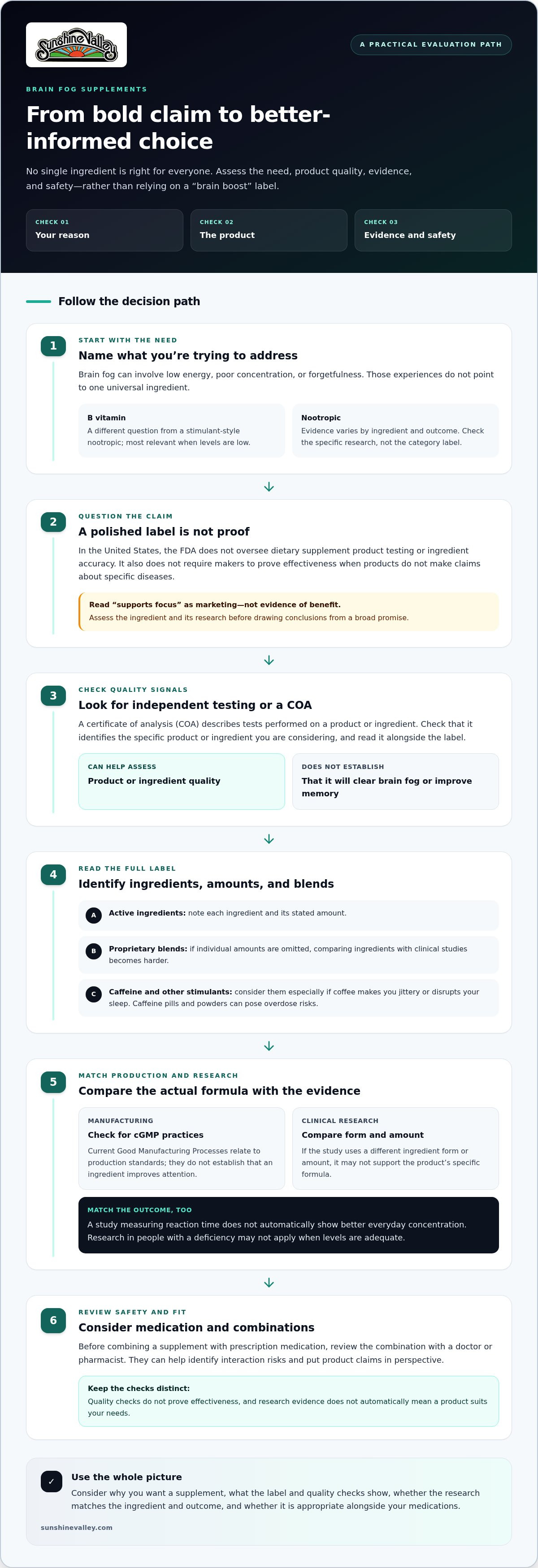
Start with why you’re considering a supplement, not its “brain boost” label. Brain fog can involve low energy, poor concentration, or forgetfulness, and these experiences don’t point to one universal ingredient. The best supplements for brain fog depend on the ingredient, the evidence behind it, and whether it suits your needs. A B vitamin, for example, addresses a different question than a stimulant-style nootropic.
In the United States, the Food and Drug Administration (FDA) does not oversee dietary supplement product testing or ingredient accuracy. The FDA also does not require supplement makers to prove effectiveness when products don’t make claims about specific diseases. That makes a polished label or confident promise insufficient evidence of either product quality or likely benefit. Treat claims such as “supports focus” as marketing until you can assess the ingredient and research.
Look for independent, third-party testing or a certificate of analysis (COA). A COA describes tests performed on a product or ingredient. Read it alongside the label, not as proof of cognitive effects, and check that it identifies the specific product or ingredient you’re considering. Testing can help assess quality, but it cannot show that a supplement will clear brain fog or improve memory.
Next, examine the full ingredient panel. Identify the active ingredients, their stated amounts, and any blends that group several ingredients together. If a label names a proprietary blend but omits individual amounts, it’s harder to compare the ingredients with clinical studies. Note added caffeine or other stimulants, especially if coffee already makes you jittery or disrupts your sleep. Caffeine pills and powders can pose overdose risks.
Manufacturing practices matter, too. Consider whether the product is made using current Good Manufacturing Processes, often abbreviated as cGMP. This is separate from clinical evidence: production standards don’t establish that an ingredient improves attention. Compare the ingredient form and amount on the label with those used in relevant studies. If they differ, the study may not support the product’s specific formula.
Finally, review the evidence for the exact outcome you care about. A study measuring reaction time doesn’t automatically show better everyday concentration, and research on people with a deficiency may not apply to someone whose levels are adequate. Before combining a supplement with prescription medication, review the combination with a doctor or pharmacist. This can help identify interaction risks and put a product’s claims in perspective.
Before choosing, assess ingredient quality and clinical evidence together. Look for products with third-party testing or a certificate of analysis (COA) as part of your review. Compare these details across products and use them to guide your decision, rather than relying on product presentation alone. Neither quality checks nor research evidence should be overlooked when choosing a brain fog supplement.
2. B vitamins and brain energy
The brain consumes about 20% of the body’s energy. B vitamins support processes involved in converting food into usable energy and maintaining nervous-system function. That role makes them relevant to brain health, but it doesn’t mean extra vitamins automatically sharpen focus. A supplement is most directly relevant when intake or blood levels are low.
A B-complex supplement contains eight B vitamins. These nutrients have distinct roles, so “B-complex” alone doesn’t explain which ingredient may matter. Vitamin B12 deserves particular attention because low levels have been associated with poorer attention and memory. A study including 39,000 people found this association, though it does not establish that supplementation benefits everyone.
Evidence from people with low B12 levels offers a more specific example. In a study of 202 people with cognitive impairment and low or deficient B12, supplementation improved cognition in 84% of participants. Memory and attention test scores improved in 78%. These findings concern a group with both cognitive impairment and low B12, not people with adequate levels.
For people who aren’t deficient in B vitamins and aren’t pregnant, B-vitamin supplements are unlikely to improve brain health. That distinction matters when deciding whether a product suits your situation. A high-dose formula isn’t a substitute for identifying a deficiency, and taking more doesn’t establish a stronger benefit. Consider the amounts of individual B vitamins on the label instead of relying on the word “complex.”
Can vitamin D, iron, or magnesium deficiencies cause brain fog? Low vitamin D and magnesium have been studied in relation to cognitive test performance, while iron supplements are recommended only when a deficiency is present. These nutrients may be relevant to symptoms, but the evidence varies by nutrient and study population.
For vitamin D, a study of 42 postmenopausal women with low levels compared daily doses of 600 IU, 2,000 IU, and 4,000 IU for one year. Participants taking 2,000 IU performed better on learning and memory tests than those taking either comparison dose. This result applies to that study group and doesn’t establish a dose for everyone.
Magnesium evidence also needs careful interpretation. A study of 2,466 people aged 60 and older associated higher magnesium levels with better attention and memory test performance, and lower risk of cognitive impairment. An association doesn’t prove that magnesium supplements caused those differences. Iron requires particular care: consult a physician and get an iron blood panel before supplementation, because high doses can be toxic.
A practical approach is to match the nutrient to a demonstrated need, rather than treating brain fog as proof of deficiency. B12, vitamin D, magnesium, and iron findings involve different measures and populations. Discuss symptoms and testing with a healthcare professional before starting targeted supplementation, especially iron or a high-dose product.
3. Evidence for brain-health supplements
Study results depend on the ingredient, participants, dose, and outcome measured. A change in a memory test doesn’t necessarily mean everyday brain fog improves. Check who took the supplement and what researchers assessed, rather than relying on a broad “brain health” claim.
Ginkgo offers a useful example of why study design matters. The National Center for Complementary and Integrative Health reports that the Gingko Evaluation of Memory (GEM) study recruited more than 3,000 older adults. Participants took ginkgo or a placebo twice daily for almost six years. The study found ginkgo didn’t lower the overall rate of developing dementia. That result addresses dementia prevention, not every possible short-term change in focus.
Multivitamin research points to a different outcome. In the Harvard-led COSMOS trial, adults aged 60 and older took a daily multivitamin for about two years. Researchers found effects roughly equal to slowing cognitive aging by about two years. This finding concerns cognitive aging in older adults, not a guaranteed remedy for brain fog or a result that applies equally to every age group.
Do omega-3 supplements improve focus or cognitive function? Evidence is mixed: a study of 176 adults with low omega-3 intake found that 1.16 grams of DHA daily for six months improved episodic and working memory compared with placebo. Large studies haven’t established that omega-3 supplements prevent dementia, and memory-test findings don’t prove improved day-to-day focus.
Does creatine help with mental fatigue or brain fog? A study of sleep-deprived individuals found cognitive effects after a single high dose, peaking four hours after ingestion and lasting up to nine hours. This finding doesn’t establish an effective dose for routine brain fog or demonstrate a lasting benefit.
What do popular brain fog supplements cost in the United States? There’s no single price that applies across products: the ingredient, formula, serving amount, and package size all affect the cost. Compare those details rather than treating unlike products as equivalent.
What are the risks and side effects of supplements marketed for brain fog? Caffeine pills and powders can pose overdose risks, while other products may cause unwanted effects or interact with medication. Combining supplements with prescription drugs can be risky, so review the full list with a doctor or pharmacist.
Which brain fog supplements interact with medications or health conditions? The relevant risks depend on the specific supplement, prescription drugs, and health conditions involved. Have a doctor or pharmacist review the full combination before starting a product.
What supplement doses have been studied for brain fog, and for how long? Research has examined 1.16 grams of DHA daily for six months, daily multivitamins for about two years, and ginkgo twice daily for almost six years. These studies measured different outcomes; their doses and durations aren’t interchangeable recommendations.
4. Nootropics versus brain supplements
“Nootropic” usually describes a product promoted for attention, memory, or mental performance. “Brain supplement” is a broader label that covers nutrients and other ingredients marketed for cognitive support. The categories overlap: L-theanine may appear in both, while a B-complex is generally described by its nutrients. Neither label establishes effectiveness.
Classify a product by its ingredients and intended effect, not its front label. Green tea naturally contains L-theanine and caffeine, combining a calming amino acid with a stimulant. Coffee is another familiar source of caffeine. It may be reasonable if it doesn’t worsen sleep or cause jitters, but caffeine pills and powders carry overdose risks.
L-theanine illustrates why ingredient-specific evidence matters. A study of 69 adults aged 50-69 found that a single 100.6-milligram dose improved reaction time and working memory on cognitive tests. That result concerns one dose and particular tests, not every product marketed for mental clarity.
Other L-theanine findings examine different outcomes. A small study found that 200 milligrams daily helped reduce stress-related symptoms and improve sleep and some aspects of cognitive health, compared with placebo. A 2019 study included 30 people. Differences in dose, participants, and outcomes make direct comparisons difficult.
Botanical ingredients also carry distinct evidence profiles. A review of trials found no convincing evidence that ginseng protects mental skills. That conclusion is more informative than a generic “natural focus” claim. A review of CDP-choline examined 14 studies, but the review count alone doesn’t tell you whether an individual product will improve your concentration.
Study size and design deserve attention, too. A UCLA curcumin study included 40 people, a small group for drawing broad conclusions. Look for the specific outcome measured, the participant group, and whether researchers compared the ingredient with a placebo. A result for memory or reaction time doesn’t automatically establish better everyday focus.
Use a simple comparison before choosing: identify the ingredient, match its research to your intended outcome, and note the study’s population and dose. Then compare those details with the product label. For example, a green tea product may combine caffeine and L-theanine, while a vitamin formula contains nutrients. These are different approaches, not interchangeable solutions.
Choose based on a defined need, such as alertness or relaxation, rather than the word “nootropic.” If caffeine affects your sleep, a stimulant-containing product may work against daytime clarity. If a study measures a different outcome from the one you want, its findings offer limited guidance for your decision.
5. What causes brain fog, and when should you see a doctor?
“Brain fog” describes experiences such as difficulty concentrating, remembering details, or thinking clearly. It doesn’t identify a single cause. A useful first step is to notice when it occurs and what else is changing, rather than assuming a supplement will address it.
Sleep is one factor to review. The article recommends prioritizing 7-9 hours per night to support memory and focus. Note whether concentration changes after a short night, a disrupted schedule, or evening caffeine. Coffee may be reasonable if it doesn’t worsen sleep or cause jitteriness, but caffeine pills and powders can pose overdose risks.
Nutrient status is another consideration. Low vitamin B12 levels have been associated with poorer attention and memory in a study including 39,000 people. Iron is different: supplementation is recommended only when a person is deficient. A physician can assess iron status with an iron blood panel before supplementation, since high doses can be toxic.
Medications and supplements deserve careful review. Combining supplements with prescription drugs can be risky, and a doctor or pharmacist can assess the products together. Bring the full supplement label, including ingredient amounts, and a current medication list. Include caffeine products, vitamins, and herbal formulas, not just supplements marketed for focus.
Daily habits can provide useful context. A diet rich in vegetables, berries, whole grains, and fish can support brain health as people age. Keep a simple record of meals, sleep, caffeine, medication changes, and periods of poor concentration. It may reveal patterns, such as symptoms after disrupted sleep or alongside a new product.
Seek medical advice if concentration or memory problems persist, worsen, or interfere with ordinary tasks. Describe when the change began, how it affects daily activities, and whether other symptoms appeared. A clinician can consider possible causes, review medications, and decide whether testing is appropriate. Don’t use a supplement trial as a substitute for investigating a continuing change.
Seek urgent care for sudden, severe confusion or a rapid change in thinking, especially when accompanied by other alarming symptoms. For less sudden concerns, prepare a concise symptom timeline and list every product you take. Include the dose shown on each label, how often you use it, and when you started.
No single checklist explains every episode of brain fog. Sleep patterns, nutrient status, medication use, and daily routines are practical starting points for discussion. A careful review can help distinguish a possible deficiency from other factors and guide safer decisions about supplements.
The article states that two servings a week of fatty fish should provide adequate omega-3s for brain health. Include this in discussions of dietary habits with a clinician.
Sunshine Valley: Super Mannitol
Sunshine Valley’s Super Mannitol is one ingredient option to consider when comparing supplements. It isn’t a substitute for identifying possible causes of brain fog, and the evidence discussed above doesn’t establish it as a treatment for impaired focus or memory.
Choose based on your needs and the ingredient information on the product label. Sunshine Valley also offers Super Inositol, Super Lactose, and Super Niacinamide. These are distinct ingredients, so compare them individually rather than assuming they serve the same purpose or have identical evidence.
If you’re considering a supplement, review its ingredients alongside your health needs and current medications. For persistent or worsening cognitive symptoms, seek medical advice rather than relying on a supplement alone. Explore Sunshine Valley’s Super Mannitol product information to learn more.
Make your next step a considered one
Choosing the best supplements for brain fog starts with a clear purpose: identify what you want to support, then assess whether an ingredient and its evidence fit. Keep expectations grounded in the research, and treat persistent changes in concentration or memory as a reason to seek medical guidance rather than simply adding another product.
If you’re comparing ingredient options, Sunshine Valley offers Super Mannitol, Super Inositol, and Super Lactose. Consider each as a distinct ingredient and review its product information in light of your needs. A thoughtful choice is more useful than selecting a supplement based on a broad promise of clarity or energy.
For product information, contact Sunshine Valley. Take your time, choose with care, and move forward with confidence.
Frequently Asked Questions
What Are Brain Health Supplements, and What Do They Actually Do?
Brain health supplements contain nutrients or other ingredients marketed to support cognitive functions such as memory, attention, or alertness. Their effects depend on the ingredient and the person taking it; the category itself doesn’t establish a benefit. A vitamin formula and a caffeine-containing product, for example, work differently. To assess a claim, identify the specific ingredient and the cognitive outcome measured by the evidence.
Which supplements have clinical evidence for improving brain fog or cognition?
Some ingredients have been studied for specific cognitive outcomes, but evidence doesn’t establish one supplement as a general treatment for brain fog. Research involving B12 has focused on people with low levels, while studies of L-theanine have assessed outcomes such as reaction time and working memory. Compare the study population, ingredient, and measured outcome with your reason for considering a supplement. Evidence for one test result doesn’t establish improvement in everyday mental clarity.
Does vitamin B12 help brain fog, and who benefits from supplementation?
Vitamin B12 supplementation may support cognition in people with low or deficient B12 levels; it isn’t a universal focus aid. A practical next step is to discuss symptoms and whether testing is appropriate, especially before starting a high-dose product. Someone with adequate B12 levels shouldn’t assume extra supplementation will improve concentration. Share current supplements and medications with a healthcare professional when discussing results or possible changes.


Leave a comment
This site is protected by hCaptcha and the hCaptcha Privacy Policy and Terms of Service apply.