




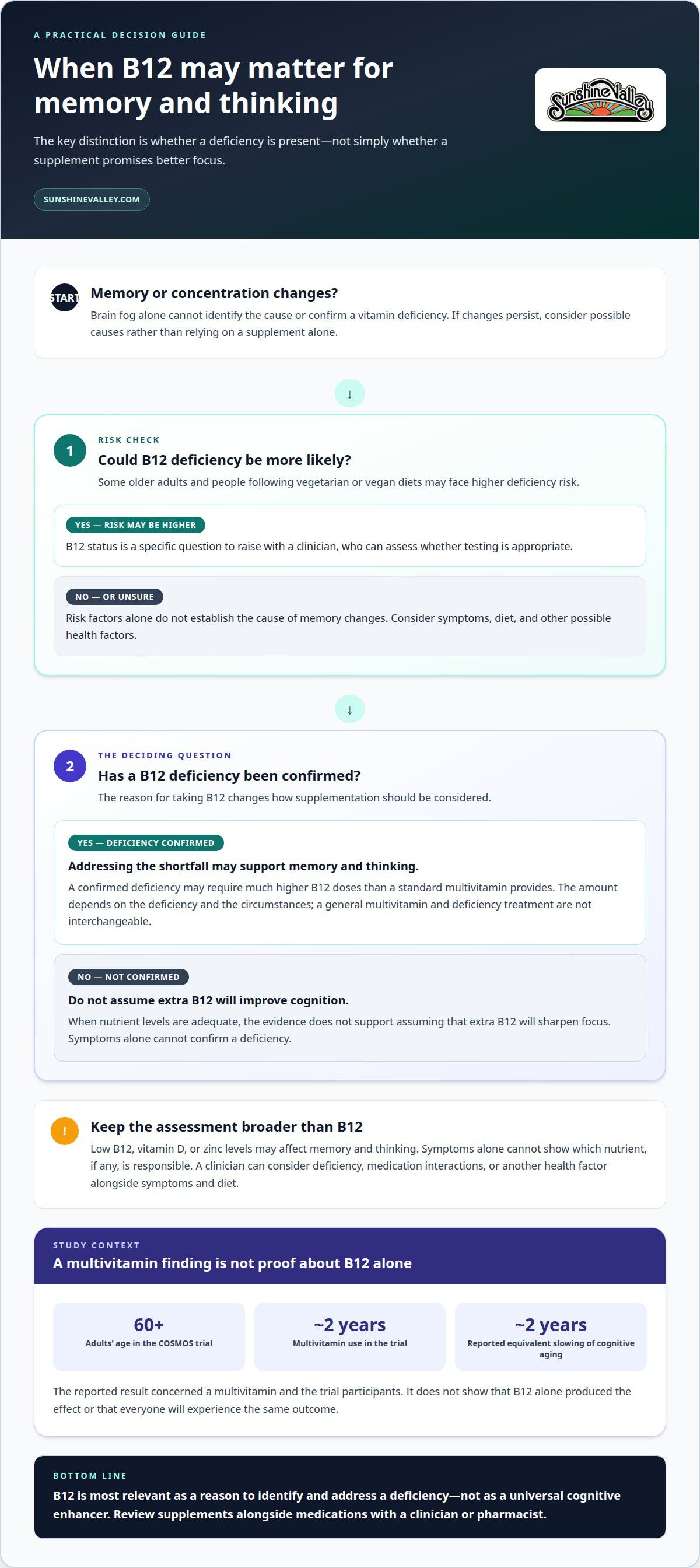
A vitamin deficiency can contribute to brain fog or memory problems, particularly when vitamin B12 levels are low. In those cases, correcting the deficiency may support memory and thinking; supplements for mental clarity and focus are less likely to help when nutrient levels are already adequate. The cause of symptoms matters more than the promise on a supplement label.
It’s understandable to look for a nutritional explanation when concentration slips or recall feels less reliable. But evidence varies by ingredient, and a supplement that may help in one situation can be ineffective or interact with medication in another.
This article examines what research suggests about B12, ginkgo, omega-3s, and L-theanine, including where potential benefits are most plausible and what safety considerations matter. You’ll also see why a confirmed deficiency changes the picture, and why reviewing a supplement alongside your medications is an important part of making an informed choice.
Key Takeaways
- Brain fog or memory changes can have different causes; a nutrient deficiency may matter more than adding a supplement when nutrient levels are already adequate.
- Learn why B12 deserves particular attention for some older adults and people following vegetarian or vegan diets.
- Ginkgo evidence does not show that it prevents dementia, and it can interact with medications such as blood thinners.
- Omega-3 research offers possible cognitive benefits, but large studies have not established that supplements help everyone.
- Explore what a small L-theanine study can and cannot tell us about attention, and why medication review matters before starting a supplement.
Evidence for brain health supplements
Can vitamin deficiencies cause brain fog or memory loss? Yes. Low vitamin B12, vitamin D, or zinc levels may affect memory and thinking, so addressing a deficiency can matter more than adding nutrients when levels are adequate. B-vitamin supplements are unlikely to support brain health unless levels are low or someone is pregnant. Symptoms alone cannot identify which nutrient, if any, is responsible.
Evidence varies by ingredient and by the people studied. In the Ginkgo Evaluation of Memory study, more than 3,000 older adults, averaging 79 years old, received 120 milligrams of ginkgo or a placebo twice a day. Researchers followed them for almost six years. The evidence for ginkgo’s effects on dementia and cognitive decline is not conclusive. A different review examined 14 studies of CDP-choline and found memory benefits for elderly people who already had memory problems. That finding does not establish a general focus benefit for healthy adults.
Curcumin has early, limited evidence. A UCLA study involving 40 people reported better memory-test performance and less buildup of abnormal brain proteins among participants taking curcumin. That small study cannot establish the same effect for everyone. Omega-3 fatty acids may support brain health even when levels aren't low, but large studies haven't proved that supplements help broadly. The evidence depends on the ingredient, study population, and outcome measured.
Diet and daily habits also matter. The MIND diet emphasizes vegetables, berries, whole grains, and fish as foods that support brain health with age. Regular exercise offers another practical foundation: the U.S. Department of Health and Human Services advises adults to aim for at least 150 minutes of physical activity a week. Food provides a broad mix of bioactive substances, rather than one isolated ingredient. Vitamin E is generally best obtained from foods such as nuts, seeds, and vegetable oils; high-dose supplements are associated with an increased risk of potentially life-threatening brain bleeds.
In the United States, a focus claim alone doesn’t establish a supplement’s safety or quality. Compare the listed ingredients and amounts, and review the product with a clinician or pharmacist, especially if you take medication.
Monthly costs vary with the ingredients, serving size, and daily use. Compare products by the amount of each ingredient per serving and the number of servings, not just the container price.
There’s no evidence-based timeline that applies to every focus supplement. Effects depend on the ingredient and reason for use; correcting a deficiency is different from taking a supplement when nutrient levels are adequate.
If changes in concentration or memory persist, consider possible causes rather than relying on a supplement alone. A clinician can assess whether a deficiency, medication interaction, or another health factor may be involved.
Vitamin B12 and cognitive impairment
Vitamin B12 is most relevant to cognition when a person has a deficiency. Some older adults and people following vegetarian or vegan diets may face higher deficiency risk. Low B12 levels may affect memory and thinking, so correcting a confirmed shortfall is different from taking extra B12 without a known need. Brain fog alone cannot identify the cause or confirm a deficiency.
A standard multivitamin may provide enough B12 for many people. A confirmed deficiency, however, requires much higher doses. That distinction makes the reason for supplementation important: a general multivitamin and treatment for a deficiency are not interchangeable. The amount needed depends on whether a deficiency exists and the circumstances behind it, rather than a promise of sharper focus.
Multivitamins have also been studied for cognitive aging. In the Harvard-led COSMOS trial, adults aged 60 and older took a multivitamin for about two years. The reported effects were roughly equal to slowing cognitive aging by about two years. This result concerns a multivitamin and the trial participants. It does not show that B12 alone produced the effect, or that every person will experience the same outcome.
Vitamin D offers another example of why the population matters. A review of 20 randomized controlled trials found no convincing evidence that vitamin D supplements help healthy people. Low vitamin D levels may be different: people at risk of not getting enough can discuss supplementation with a healthcare provider. The key question is whether a low level or specific risk is present, not whether vitamin D is advertised for cognition.
Ashwagandha and magnesium also warrant ingredient-specific evaluation. For ashwagandha, assess whether a study measured a clear cognitive outcome, such as memory or attention, and whether its participants resemble the person considering it. For magnesium, distinguish general nutrient use from evidence of cognitive benefit. The findings for B12 or multivitamins cannot establish results for either ingredient.
A practical review starts with the concern, diet, and possible deficiency risk. A clinician can assess whether testing is appropriate and interpret results alongside symptoms and medications. For a vegetarian or vegan adult with memory concerns, B12 status is a more specific question than simply choosing a product labeled for focus. For someone with adequate nutrient levels, the evidence does not support assuming that extra B12 will improve cognition.
These distinctions help separate targeted deficiency correction from general supplementation. They also clarify why age, dietary pattern, and measured nutrient status can change the decision. Vitamin B12 may matter, but the evidence is strongest as a reason to identify and address deficiency, not as a universal cognitive enhancer.
Ginkgo biloba evidence and medication interactions
Ginkgo evidence needs careful interpretation. A large study examined dementia outcomes among older adults, not short-term concentration during work or study. Ginkgo did not lower the overall rate of dementia, nor did it slow cognitive decline in people who already had dementia. These findings don’t establish a focus benefit or answer every question about memory and attention in other groups.
Creatine and bacopa require separate evidence. Ginkgo findings can’t show whether either improves focus, and the evidence discussed here doesn’t establish creatine or bacopa as effective focus supplements. The clearest finding about ginkgo is narrower: it did not prevent dementia or slow decline in people with dementia. Don’t infer an everyday focus benefit from a study measuring dementia outcomes.
Medication interactions are a practical concern. Ginkgo can interact negatively with medications, including blood thinners, so review your full medication list before using it. Include prescription medicines, over-the-counter products, and supplements you already take. A doctor or pharmacist can assess the combination and identify potential risks. Mention supplements you use occasionally, too.
Use a clear review process:
- Write down every medication and supplement you take or are considering.
- Include ginkgo by name, along with any blood thinner or other medication.
- Discuss the complete list with a doctor or pharmacist before adding ginkgo.
- Revisit the list when a medication or supplement changes.
Sharing this list helps a healthcare professional assess combinations rather than considering ginkgo in isolation. Explain why you’re considering it, whether for concentration, memory, or concern about cognitive decline. These are different goals, and dementia study findings don’t prove a benefit for everyday focus.
For example, if you take a blood thinner, mention ginkgo specifically during a medication review. The same principle applies when considering several supplements together. A familiar ingredient name doesn’t eliminate the need to assess interactions. Review the exact products you use so the healthcare professional has a complete picture.
Before starting a supplement, consult a healthcare provider and review the evidence alongside your medications. Ginkgo’s dementia findings don’t make it a proven focus aid, and its potential interaction with blood thinners makes a medication review especially relevant. Weigh your intended goal, the available evidence, and your complete medication list together.
Omega-3 fatty acids and memory, attention, and learning
Omega-3 fatty acids include three types: EPA, DHA, and ALA. The body converts ALA into EPA or DHA only in small amounts. So these forms aren’t interchangeable when considering the evidence. A study of one type, or a supplement containing a particular mix, doesn’t automatically establish the effects of another. Keep the specific omega-3 type in view when interpreting research.
Research reviews report possible cognitive benefits, but findings need context. One review of multiple studies found omega-3 fatty acids improved learning, memory, and blood flow to the brain. These outcomes describe different functions. Better learning scores, for example, don’t necessarily mean better everyday attention. A review can bring together varied studies, so its conclusion should be read alongside the populations and measures examined.
Large studies have not proved that omega-3 supplements help broadly. That possibility isn’t evidence of a general effect for everyone. It also ties the potential benefit to a specific genetic group and timing, rather than supporting a universal recommendation.
Children with ADHD represent another studied group. A review found that children with ADHD who took omega-3 supplements had improved attention, memory, and behavior. Those results apply to the children and outcomes examined. They don’t show that adults without ADHD will experience the same changes, or that every omega-3 formulation produces similar effects. The population matters when judging whether a finding fits your situation.
For a practical comparison, first identify whether a product contains EPA, DHA, ALA, or a combination. Then distinguish its intended outcome from the outcome measured in a study. A memory result doesn’t automatically mean an attention benefit. Likewise, because conversion of ALA is limited, its presence alone doesn’t show that a product supplies the same forms researchers examined.
Dietary context matters, too. The MIND diet includes fish among foods emphasized for brain health as people age. That food-based approach differs from relying on a capsule to improve a particular cognitive skill. Before considering omega-3 supplements, review your medications and other supplements with a healthcare professional. This gives a clearer basis for weighing the evidence, your health context, and the specific ingredient under consideration.
L-theanine and attention
A 2019 study of L-theanine and mental performance included 30 people. That participant count gives useful context, but it cannot establish a broad result by itself. To judge a focus claim, readers need to know what the study measured, who took part, and whether the findings apply beyond its participants. A study of mental performance may assess a narrower task than everyday concentration.
Attention has several dimensions, too. Staying on task, shifting between tasks, and avoiding distractions are different outcomes. A result on one measure doesn’t automatically prove improvement across all of them. For example, a brief attention test alone can’t show better focus throughout a workday. Look for the specific outcome rather than relying on a broad label such as “mental performance.”
The 30-person study is best treated as an early piece of evidence, not a definitive answer. Small studies can help researchers examine a question, but a finding in a limited group does not establish the same effect in broader populations. Stronger conclusions need repeated research and comparable outcomes. One study also cannot show whether L-theanine works similarly for different ages, routines, or reasons for seeking help.
When evaluating an L-theanine claim, separate three questions:
- What attention or mental-performance measure did researchers examine?
- Did the study assess a short task or a real-world activity?
- Do other studies report comparable findings in different participants?
These questions help distinguish a measured test outcome from a broader promise. A supplement label may use general language, while research examines a specific task. The wording matters: “mental performance” doesn’t necessarily mean improved memory, sustained attention, or clearer thinking in daily life.
It also helps to separate evidence from expectations. If someone considers L-theanine for a particular task, define that task first. For example, note whether the goal is to follow a meeting, read without distraction, or complete focused work. Then assess whether available research studied that same kind of attention. The 2019 study’s 30 participants are a concrete starting point, not proof of a universal effect.
Overall, the available study detail supports a measured conclusion: L-theanine has been examined for mental performance, but the 2019 study included only 30 people. That alone cannot establish reliable benefits for attention across the population. Readers can use study size, the specific outcome, and replication as practical markers when weighing focus claims. Those markers keep conclusions aligned with what research actually tests, rather than with a product’s broad positioning.
Sunshine Valley: Super Mannitol
Sunshine Valley offers Super Mannitol for readers exploring its food supplement range. The evidence reviewed above focuses on B12, ginkgo, omega-3s, and L-theanine; it does not establish mannitol as a supplement for attention or mental clarity. Keep that distinction clear when choosing an ingredient for a specific cognitive goal.
If you’re considering a supplement, match the ingredient to your reason for using it and review potential interactions with a healthcare professional. To explore Super Mannitol and other available offerings, visit Sunshine Valley.
Make Your Next Choice Evidence-Led
Choose a next step that fits your goal. If you’re concerned about concentration or memory, consider what might be affecting it before choosing a supplement. A focused conversation with a healthcare professional can help clarify whether nutrient status, medication use, or another factor deserves attention. That context is more useful than choosing based only on a claim about sharper focus.
If you’re exploring Sunshine Valley’s supplement range, options include Super Mannitol, Super Inositol, and Super Lactose. These products aren’t presented as proven treatments for attention or cognitive concerns. Keep the distinction clear: evidence for supplements for mental clarity and focus depends on the specific ingredient and outcome studied. Match your decision to your needs and the available evidence.
To learn more about Sunshine Valley’s offerings, contact Sunshine Valley today. Thoughtful choices begin with clear information, and each informed step can help you move forward with confidence.
Frequently Asked Questions
Can vitamin deficiencies cause brain fog or memory loss?
Yes, low levels of vitamin B12, vitamin D, or zinc may affect memory and thinking. A vegetarian or vegan diet can raise the chance of B12 deficiency, making nutrient status worth discussing if memory changes arise. Brain fog alone doesn’t identify a deficiency. The practical distinction is whether a specific shortfall exists, since supplementing without one may not improve cognition.
How much do you take?
There isn’t one amount that applies to every product. Doses used in research differ by ingredient and don’t establish a suitable amount for every person. For supplements for mental clarity and focus, consider the ingredient, reason for use, current medications, and serving details. Taking B12 to address a confirmed deficiency differs from using a general multivitamin, so discuss the intended dose with a healthcare professional.
Which supplements have evidence for improving mental clarity and focus?
Evidence for supplements for mental clarity and focus depends on the ingredient, population, and outcome studied. B12 is most relevant when levels are low, while omega-3 findings vary. Ginkgo hasn’t been shown to prevent dementia. A small L-theanine study examined mental performance, but it can’t establish broad benefits. Treat evidence for one group or outcome as specific rather than assuming it applies universally.
What does research say about caffeine and L-theanine for focus?
The available findings here don’t establish that combining caffeine and L-theanine improves focus. A 2019 L-theanine study included 30 people, which gives limited evidence for broad conclusions. Caffeine pills and powders aren’t recommended because of overdose risks. Coffee may suit some people if it doesn’t worsen sleep or cause jitters. These factors matter when weighing a caffeine-based approach.
Can omega-3 supplements improve concentration or cognitive function?
Some reviews report improvements in learning, memory, or brain blood flow, but large studies haven’t proved broad benefits from omega-3 supplements. Findings also vary by group and outcome. A review involving children with ADHD reported improvements in attention, memory, and behavior, but that doesn’t establish the same effect for adults. Consider whether the research matches the specific cognitive goal and population.
What are typical doses of supplements studied for focus?
Study amounts vary by ingredient and aren’t universal recommendations. In the Ginkgo Evaluation of Memory study, participants received 120 milligrams twice a day. Studies of lion’s mane typically use 500 mg to 3,000 mg per day, while phosphatidylserine studies typically use 100 mg to 300 mg per day. The L-theanine study detail doesn’t provide a dose, so don’t infer one from its participant count.
What are the risks, side effects, and medication interactions of common focus supplements?
Ginkgo can interact negatively with medications, including blood thinners, so review supplements and medicines together with a doctor or pharmacist. Caffeine pills and powders carry overdose risks. High-dose vitamin E supplements are associated with an increased risk of potentially life-threatening brain bleeds. Before adding another supplement, share the full list of products you take or are considering, including those used occasionally.
Can sleep, nutrition, exercise, or treating underlying conditions improve focus more than supplements?
These factors can be important to assess before choosing a supplement. Exercise and a plant-based diet are recommended lifestyle approaches for long-term memory and brain health. The MIND diet, for example, emphasizes vegetables, berries, whole grains, and fish. The U.S. Department of Health and Human Services advises adults to aim for at least 150 minutes of physical activity a week. Persistent focus changes also warrant attention to possible underlying causes.



Leave a comment
This site is protected by hCaptcha and the hCaptcha Privacy Policy and Terms of Service apply.