




Vitamin C may support MSM absorption, but there isn’t a single established dose for everyone. For combining MSM and vitamin C for better absorption, one suggested starting point is 100 mg to 200 mg or more of vitamin C per day alongside MSM. The right routine also depends on your total vitamin C intake and the MSM amount you use.
It’s reasonable to ask whether taking MSM and vitamin C together can make an MSM routine more effective. Vitamin C plays a role in collagen production, while MSM is commonly used to support joint comfort and mobility. These different roles help explain why people pair them, but they do not establish that vitamin C improves MSM absorption.
This article reviews what is known about combining MSM and vitamin C for better absorption, whether you need to take them at the same time, and how to think about dosage without treating one amount as right for everyone. It also explains how consistency fits into a supplement routine, so you can make a more informed decision.
Key Takeaways
- Vitamin C may complement MSM, but the best pairing depends on your overall intake and supplement routine.
- For context, the recommended dietary allowance for vitamin C is 75 mg per day for women, according to the National Institutes of Health, Office of Dietary Supplements.
- MSM research on knee osteoarthritis includes a 12-week pilot trial involving 50 adults, offering useful context for understanding the evidence on joint comfort and function.
- Consider consistency when assessing a routine; reported timelines for noticing changes vary, and some tissue-related benefits may take several weeks.
- Learn how dose, timing, and daily habits can shape a practical approach to combining these supplements.
Joint health and mobility
MSM and vitamin C are discussed together for joint support because they have distinct, potentially complementary roles. Research in people, animals, and skin treatments provides different kinds and levels of evidence.
Potential Joint Health Benefits
Potential joint benefits mean support for comfort and physical function, not proof that a supplement combination treats joint disease. That distinction matters when deciding what to expect from a daily routine. In a 12-week pilot trial involving 50 adults with knee osteoarthritis, MSM was associated with improvements in pain and physical function compared with placebo. The result offers a human research signal, but it does not establish that vitamin C increases MSM’s effect in people.
The joint findings need context: the pilot study tested MSM for knee osteoarthritis, not every joint condition or every supplement pairing. An animal study found more pronounced effects with combined MSM and vitamin C than with MSM alone. This supports further study of the combination, but animal results do not establish the same outcome in people. Joint comfort and mobility also depend on factors beyond supplements, including the underlying issue and daily activity.
Bone research offers another possible connection. In a mouse mandible model, MSM injection induced osteoblast formation and increased bone formation in the mandible. In a separate mouse model of age-related bone loss, MSM supplementation improved bone mass, microstructure, and load-bearing strength. These findings come from specific animal models, not evidence of a treatment effect in people.
Vitamin C supports collagen production, and collagen contributes to bone strength. Preclinical animal and human studies report faster bone regeneration after fractures and increased type I collagen synthesis with vitamin C supplementation. However, human clinical evidence for fracture-related benefits remains limited. These findings help explain the biological interest in the pairing, but do not establish a particular dose for joint pain.
Vitamin C and MSM for Joint Pain
Does vitamin C increase MSM’s effectiveness for joint pain or inflammation? An animal study found more pronounced effects from combined supplementation than from MSM alone, but this does not prove greater pain relief in people. Vitamin C’s role in collagen production and antioxidant activity provides a rationale for pairing the supplements, not evidence that they reduce joint inflammation in humans.
Skin findings are separate from joint outcomes. One study reported improvements in pigmentation, elasticity, and wrinkling after pyruvic acid and MSM peeling sessions every two weeks. This was a topical peeling treatment, not oral MSM with vitamin C, so it does not show that taking the supplements improves skin or joint comfort.
Can MSM and vitamin C interact with medications or health conditions? The practical answer depends on the specific medication, condition, and supplement amounts. Don’t assume that a combination is suitable in every case. Consider your full medication and supplement routine rather than assessing MSM and vitamin C in isolation.
MSM and vitamin C dosage and timing
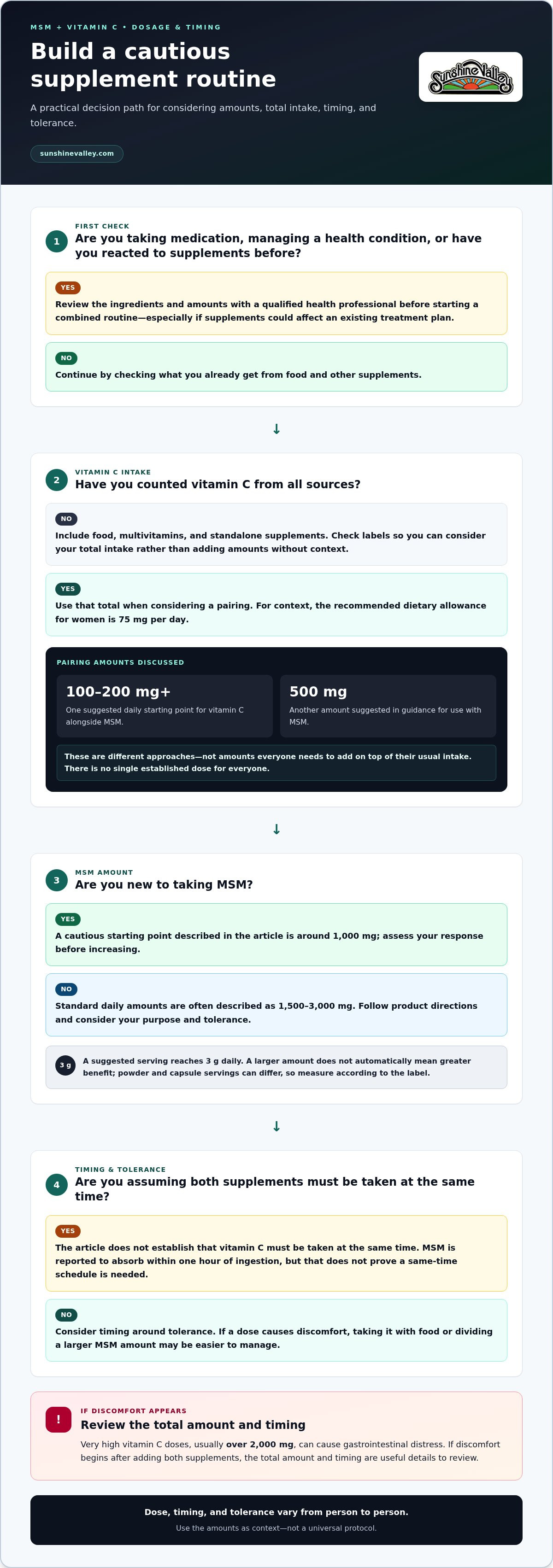
Dosage depends on your goal, existing dietary intake, and tolerance. The amounts discussed in research are not a universal protocol. Compare supplement labels with the nutrients you already get from food and other products to avoid unintentionally stacking doses.
For women, the recommended dietary allowance for vitamin C is 75 mg per day, according to the National Institutes of Health, Office of Dietary Supplements. Pairing suggestions can be higher: one recommendation starts at 100 mg to 200 mg or more daily, while other guidance suggests 500 mg with MSM. These are different approaches, not amounts everyone needs to add on top of their usual intake.
MSM guidance also varies. Standard daily amounts are often described as 1,500 mg to 3,000 mg. People starting may begin around 1,000 mg and assess their response before increasing. A suggested serving size reaches 3g daily, but a larger amount does not automatically mean greater benefit. The relevant considerations include the purpose of use, the product directions, and how the person tolerates it.
For a cautious routine, consider these practical points:
- Account for vitamin C from all sources. Food, multivitamins, and standalone supplements all contribute to total intake.
- Change one variable at a time. Starting with MSM alone, then adding vitamin C, makes it easier to identify which change affects tolerance.
- Use label directions. Powder and capsule servings can differ, so measure the amount rather than estimating.
- Consider timing around tolerance. If a dose causes discomfort, taking it with food or dividing a larger MSM amount may be easier to manage.
What are the side effects of combining MSM and vitamin C? Very high vitamin C doses, usually over 2,000 mg, can cause gastrointestinal distress. If discomfort begins after adding both supplements, the total amount and timing are useful details to review.
Who should avoid taking MSM and vitamin C supplements together? If you take medication, manage a health condition, or have previously reacted to supplements, review the ingredients and amounts with a qualified health professional before starting a combined routine. This is particularly important when supplements could affect an existing treatment plan.
Dosage is only one part of a routine. MSM is reported to absorb within one hour of ingestion, but that does not show that vitamin C must be taken at the same time. Timing and consistency are separate considerations.
Consistency and time to notice results
Timelines vary by the outcome being observed. Some people report changes in muscle soreness within a few days, while joint comfort and skin quality may take 2 to 4 weeks of consistent daily use. These are different measures, so an early change in soreness doesn’t establish a change in cartilage or connective tissue.
For tissue-related goals, one recommendation is to allow at least 30 days before expecting the body to begin incorporating these building blocks into tissues. Another account places significant support for tissue integrity and mobility after 4 to 8 weeks of consistent daily use. These timelines help set expectations, but they describe different outcomes rather than one shared endpoint.
A study involving 2.6 g of MSM for 30 days reported improved upper, lower, and total respiratory symptoms after three weeks of supplementation. That result concerns respiratory symptoms, not joint pain or collagen production. It illustrates why a study’s population, dose, duration, and measured outcome matter before applying its findings to a different goal, such as mobility.
Hair and nail strength may require a longer observation window, with improvements reported after 6 to 8 weeks. Collagen synthesis is also a process, not an immediate sensation. Vitamin C supports collagen production, while collagen is a structural protein found in connective tissues. Those roles explain interest in tissue support, but they don’t establish when a person will notice a change in cartilage or joint function.
Use a simple tracking routine to assess whether daily consistency is working for you:
- Choose one outcome. Record a specific example, such as morning stiffness, walking comfort, or post-exercise soreness.
- Keep the routine steady. Follow the same daily schedule and avoid changing several supplements at once.
- Review at set intervals. Compare notes after 2 to 4 weeks, then again around 30 days.
- Record other influences. Note activity, sleep, and periods of higher stress, which can affect how symptoms feel day to day.
Separate short-term sensations from longer-term goals. A change in muscle soreness within a few days is not the same as improved mobility after several weeks. Likewise, the reported 6 to 8 weeks for hair and nail strength shouldn’t be used as a timeline for joints. Matching each observation to its own timeframe makes the results easier to interpret.
How vitamin C may support MSM absorption
Vitamin C is sometimes described as supporting MSM absorption, but this claim needs careful interpretation. A proposed benefit is not the same as a demonstrated increase in blood MSM levels. Combining MSM and vitamin C for better absorption is a different question from whether the pairing affects antioxidant activity, exercise recovery, or tissue support. Evidence for one outcome does not establish another.
Are there studies comparing MSM with and without vitamin C? An animal study found more pronounced effects from combined MSM and vitamin C than from MSM alone. This suggests a possible advantage in that animal model, but does not establish improved absorption or stronger results in people.
Human exercise research offers related, but different, evidence. A study of 18 men reported that MSM supplementation at 50 mg per kg of body weight for ten days reduced exercise-induced muscle damage and increased antioxidant activity after an 8.7-mile run. This study examined MSM, not a direct comparison of MSM with and without vitamin C. Its findings therefore cannot demonstrate that vitamin C improved MSM absorption.
Another reported finding concerns reduced glutathione, an antioxidant involved in the body’s response to oxidative stress. A single MSM dose before exercise can elevate reduced glutathione levels for up to 10 days. Separately, MSM and vitamin C supplementation can reduce endurance exercise-induced muscle damage as measured by creatine kinase levels. These findings relate to antioxidant activity and recovery measures, not proof of a specific absorption mechanism.
Vitamin C also plays a distinct role in collagen production. Because collagen supports connective tissues, researchers have considered the nutrients potentially complementary for tissue support. That biological rationale does not show that vitamin C carries MSM into the body, changes MSM levels, or guarantees better joint comfort. Keep the proposed absorption benefit separate from vitamin C’s role in collagen production.
If you’re considering combining MSM and vitamin C for better absorption, distinguish what each type of evidence measures:
- Absorption: A claim that vitamin C supports MSM absorption does not, by itself, provide a measured change in blood levels.
- Animal comparison: The combined-supplement finding offers a research signal, but comes from an animal study.
- Exercise recovery: Muscle damage and creatine kinase are outcomes distinct from joint function or absorption.
- Collagen support: Vitamin C’s role in collagen production offers a separate reason for interest in pairing nutrients.
The clearest takeaway is to treat improved MSM absorption as a proposed benefit, not an established outcome in people. The evidence includes an animal comparison and human exercise findings, but they address different questions. Pairing the supplements may suit your routine, while the absorption claim remains separate from demonstrated effects on exercise recovery, antioxidant activity, or collagen production.
Should MSM and vitamin C be taken at the same time or separately?
You can take MSM and vitamin C together or at separate times. Taking them together may be easier to remember, while separating them can help you notice how each affects your tolerance. MSM is reported to absorb within one hour of ingestion, but that alone does not mean vitamin C must be taken simultaneously.
For many people, the most practical schedule is one they can follow consistently. For example, you might take MSM and vitamin C in the morning if taking both together suits you. If the combination feels uncomfortable, separating them across the day may make it easier to assess tolerance. Keep your total daily amounts in mind rather than automatically adding another dose.
MSM timing can also depend on the amount taken. People taking more than 2,000 mg of MSM are advised to consider splitting it between morning and early afternoon. This can make each dose smaller and distribute it through the day. Take each MSM dose with 8 to 10 ounces of water, as suggested in the guidance for this routine.
Use these practical factors to choose a schedule:
- For convenience: Take MSM and vitamin C together at a regular time, such as with breakfast.
- For tolerance tracking: Introduce one supplement first, then add the other separately so you can notice changes.
- For divided MSM doses: Keep the larger amount split between morning and early afternoon, rather than moving both doses late in the day.
- For food or water: Take the powders with food or water if that matches the product directions and feels comfortable.
Consistency matters more than choosing an exact time. Tying a morning routine to breakfast may be easier to remember than taking an unanchored dose later. If you split your MSM intake, use the same morning and early-afternoon schedule each day. Keep vitamin C intake steady as well, so comparisons reflect a consistent routine rather than frequent changes.
Research describes vitamin C as potentially supporting MSM absorption, but taking both at the same moment should not be treated as a proven requirement. The timing decision can therefore focus on adherence and comfort: combine doses when convenient, or separate them when that helps you manage your routine. For readers considering an MSM supplement, explore MSM supplement options as part of a consistent daily plan.
Sunshine Valley: Super Mannitol
Sunshine Valley’s Super Mannitol is a separate supplement, not an MSM and vitamin C combination. If your goal is to follow the routine discussed above, keep that distinction clear: Super Mannitol does not replace either nutrient or establish an absorption benefit.
Super Mannitol may be relevant if you’re exploring Sunshine Valley’s wider supplement range rather than looking for MSM specifically. Choose based on the ingredient you intend to add, its role, and how it fits with your existing supplements. Review product information carefully, especially if you take medication or manage a health condition.
Visit Sunshine Valley’s website to explore Super Mannitol and the company’s other supplements.
Build a Routine That Fits Your Next Step
Choosing a supplement routine is a personal decision. If you’re considering combining MSM and vitamin C for better absorption, use the evidence as a starting point, then choose a schedule and products that suit your needs. The specific absorption benefit remains uncertain, so keep expectations realistic and your routine straightforward.
For readers comparing supplement ingredients, Sunshine Valley offers Super Mannitol, Super Inositol, and Super Lactose. These are distinct products, not substitutes for MSM or vitamin C. Review each product’s information and consider how it fits your intended routine.
If you have questions about Sunshine Valley’s offerings, contact Sunshine Valley with questions. Take your next step with care and choose a routine you can follow consistently.
Frequently Asked Questions
How Much Vitamin C Should I Take With MSM?
Suggestions for pairing vitamin C with MSM range from 100 mg to 200 mg or more daily, but your total intake matters. Count vitamin C from food, multivitamins, and separate supplements before adding another serving. For example, someone already using a multivitamin can check its label first, then consider whether an additional vitamin C supplement fits their overall routine.
What is MSM?
MSM stands for methylsulfonylmethane, a sulfur-containing compound used in dietary supplements. It is commonly taken as a powder or in other supplement forms. People may consider it for goals such as joint support or exercise recovery, but the goal determines which evidence is relevant. Research on knee comfort, for example, does not automatically answer questions about muscle soreness.
Does vitamin C improve MSM absorption in humans?
Human research has not established that vitamin C increases MSM absorption. An absorption claim would ideally be supported by measurements of MSM levels in the body, rather than a different outcome such as soreness or antioxidant activity. When comparing supplement claims, look for research that directly tests absorption in people, not just combined use or related biological effects.
What does clinical research say about taking MSM and vitamin C together?
Research offers a possible rationale for pairing MSM and vitamin C, but the findings need careful interpretation. An animal comparison found more pronounced effects from combined MSM and vitamin C than from MSM alone. Human research has also examined exercise-related outcomes from supplementation. Neither type of result, by itself, proves that the combination improves MSM absorption or treats a joint condition.
What is the recommended dose of MSM and vitamin C when taken together?
There isn’t one established combined dose for everyone. Common guidance describes MSM amounts of 1,500 mg to 3,000 mg daily and 500 mg of vitamin C as a standard wellness pairing. These figures are reference points, not a requirement to begin at the highest amount. Check serving directions, account for other supplements, and consider dividing larger MSM amounts across the day.
How can consumers choose a quality MSM and vitamin C supplement?
Compare product ingredients and serving directions with your routine, and account for vitamin C from food and other supplements. Choose a clearly measured serving rather than estimating, since powder and capsule servings can differ.



Leave a comment
This site is protected by hCaptcha and the hCaptcha Privacy Policy and Terms of Service apply.