




How long does it take for inositol to work for pcos? There isn’t one reliable deadline, and a change in one measure doesn’t mean every PCOS symptom will change. That can make it difficult to know whether to continue, adjust your approach, or discuss other options.
It’s reasonable to want a clear timeframe. The evidence doesn’t support a guaranteed result or a single timeline for everyone. What you notice may depend on the outcome you’re tracking, and personal experiences aren’t a substitute for clinical evidence.
This article explains what research can and can’t tell us about inositol timelines, which changes may be useful to monitor, and how to review progress without assuming a particular outcome. You’ll also learn why consistency and individual factors matter, and when to discuss your symptoms, health measures, or supplement use with a healthcare professional. The goal is a practical, evidence-aware way to assess your experience, not a promise that inositol will improve PCOS.
Key Takeaways
- There’s no guaranteed timeline for inositol and PCOS. Possible changes depend on the outcome being monitored and individual health context.
- Study timelines show when researchers collected information, not necessarily when participants first noticed a change.
- Find out how long does it take for inositol to work for pcos, and why research can’t provide one answer for everyone.
- Use a simple log to track cycle dates, selected symptoms, supplement use, and changes in care.
- Review practical supplement-label considerations and know when to discuss your approach with a healthcare professional.
How long does inositol take to work for PCOS? Start with realistic expectations
Research hasn’t established a guaranteed timeline for inositol to affect PCOS; any changes can vary by outcome and individual circumstances. So, if you’re asking how long does it take for inositol to work for pcos, the evidence doesn’t support a single countdown for everyone. A change may be noticeable before it can be shown to be sustained, and noticing a change alone doesn’t establish that inositol caused it.
This distinction matters because cycles can vary naturally, symptoms may fluctuate, and other parts of a care plan may change at the same time. A careful assessment considers what changed, when it changed, and whether the difference persists. One encouraging sign isn’t proof of a predictable effect.
What does “working” mean when you have PCOS?
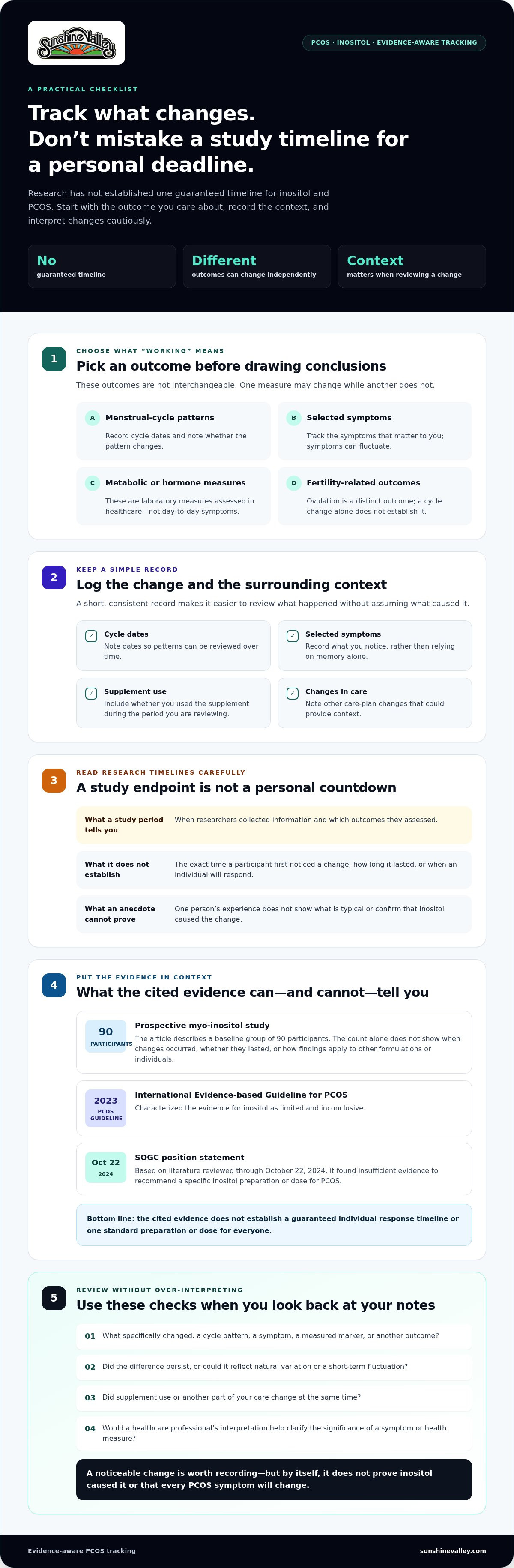
“Working” can refer to different outcomes, and they aren’t interchangeable. You might be watching menstrual-cycle patterns, metabolic measures assessed in healthcare, or fertility-related outcomes such as ovulation. The general overview of Inositol and PCOS describes inositol’s physiological roles, but it can’t tell you what response to expect personally.
One measure may change while others don’t. For example, a cycle pattern might look different without a noticeable change in skin symptoms or a measured metabolic marker. A change in a lab result also doesn’t necessarily mean symptoms have shifted. PCOS isn’t resolved simply because one symptom improves, so discuss the significance of specific changes with a healthcare professional.
Why there is no single countdown
Studies may follow participants for different lengths of time and assess different outcomes. A study’s observation period tells you when researchers collected information, not necessarily when each participant first noticed a change. An outcome reported at a study’s endpoint doesn’t establish the exact onset, durability, or likely timing for an individual.
Results need context, too. PCOS presentation and health history vary, as do concurrent care and the outcome a person hopes to change. These differences make a universal timeline difficult to establish. Research guidelines have also cautioned that evidence is limited and doesn’t establish one inositol preparation or dose as the standard for everyone.
Personal accounts can offer perspective, but they aren’t a reliable clock. Someone’s report of noticing a change quickly, or seeing no change, can’t establish what’s typical or prove that inositol was responsible. Individual experiences may involve different health circumstances, expectations, and care plans.
For a more useful assessment, define the outcome you’re monitoring before drawing conclusions. Separate what you observe from what a clinician measures, and note other changes that may provide context. The sections ahead explain how research reports timelines and how to track your experience without mistaking a study endpoint or anecdote for a personal guarantee.
What PCOS research says about inositol timelines and measured outcomes
Clinical studies can show what researchers measured over a defined period. They don’t necessarily show when each participant first noticed a change, or how soon someone else might experience one. That distinction is central to interpreting claims about how long does it take for inositol to work for pcos.
How clinical studies assess inositol in PCOS
Research may assess outcomes such as menstrual patterns or laboratory markers related to hormones or metabolism. These aren’t identical to symptoms a person can observe day to day. A lab value is collected and interpreted under study conditions; cycle dates and symptoms are recorded by participants and may be affected by natural variation and other care.
A prospective study of myo-inositol in women with PCOS included a baseline group of 90 participants. The participant count alone doesn’t show when changes occurred, whether they were sustained, or how findings apply to other formulations and individuals. To assess a timeline, you need details about the follow-up period, the outcomes measured, and when those measurements were taken.
What study results can, and cannot, tell you
Even when a study reports a difference in a measured outcome, it describes findings in that study population under its particular conditions. It doesn’t guarantee that an individual will experience the same result. The study’s total duration is also not the time to first noticeable change: researchers may measure at scheduled visits without recording the precise onset of a participant’s experience.
Guidelines provide useful context for weighing these findings. The 2023 International Evidence-based Guideline for PCOS characterized evidence for inositol as limited and inconclusive. The Society of Obstetricians and Gynaecologists of Canada’s position statement, based on literature reviewed through October 22, 2024, found insufficient evidence to recommend a specific inositol preparation or dose for PCOS. These assessments support caution, not a universal countdown.
Citation-ready summary: The 2023 International Evidence-based Guideline for PCOS described evidence for inositol as limited and inconclusive, while the SOGC’s position statement, based on literature reviewed through October 22, 2024, found insufficient evidence to recommend a specific preparation or dose. Neither establishes a guaranteed individual response timeline.
For your own decisions, distinguish a measured marker from a change you notice. When considering a research finding, pay attention to the study population, formulation, outcome, and assessment period before applying it to yourself. Product quality and manufacturing standards are purchasing considerations, not evidence of a particular PCOS outcome. Sunshine Valley’s Super Inositol powder is a powdered supplement option; choosing a product doesn’t establish how or whether an individual will respond.
Why inositol experiences differ: outcomes, health context, and evidence
Two people can use the same supplement and describe different experiences. That doesn’t necessarily mean one account is more accurate. PCOS symptoms, health history, care plans, and the outcome someone is watching can all differ. These distinctions matter more than comparing someone else’s timeline with your own.
Which outcomes are people often watching?
People may pay attention to menstrual-cycle regularity, acne, unwanted hair growth, or laboratory measures. These outcomes are distinct. Cycle dates and skin changes are observed over time, while laboratory markers are measured through clinical testing. They may not move together, and a change in one doesn’t confirm a change in another.
Fertility-related goals need their own context. Cycle patterns alone don’t confirm ovulation, and ovulation is not the same as achieving pregnancy. If you’re trying to conceive, discuss how to assess progress with a healthcare professional rather than relying on symptoms or an online timeline. No listed symptom or measure is guaranteed to change with inositol.
Why personal timelines are not interchangeable
PCOS can present differently, and people may have different diagnoses, baseline health measures, and concurrent treatments. A medication change or another adjustment to care can also affect what someone notices. A fast change doesn’t prove inositol caused it, and a slower or absent change by itself doesn’t establish that the supplement is ineffective.
Pregnancy goals and medication changes call for individualized guidance. A clinician can help interpret relevant measures and consider the full care plan. Don’t change prescribed treatment based on a personal account or an assumed supplement timeline.
The comparison below shows how to use different kinds of information without treating them as equivalent:
| Information type | What it can tell you | What it cannot establish |
|---|---|---|
| Anecdote | One person’s account of what they noticed and when. | A typical timeframe, cause, or expected result for others. |
| Study outcome | What researchers measured in a defined group under a particular study design. | A guaranteed individual response or the precise moment each participant first noticed a change. |
| Personal tracking | Your recorded cycle dates, selected symptoms, supplement use, and care changes. | A diagnosis or proof that one factor caused a change. |
Use each source for its proper purpose. If someone says they noticed a change in a few weeks, treat that as their experience, not a benchmark. If you’re asking how long does it take for inositol to work for pcos, consistent personal records can make a healthcare review more specific, but they can’t replace clinical interpretation. Compare like with like: cycle patterns with cycle patterns, symptoms with symptoms, and measured markers with comparable measurements.
How to track changes and decide when to review your approach
A brief, consistent record can make a healthcare conversation more useful than trying to recall changes from memory. It isn’t a way to diagnose yourself or prove that inositol caused an outcome. Its purpose is to capture what you noticed, when it happened, and what else may have changed during the same period.
Build a useful PCOS progress record
Start with a baseline: note the concerns that matter to you before beginning or changing a supplement. Choose a small number of outcomes, such as cycle dates and one or two symptoms. A calendar or notes app is enough. Record entries at a manageable pace so tracking stays informative rather than becoming a source of worry.
Include context alongside observations. For example, note when you use a supplement, any changes to medication or routine, and significant health circumstances. Don’t change prescribed treatment to make the record easier to interpret.
- Cycle dates: Record the first day of bleeding and any notable pattern changes. Avoid assuming that a different cycle pattern confirms ovulation.
- Selected symptoms: Track only concerns relevant to your goals, such as acne or hair changes. Use consistent descriptions rather than relying on a general impression weeks later.
- Supplement and care changes: Note when supplement use begins or changes, along with medication adjustments or other relevant care changes.
- Review notes: Write down questions and concerns to discuss at your next healthcare appointment.
Keep the record factual. “Noticed fewer new breakouts this month” is more useful than “the supplement fixed my hormones.” If you’re wondering how long does it take for inositol to work for pcos, notes can help describe your experience, but they can’t establish cause. A clinician can interpret laboratory tests and advise whether testing is appropriate; home symptom tracking isn’t a substitute for those measures.
When to seek individualized medical guidance
Arrange a healthcare discussion for persistent concerns, new symptoms, questions about supplement use alongside medication, or changes that affect your wellbeing. Seek individualized advice if you’re pregnant, trying to conceive, or managing other health conditions. Your clinician can consider your goals and full care plan, including which outcomes are meaningful to assess.
There’s no need to wait a particular number of weeks before asking for guidance. If you’re unsure whether to continue a supplement, how it fits with prescribed treatment, or what a change means, bring your notes and product label to the conversation. Don’t stop prescribed treatment or replace medical care with a supplement without discussing it with your healthcare professional.
Sunshine Valley offers a powdered option, Super Inositol powder, for customers considering inositol as part of their supplement choices. Choosing a product is separate from deciding whether it’s appropriate for you or predicting a PCOS outcome.
Choosing an inositol supplement for PCOS: informed next steps
Choosing a supplement is separate from predicting a health outcome. A product’s quality or presentation can’t establish whether it will affect PCOS, which outcome might change, or how soon. Read the label to understand what you’re considering, and seek individualized advice if your health circumstances make that important.
What to consider when reviewing an inositol product
Read the ingredient and serving information on the product label. Check how the product is presented and whether its format fits your preferences and routine. For a powder, consider whether you’re comfortable using that form as directed on its label. Don’t assume that a particular formulation, serving, or marketing phrase is right for your needs without appropriate guidance.
- Review the details: Read the ingredient list and serving information rather than relying on a product name or headline claim.
- Consider routine: Choose a format you can incorporate comfortably, without treating convenience as evidence of effectiveness.
- Keep your care in view: Discuss supplement suitability with a healthcare professional if you take medication, have other health conditions, are pregnant, or are trying to conceive.
If you’re still asking how long does it take for inositol to work for pcos, a label can’t provide a response timeline. Premium ingredients and careful manufacturing don’t demonstrate a particular PCOS outcome. Those details may inform a purchasing decision, while evidence about health effects must be considered separately.
A measured next step with Sunshine Valley
Sunshine Valley offers Super Inositol as a powdered dietary supplement. The company emphasizes ingredient quality, manufacturing, and hygiene standards. These are product and production considerations, not proof that the supplement treats PCOS or will change symptoms, cycles, laboratory measures, or fertility outcomes.
Before adding any supplement, consider your own goals and current care. A healthcare professional can help you assess whether it is suitable in your circumstances and how to interpret changes you’re tracking. Keep decisions about prescribed treatment within that conversation; a supplement shouldn’t be assumed to replace medical care.
If a powdered format is one you’re considering, explore Sunshine Valley’s Super Inositol and review its product information as part of an informed decision. Keep expectations grounded in what the evidence can show, not in a promised result or timetable.
Make your next step informed and personal
Rather than setting a deadline based on someone else’s experience, identify the health questions you want to address and bring them to a healthcare professional. A focused conversation can help you decide whether inositol fits your circumstances, what to monitor, and how to interpret changes alongside your existing care. That’s a more useful answer to “how long does it take for inositol to work for pcos” than a promised timeframe.
If you’re considering a supplement, review its label and consider whether its format fits your routine. Sunshine Valley has served customers since 1956, with a focus on supplement quality and manufacturing hygiene. These are purchasing considerations, not evidence of a particular PCOS response.
For a closer look at the company’s powdered Super Inositol, explore Sunshine Valley Super Inositol. Keep your expectations measured, your questions clear, and your next step guided by what’s right for your health.
Frequently Asked Questions
How long does inositol take to regulate periods with PCOS?
Research doesn’t establish a guaranteed timeframe for periods to become more regular. Studies may check cycle patterns at set points, but that doesn’t predict when an individual will notice a change. Record the first day of bleeding and any unusually long gaps or changes from your usual pattern. If irregularity persists or your bleeding pattern concerns you, share the dates with a healthcare professional for personalized advice.
Can inositol work for PCOS in a few weeks?
Some people may notice changes within a few weeks, but personal accounts can’t establish what others should expect. There’s no universal number of weeks supported as a reliable deadline. If you notice an early difference, record what changed and whether other factors shifted at the same time. If you don’t notice one, that alone doesn’t prove the supplement has failed. Discuss your expectations and health context with a clinician.
What happens if inositol does not seem to help my PCOS?
Start by identifying the outcome you hoped would change, such as cycle timing or a specific symptom, and consider whether you’ve recorded it consistently. A missed or unclear change can be difficult to interpret, especially if other care or routines changed too. Don’t increase the amount you take or stop prescribed treatment based on an online timeline. Bring your concerns and product label to a healthcare professional to discuss appropriate next steps.
Does myo-inositol work faster than other forms of inositol for PCOS?
There isn’t enough information here to establish that myo-inositol works faster than other forms. A study involving one form can’t provide a reliable head-to-head comparison unless it directly compares forms under suitable conditions. Formulations and research methods may differ, so avoid choosing based on an assumed speed advantage. If you’re comparing labels or considering a change, discuss the specific product and your circumstances with a qualified healthcare professional.
How long should I take inositol before reviewing it with my doctor?
No single review interval is established as right for everyone. You can arrange a discussion based on your goals, health history, and other care rather than waiting for a set number of weeks. Bring a brief record of cycle dates, symptoms, supplement use, and changes in medication or routine. This gives your healthcare professional concrete context and helps guide whether to continue, adjust, or reconsider your approach.
Can I take inositol for PCOS while trying to get pregnant?
Ask your healthcare professional whether inositol is appropriate alongside your fertility care. Suitability depends on personal circumstances, and an online timeline can’t predict ovulation or pregnancy outcomes. Before starting or changing a supplement, discuss what else you take and any prescribed treatment. Don’t substitute a supplement for medical advice or fertility care. A clinician can help you make decisions in view of your goals and health history.
Does a lack of symptom change mean inositol is not working?
Not necessarily, because symptoms and other measures don’t always change together. For example, you may not notice a visible difference even if a clinician is assessing a separate laboratory measure, or the reverse may be true. A single observation also can’t show what caused a change. Note the outcome you’re monitoring and any relevant care changes, then review the pattern with a healthcare professional before drawing conclusions.



Leave a comment
This site is protected by hCaptcha and the hCaptcha Privacy Policy and Terms of Service apply.