




The evidence for MSM’s hair-growth claims is thinner than the dosage advice online suggests. If you’re searching for an msm dosage for hair growth, the key question is whether any amount has been shown to stimulate new hair growth in people. So far, available human research doesn’t establish one.
It’s understandable to look for a clear number. Online recommendations can sound precise, while personal testimonials may make results seem certain. But a dose studied for hair appearance isn’t proof that MSM regrows hair or treats hair loss.
This article examines what human research can and can’t tell us, including a small study that explored hair shine and volume. It also explains how those outcomes differ from evidence of new growth, what is known about potential side effects and interactions, and what to consider before using powdered MSM. The aim is a clear, evidence-conscious view, not an unsupported dosage recommendation.
Key Takeaways
- For msm dosage for hair growth, separate general supplement directions from a dose proven to support hair growth.
- Compare human findings, animal research, and testimonials by the type and strength of evidence they provide.
- Interpret the 2024 poodle study cautiously: it examined MSM alongside myo-inositol in animals, not MSM alone in people.
- Track when hair changes began, their pattern, and any accompanying symptoms without assuming a single cause.
- Use a practical checklist for MSM powder, including ingredient identity, serving information, clear directions, and transparent manufacturer details.
MSM Dosage for Hair Growth: What Is Known, and What Is Not
Current evidence doesn’t establish a specific MSM dose for human hair growth. That distinction matters: an amount used in a supplement or studied for another purpose isn’t automatically a proven dose for hair. If you’re searching for msm dosage for hair growth, there isn’t an established clinical target to rely on.
A hair-growth claim describes a hoped-for effect; an established clinical dosage is an amount shown in relevant human research to produce that effect. For MSM and human hair growth, the first may appear in marketing or personal accounts, but the second has not been established.
What is MSM, and why is it discussed for hair?
MSM is short for methylsulfonylmethane, a sulfur-containing compound used in dietary supplements. The Methylsulfonylmethane (MSM) overview describes its chemical properties and dietary uses. MSM’s sulfur content is part of the proposed rationale for discussing it in relation to hair, since sulfur is a component of keratin, a protein in hair.
That rationale is a hypothesis, not proof of an outcome. A nutrient’s role in a body structure doesn’t show that taking more of it will make hair grow. Hair growth involves biological processes beyond the presence of a single compound, and sulfur content alone can’t establish that an MSM supplement is effective or appropriate for an individual.
Claims about hair appearance also need careful wording. A change in shine or texture is not the same as evidence of new growth or treatment of hair loss. Those outcomes should not be treated as interchangeable.
Is there an established MSM dose for hair growth?
No specific human hair-growth dose is established by the evidence available for this article. General directions on a supplement label describe how that product is intended to be used. They aren’t, by themselves, clinical validation that the serving promotes hair growth.
For that reason, avoid treating a dosage repeated online as a medical recommendation. A dose studied for another purpose, or an amount used by someone sharing a personal experience, may not answer whether MSM helps human hair grow. The context and quality of the evidence matter.
If you’re considering a supplement, read its directions and discuss personal suitability with a qualified healthcare professional, especially if you have a health condition, take medication, or are pregnant or nursing. Don’t increase a serving to chase a hair result that research hasn’t established.
Hair changes can also have many possible causes. Timing, pattern, and other symptoms may be useful details to record, but they can’t identify a cause on their own. A change that begins after starting MSM doesn’t necessarily mean MSM caused it, just as taking MSM doesn’t establish that it will reverse the change. Keep the observation separate from the conclusion.
What Research Actually Says About MSM and Hair Growth
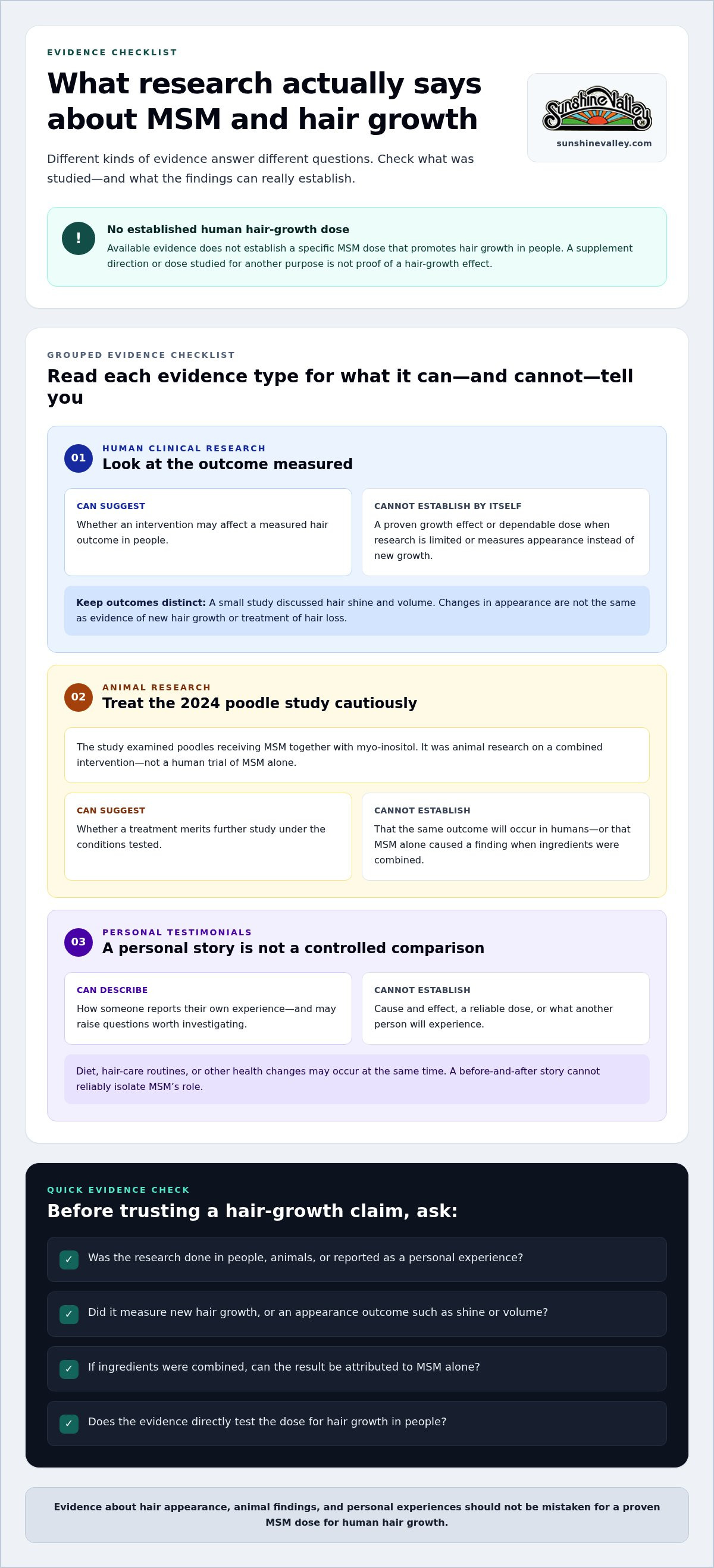
Evidence types answer different questions. A human study can offer clues about effects in people, animal research can suggest avenues for further investigation, and a testimonial records one person’s experience. They aren’t interchangeable. For anyone weighing msm dosage for hair growth, none of these evidence types should be treated as a reliable dose unless it directly tests that dose for hair growth in people.
| Evidence type | What it can suggest | What it cannot establish |
|---|---|---|
| Human clinical research | Whether an intervention may affect a measured hair outcome in people. | A proven hair-growth effect or dependable dose when the research is limited or measures appearance rather than new growth. |
| Animal research | Whether a treatment merits further study under the conditions tested. | That the same outcome will occur in humans, or that MSM alone caused it when ingredients were combined. |
| Personal testimonials | How someone describes their own experience. | Cause and effect, a reliable dose, or a prediction of another person’s results. |
What the poodle study can, and cannot, show
A 2024 study examined poodles receiving MSM together with myo-inositol. That makes it animal research on a combined intervention, not a human trial of MSM alone. The study may inform questions about hair quality in dogs, but it cannot establish that MSM promotes human hair growth or treats hair loss. Without separating the ingredients, any observed finding also can’t be attributed to MSM by itself.
The 2024 poodle study cannot prove that MSM alone grows human hair because it involved dogs and combined MSM with myo-inositol.
Why testimonials are not dosage evidence
A personal account may describe a meaningful change, and it can be a reason to ask further questions. But a timeline alone doesn’t show what caused the change. Someone may also have changed their diet, hair-care routine, or other aspects of their health during the same period. Hair can change for multiple reasons, so a before-and-after story cannot reliably isolate MSM’s role.
Testimonials also don’t provide a controlled comparison. They can’t show whether the same result would have occurred without the supplement or whether another person would respond similarly. A dose mentioned in a post is an individual’s reported use, not an established recommendation. For a more useful assessment, focus on what a study measured, who or what was studied, and whether its design can distinguish an ingredient’s effect from other explanations.
If you’re considering a powdered supplement, review its ingredient and serving information as part of a broader decision. Sunshine Valley’s powdered MSM is one product to consider, without assuming the format or ingredient guarantees a hair result.
MSM Dosage and Safety: How to Read Supplement Guidance
A supplement label can tell you how the manufacturer intends its product to be used. It can’t establish that the serving is a clinically validated treatment for hair growth. No specific human hair-growth dose has been established for MSM, so a number on a package or repeated online shouldn’t be mistaken for evidence that it will stimulate new hair.
That distinction is central to interpreting msm dosage for hair growth. General product directions and a therapeutic dose supported by relevant clinical research are not the same thing. Don’t increase your intake to try to speed up a result, especially when a hair-growth benefit and a dose for that purpose haven’t been established.
How to interpret a supplement label
Read the label carefully and distinguish three details: serving size, the amount of MSM in that serving, and the manufacturer’s suggested-use directions. These describe the product and its intended use. They don’t prove that the serving has been tested for hair growth. Powder products may also present serving information differently from capsules, so compare the actual label rather than assuming products are interchangeable.
Follow the directions for the specific product you use. Don’t combine products or take more than directed in pursuit of faster hair growth. Research protocols for other purposes, where available, may differ in formulation and context; they are not automatically suitable instructions for your routine. If the label is unclear, a pharmacist or other qualified healthcare professional can help interpret it.
Who should discuss MSM with a clinician?
Individual advice is especially important if you’re pregnant or breastfeeding, managing a medical condition, or taking prescription medicines. A clinician or pharmacist can review your circumstances and consider the full picture, including other supplements you use. This is a sensible precaution, not a claim that a particular interaction will occur.
Keep a current list of medicines and supplements when seeking guidance. Include product names, serving directions, and how often you take them. That makes it easier for a healthcare professional to consider combined use and offer advice suited to you. Don’t stop prescribed medicine or change its use to accommodate a supplement without professional guidance.
MSM is generally described as well tolerated, but side effects are possible. Reported effects may include digestive discomfort such as nausea, diarrhea, or bloating, as well as headache or skin reactions. These symptoms can have other causes, so don’t assume MSM is responsible. If you notice a concerning reaction after starting a supplement, stop and seek qualified advice; urgent or severe symptoms warrant prompt medical attention.
For anyone considering a powdered option, Sunshine Valley’s Super MSM powder is one way to explore the ingredient. Product choice is separate from evidence of a hair benefit: review the label and consider personal suitability before use.
Before Blaming MSM: Consider Common Reasons for Hair Changes
Noticing more hair in a brush or a change in density can be unsettling. But timing alone can’t show whether a supplement caused the change or will resolve it. Hair may change alongside shifts in health, medication, diet, or daily life, among other factors. A short description cannot identify the cause, so avoid treating a change as proof that you need MSM or a higher serving.
Before relying on a supplement claim, record what changed and when, then seek an assessment if the change is sudden, persistent, patchy, or concerning. This gives you a clearer starting point for a conversation with a healthcare professional.
Track the change before choosing a supplement
Make a simple record of when you first noticed shedding or thinning, whether it is continuing, and whether the pattern seems to be changing. Note other changes around the same time, such as a new medicine, a dietary shift, a health event, or a change in hair-care routine. These details can help a clinician consider the timeline without assuming any one factor is responsible.
Keep observations factual. For example, note “more hair noticed while brushing” rather than concluding that a nutrient is low or that MSM caused the change. Don’t start high-dose supplements to correct a suspected deficiency without an assessment. A supplement choice should not replace finding out whether evaluation is appropriate.
When professional evaluation is a sensible next step
Seek medical advice for hair changes that come on suddenly, persist, appear in distinct patches, cause distress, or occur with other symptoms. You don’t need to know the cause before asking for help. A clinician can review your history and pattern, assess possible explanations, and discuss whether testing or treatment is appropriate for your situation.
Bring your notes and a list of medicines and supplements, including when you started or changed them. This can help make the discussion more specific. Avoid stopping prescribed medication or changing a treatment on your own; a healthcare professional can guide next steps based on your circumstances.
That assessment matters when you’re considering msm dosage for hair growth. Without knowing what may be contributing to a change, choosing a supplement or adjusting its use may not address the underlying issue. MSM should not be presented as a proven way to restore hair, and personal observations cannot establish that it will help in an individual case.
- Timing: When did you first notice the change, and has it continued?
- Pattern: Does it seem diffuse, concentrated in an area, or different over time?
- Context: Have there been changes in health, medicines, diet, or hair care?
- Other concerns: Are there accompanying symptoms or reasons the change feels worrying?
Use these prompts to prepare for a clinical discussion, not to self-diagnose. If you’re considering a supplement after reviewing the evidence and your personal circumstances, explore Sunshine Valley’s powdered MSM as a product option, without assuming it will treat the cause of hair changes.
Choosing MSM Powder with Realistic Expectations
A powder’s format doesn’t establish its purity, effectiveness, or suitability for you. Product selection is separate from whether MSM has been shown to support hair growth. Use the label to understand what the product contains and how it is intended to be used, not as proof of a hair benefit or a reason to take more.
A practical label review can help you compare products without relying on broad promises. Look for clear information you can understand and use consistently:
- Ingredient identity: Check that the ingredient is clearly identified as MSM.
- Serving information: Find the amount per serving and how a serving is described.
- Directions: Look for clear suggested-use instructions, and don’t exceed them to pursue faster results.
- Manufacturer details: Look for accessible information about who makes the product and how to use it.
These points support an informed choice, but they don’t establish clinical effectiveness or guarantee that a product is right for you. Don’t infer independent testing, certification, or a particular level of purity from the word “powder” or from claims that aren’t explained. If the label leaves you uncertain, pause and seek qualified guidance rather than guessing at a serving.
What to look for in an MSM powder
Compare labels based on the details they actually provide. A clearly stated ingredient and serving amount help you understand what you’re considering, while straightforward directions make intended use easier to follow. Manufacturer information can also help you understand the product and its use. Avoid choosing based on promises of guaranteed hair growth. No packaging detail can substitute for evidence that a specific dose works for that purpose.
How Sunshine Valley presents Super MSM
Super MSM is Sunshine Valley’s powdered MSM product. Sunshine Valley was founded in 1956 and emphasizes premium-quality ingredients, modern manufacturing, and strict hygiene standards. These are company and manufacturing priorities, not proof that MSM promotes hair growth or treats hair loss. They also shouldn’t be read as a claim of a specific certification or test result.
For a closer look at considerations around MSM powder, explore the premium MSM powder guide. Readers assessing manufacturing practices can also review the article on hygienic supplement manufacturing. Use these resources to understand product and process considerations, not as evidence for an established msm dosage for hair growth.
Choose a supplement based on clear information and your own circumstances, with realistic expectations. If hair changes are sudden, persistent, patchy, or concerning, clinical assessment is more appropriate than relying on a supplement claim. If you’re comparing product information, Sunshine Valley’s guides offer a measured place to continue your research.
Make Your Next Step an Informed One
A supplement decision doesn’t have to begin with a number from a forum or a promise on a label. Start with what matters to you: the change you’ve noticed, the questions you want answered, and whether a healthcare professional’s input would help you decide what to do next. That approach keeps msm dosage for hair growth in perspective and makes room for choices based on your needs, not pressure for a quick fix.
If you’re considering MSM as part of your routine, review the product information carefully and keep your expectations grounded. Sunshine Valley’s Super MSM is a powdered supplement option; choosing it doesn’t replace clinical assessment when hair changes are concerning.
Explore Sunshine Valley’s Super MSM and take your next step with care. Thoughtful decisions begin with clear information, and you can move forward at a pace that feels right for you.
Frequently Asked Questions
Is MSM proven to regrow human hair?
No, the available research doesn’t establish MSM as a proven treatment for regrowing human hair. The poodle study examined MSM combined with myo-inositol in animals, so it can’t show that MSM alone works in people. A plausible explanation or an individual’s account isn’t proof of effectiveness. If you’re experiencing hair loss, a qualified clinician can help assess possible causes and discuss options supported by evidence for your situation.
How long does MSM take to affect hair growth?
There’s no reliable timeline for MSM-related hair growth because an effective human hair-growth dose and benefit haven’t been established. Claims that it works after a set number of weeks or months aren’t a dependable guide. If you’re monitoring shedding, note when it began and whether it continues or changes. Seek medical advice for persistent or concerning changes rather than extending supplement use based on an unsupported timeline.
Can MSM powder be applied directly to the scalp?
Don’t assume a dietary supplement powder is suitable for scalp application. Oral supplements and topical products are formulated and labelled for different uses, and powder intended to be taken as a supplement isn’t automatically appropriate for skin. There’s no basis here to recommend applying it to promote hair growth. Unsuitable products may irritate or cause sensitivity. Use only products specifically intended and labelled for topical application, following their directions.
Can MSM stop hair shedding caused by a nutrient deficiency?
MSM shouldn’t be assumed to correct a nutrient deficiency or stop shedding related to one. Hair changes can have different causes, and a short description can’t confirm that a nutrient issue is involved. Avoid self-diagnosing or taking high-dose supplements to address a suspected deficiency. If shedding persists, discuss it with a clinician and mention relevant changes in your diet, health, or medicines so they can assess appropriate next steps.
Can you take MSM with biotin for hair growth?
Taking MSM with biotin doesn’t establish that either supplement promotes hair growth, and results from one ingredient can’t be assumed for a combination. Before combining them, read both labels for serving directions and overlapping ingredients. Your health circumstances matter too. Ask a clinician or pharmacist to review the combination if you take medicines, manage a health condition, or already use several supplements, rather than adding products based on online claims.
Is MSM safe to take during pregnancy or breastfeeding?
There isn’t enough situation-specific information here to declare MSM safe or unsafe during pregnancy or breastfeeding. These are times to get individualized guidance before starting a dietary supplement. Share the product label and intended use with a qualified healthcare professional, who can consider your circumstances and other supplements or medicines. Don’t rely on online dosage suggestions or personal testimonials to determine whether MSM is appropriate for you during this period.



Leave a comment
This site is protected by hCaptcha and the hCaptcha Privacy Policy and Terms of Service apply.