




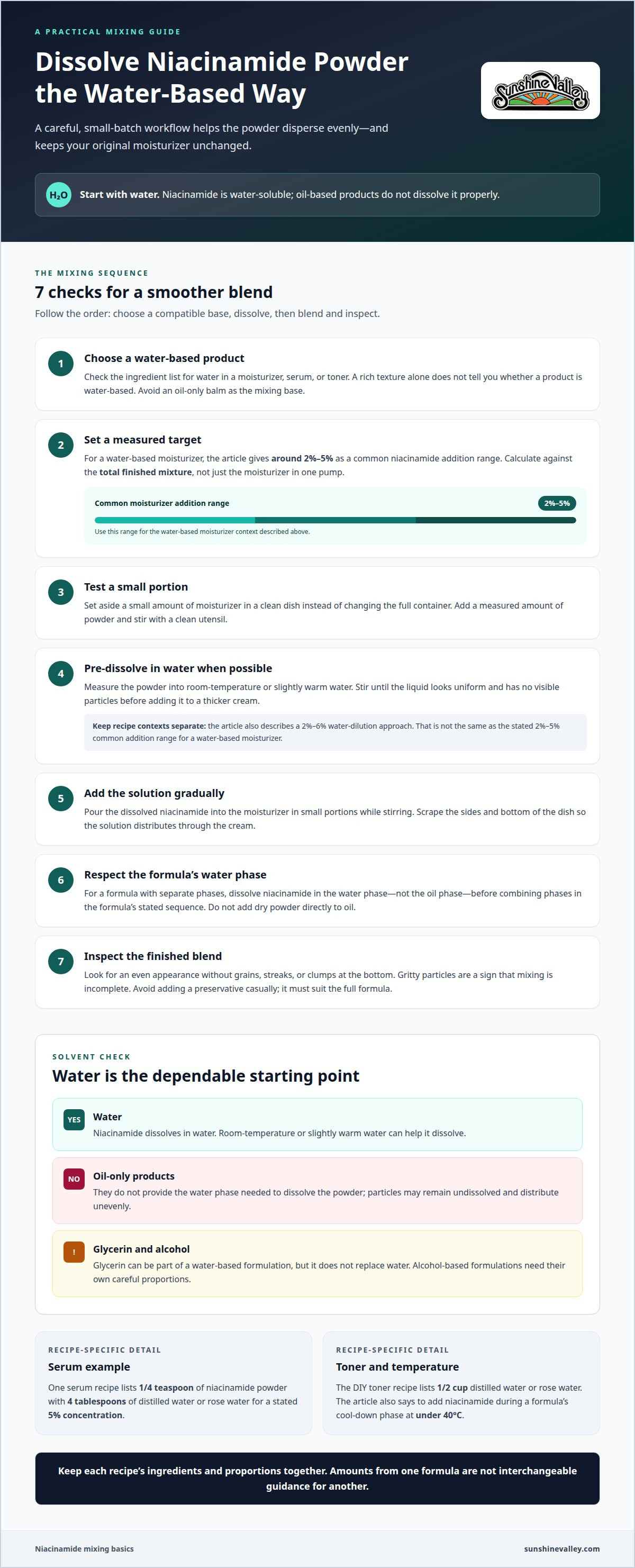
The practical answer to how to dissolve niacinamide powder is to use water or a water-based skincare product, not an oil-based one. In a water-based moisturizer, aim for a niacinamide concentration around 2% to 5%. Mix thoroughly so the powder disperses evenly rather than leaving gritty particles behind.
If you’re wondering how to dissolve niacinamide powder, water is the practical starting point: niacinamide is water-soluble. Choose a compatible water-based formula and prepare only a small amount at a time, rather than adding powder to a whole container of moisturizer.
This guide explains which water-based products work, how to blend niacinamide into moisturizer, and what to do if the mixture feels grainy or doesn’t disperse well. You’ll also learn how to store the dry powder so it stays protected between fresh mixes.
Key Takeaways
- Choose a water-based product as your mixing base; oil-based products won’t dissolve the powder properly.
- When adding niacinamide to moisturizer, calculate the amount carefully to keep the final concentration controlled.
- Mix a small amount for immediate use instead of altering the whole moisturizer container.
- Learn how glycerin and alcohol differ from water as mixing options, and what to consider before using either.
- Keep the dry powder sealed and protected from heat, moisture, and sunlight between mixes.
Choosing a water-based product to dissolve niacinamide powder
Choose a water-based skincare product, because niacinamide dissolves in water. For a moisturizer, calculate the final concentration before mixing the powder.
Confirm Water Solubility
Choose water as your solvent, then check the ingredient list for a water-based formula. Niacinamide powder dissolves in water, but oil-based products won’t dissolve it properly. Glycerin can be part of a water-based formulation, but it does not replace water. Alcohol-based formulations need their own careful proportions, so water is the simpler starting point.
Dissolve the Powder in the Water Phase
Identify the water phase in the formulation before adding the powder. In production, niacinamide is dissolved in water rather than oil, then the phases are combined as the formula requires. For a simple skincare mix, room-temperature or slightly warm water can help the powder dissolve. Stir until the liquid looks uniform, and check for visible grains before adding it to moisturizer.
- Read the base’s ingredients. Choose a moisturizer, serum, or toner that contains water. Water-based products provide the solvent niacinamide needs. A rich texture alone doesn’t mean a moisturizer is oil-based, so use the ingredient list to guide your choice. Don’t use an oil-only balm as the mixing base.
- Decide the final concentration. For a water-based moisturizer, around 2% to 5% niacinamide is a common addition range. Calculate the powder against the total mixture, not just the amount of moisturizer in one pump. For example, adding powder changes the proportion in the finished blend, so keep the batch size consistent.
- Make a small test mixture. Set aside a small amount of moisturizer in a clean dish instead of stirring powder into the full container. This lets you assess the texture and how evenly it mixes before use. Add a measured amount of niacinamide, then stir with a clean utensil. Testing a small portion also leaves the original moisturizer unchanged.
- Pre-dissolve when possible. Measure the powder into room-temperature or slightly warm water first. A water solution makes it easier to distribute niacinamide through a thicker cream. Water dilution in the 2% to 6% range is one approach described for this ingredient. Stir until the liquid appears clear and free of visible particles.
- Add the solution gradually. Pour the dissolved niacinamide into the moisturizer in small portions while stirring. Adding it slowly helps the water solution blend through the cream instead of forming separate pockets. Scrape the sides and bottom of the dish as you mix. Check the finished texture under good light for grains or streaks.
- Use the formula’s water phase. In a formulation with separate phases, add niacinamide to the water phase, not the oil phase. Dissolve it before combining the phases, following the formula’s production sequence. This respects niacinamide’s water solubility and helps distribute it through the finished product. Don’t add dry powder directly to oil.
- Assess the finished blend. Smoothness is a practical sign that the powder has dispersed; gritty particles mean mixing is incomplete. A well-mixed formula should have an even appearance, without clumps gathered at the bottom. Niacinamide, also known as vitamin B3, is used in skincare formulations addressing skin tone. Avoid adding a preservative casually; it must suit the full formula.
Recipe details can help you compare water-based options, but keep each formula’s ingredients and proportions together rather than transferring amounts between recipes. The page’s beginner-level niacinamide micellar-water formula takes 15 minutes to make. Its serum recipe uses 1/4 teaspoon of niacinamide powder with 4 tablespoons of distilled water or rose water for a stated 5% concentration. The page’s DIY niacinamide toner recipe uses 1/2 cup of distilled water or rose water. These are distinct preparations, so choose the one that matches the product you intend to make and follow its own directions.
Temperature and water amounts also matter to the specific recipe. The page recommends adding niacinamide during the cool-down phase at a temperature under 40°C to preserve efficacy. Its niacinamide serum recipe uses 89.7 g of water, while its sodium hydroxide solution recipe uses 90g of water; those figures belong to their respective formulas and are not interchangeable guidance for mixing powder into moisturizer. Use the water specified for the formula you are following, and make sure the niacinamide is evenly dissolved before combining it with other ingredients. If you are adapting a finished product rather than making a formula from its listed ingredients, avoid assuming that a recipe’s water quantity or stated concentration will carry over unchanged.
Is niacinamide powder soluble in oil, glycerin, or alcohol?
Water is the dependable starting point for dissolving niacinamide. Oil-based products won’t dissolve it properly, while glycerin and alcohol require more care. Assess the base’s ingredients before mixing, rather than assuming every liquid works as a solvent on its own.
- Keep oil out of the dissolving step. Niacinamide powder is water-soluble, so don’t stir it straight into an oil-only product. In facial oil, the particles may remain undissolved and distribute unevenly. A bottle of plain oil, for example, doesn’t provide the water phase needed to dissolve the ingredient. Choose a water-based formula instead, or dissolve the powder in water before considering a compatible formulation.
- Check whether the product contains water. Read the ingredient list on a moisturizer or serum before mixing. A creamy appearance doesn’t tell you whether its base can dissolve niacinamide; the ingredients do. If water appears in the formula, it has a water phase. If the product is anhydrous, meaning it contains no water, stirring for longer won’t make the powder dissolve.
- Use glycerin as part of a water mixture. Glycerin can appear alongside niacinamide in a water-based formulation, but don’t treat pure glycerin as interchangeable with water. One suggested formulation combines 5% niacinamide with 10% to 20% glycerin in water. The key detail is that water remains part of the mixture. Measure ingredients for the whole formulation, rather than adding an unmeasured amount of glycerin to powder.
- Make a small glycerin-and-water test batch. Prepare a measured water-based mixture, then stir in the niacinamide until it looks uniform. A formula with 5% niacinamide and 10% to 20% glycerin offers a concrete reference point. Check the bottom and sides of the mixing vessel for residue. If particles remain, keep stirring and assess the water phase before adding the mixture to another product.
- Approach alcohol as a separate formulation. Alcohol-based niacinamide solutions use different proportions from a simple water mix. The suggested starting concentration is 2% to 5% niacinamide, with 20% to 30% alcohol in the solution. Treat these values as formulation guidance, not a reason to pour alcohol into a finished moisturizer. Alcohol changes the base, so mixing it into an existing product can alter the original formula.
- Don’t assume every alcohol works the same way. The stated alcohol range applies to alcohol-based solutions, not every product containing alcohol. Check the specific ingredient and the formula’s intended proportions before mixing. An alcohol-based toner and a moisturizer with a small alcohol component are different starting bases. For a water-based skincare formula, water remains the straightforward solvent for niacinamide powder.
- Check the finished mixture before applying it. Stir thoroughly, then look for visible grains, clumps, or settling. Oil-only products can leave powder undissolved; a water phase supports dissolution. Glycerin belongs in a measured water formulation, while alcohol requires its own concentration plan. Choose a base by its composition, not just its texture or product label.
- Choose the simplest compatible base. For a personal mixing step, start with water or a water-based product rather than experimenting with oil alone. If you’re working from a glycerin formula, preserve its stated water component and proportions. For an alcohol formula, follow its separate concentration guidance. You can explore powdered niacinamide as a starting ingredient for a water-based mix.
What are the risks of using undissolved or high-concentration niacinamide?
Two practical concerns are uneven mixing and skin irritation. Assess the concentration and formula, and pay attention to how your skin responds before continuing.
- Check for undissolved particles. Inspect the mixture under good light before applying it. Visible grains or clumps mean the powder hasn’t dispersed evenly. Particles may collect in one area of a moisturizer, so each dab can contain a different amount. Stir again and reassess the texture. Don’t apply a visibly gritty mixture as if it were uniform.
- Calculate the concentration before adding more. Niacinamide concentrations over 10% may increase the risk of irritation. Include the powder and base together when estimating the final concentration. Adding another scoop to a partly mixed product can make the result difficult to assess. Keep the amount measured, and avoid treating a higher percentage as a shortcut to better results.
- Use a modest concentration when making a new blend. A range of 2% to 5% is suggested for beginners or people with sensitive skin. This gives you a more controlled starting point than jumping to a stronger mixture. Record the amount of powder and moisturizer used, so you can reproduce the same blend. If the concentration is uncertain, don’t keep adding powder by eye.
- Consider the formula’s pH. Niacinamide is used in formulations with a pH between 4 and 6. Very acidic conditions can cause niacinamide to convert to niacin, which may produce temporary redness. Don’t try to correct a formula by adding random ingredients. If you’re making a formulation, pH and ingredient proportions need to be considered together, rather than judged by texture alone.
- Test a small area first. Apply a small amount of the finished mixture to a limited skin area before regular use. Patch testing a new ingredient and waiting 24-48 hours can help you check for irritation. Avoid testing several new products at once, because that makes it harder to identify the cause of a reaction. Note the application time and any changes during the waiting period.
- Stop if irritation appears. If redness or discomfort follows application, discontinue the mixture rather than adding more product to mask the reaction. Temporary redness is associated with niacin formation in very acidic conditions, but irritation can have other causes. Review the concentration, pH, and whether the powder dissolved fully. Don’t resume the same mixture while symptoms remain.
- Keep the trial simple. Use one new niacinamide mixture at a time, and avoid changing its concentration between applications. For example, a 2% blend followed by a stronger blend makes skin responses harder to compare. A consistent formula helps you track what you applied and when. If you’re combining niacinamide with other skincare ingredients, avoid introducing several new actives during the same test period.
- Make only what you can assess. Mix a small portion for immediate use instead of modifying a whole container of moisturizer. A small batch limits how much product is affected if the mixture feels gritty or causes redness. Keep the original product separate and use a clean utensil for the test mixture. This makes it easier to compare the altered and unaltered moisturizer.
- Choose a controlled starting ingredient. Begin with a clearly measured niacinamide powder and follow a defined formulation, rather than estimating portions. For a suitable ingredient to use in a measured skincare blend, explore niacinamide powder. Keep your concentration and pH considerations in view, and assess the finished mixture before applying it to a larger area.
Keep the schedule straightforward rather than increasing use to compensate for an uncertain mixture. The page recommends using its DIY niacinamide toner twice daily, while its DIY niacinamide serum is recommended once or twice daily. Follow the frequency for the product you’re using instead of combining the directions into a more frequent routine. If vitamin C is also part of your routine, the page recommends using vitamin C in the morning and niacinamide in the evening, or alternating days. These are routine options, not a reason to keep applying a mixture that feels irritating. Keep the product and timing consistent while assessing your skin, and avoid introducing another new blend at the same time. If the concentration or dispersion remains unclear, pause rather than increasing use.
Sunshine Valley: Super Mannitol
Sunshine Valley offers Super Niacinamide, its powdered niacinamide offering, for readers looking for the ingredient discussed in this guide. It’s relevant when you want to source niacinamide powder and follow a measured formulation approach, rather than relying on an unidentified ingredient. The product name in this section heading is Super Mannitol, but niacinamide is the offering that matches this article’s skincare topic.
Use the mixing principles above to assess whether your intended base is water-based, and keep concentration and even dispersion in mind. A powder ingredient alone doesn’t make a finished skincare formula; the base and mixing method matter too. For product information, visit Sunshine Valley’s website.
Make Your Next Skincare Mix Deliberate
Use your next batch as a chance to refine your formulation, not simply add more powder. Record the ingredients, proportions, and texture of each test so you can make a consistent choice next time. Knowing how to dissolve niacinamide powder is one part of creating a considered skincare routine; selecting the ingredient and keeping a clear record of your process matter too. If you prefer to source the powder before planning a formulation, Sunshine Valley offers Super Niacinamide. Its other offerings include Super Mannitol, Super Inositol, and Super Lactose.
Choose an ingredient that fits your intended use, then keep your preparation measured and deliberate. For information about Sunshine Valley’s offerings, visit Sunshine Valley. Take the next step with care, and build a skincare approach that feels clear and manageable.
Frequently Asked Questions
How do you dissolve niacinamide powder in water step by step?
To dissolve niacinamide powder, measure the powder and water separately, then combine them in a clean container. Stir until the liquid looks uniform, checking the bottom and sides for settled grains. Calculate the concentration using the total weight of the finished mixture. Add the solution gradually to a compatible product, mixing between additions. Make a small batch first.
What temperature water dissolves niacinamide powder best?
Room-temperature or slightly warm water is suitable for dissolving niacinamide powder. Choose a moderate temperature and watch the mixture as you stir. Start with comfortably warm, not hot, water. If grains remain, keep mixing before raising the temperature. For a larger skincare formulation, follow its temperature and production steps rather than assuming heating is necessary.
How much niacinamide powder can dissolve in water?
A practical dilution range for water is 2% to 6% niacinamide. This describes a suggested formulation concentration, not a maximum solubility limit. For example, calculate the powder as a proportion of the total finished mixture, then measure both ingredients rather than estimating by spoonful. If you’re preparing a skincare product, keep the intended concentration consistent and avoid adding extra powder simply because the mixture looks thin.
Can niacinamide powder be mixed into moisturizer or serum?
Yes, niacinamide powder can be mixed into a water-based moisturizer or serum if you control the final concentration. Set aside one portion of moisturizer, mix in a measured amount, and assess the texture before applying. A serum may respond differently from a cream, so don’t change an entire bottle at once. Record your amounts and keep the original product separate for comparison.
How should you store niacinamide powder and a dissolved solution?
Keep dry powder in its tightly sealed container, in a cool, dry place away from sunlight. For a dissolved solution, use a clean, dark glass bottle and protect it from light; refrigeration can help extend storage, especially without preservatives. Homemade solutions typically last 2 to 4 weeks. Label the bottle with its preparation date, and discard it if its appearance or smell changes.


Leave a comment
This site is protected by hCaptcha and the hCaptcha Privacy Policy and Terms of Service apply.