



An encouraging sleep finding isn’t proof that a supplement improves sleep. Inositol powder for sleep support has drawn interest, but the research is still developing. Studies also differ in their purpose, participants, and formulations, making results difficult to interpret.
If you’re weighing conflicting claims, ask whether a study tested inositol alone, whether it measured sleep directly, and what its findings can establish. This article reviews the proposed connection between inositol and sleep, separates preliminary evidence from firm conclusions, and offers practical considerations for assessing a powder supplement. For questions about dosage or safety, speak with a healthcare professional.
Sunshine Valley offers Super Inositol as a powdered dietary supplement. The company, founded in 1956, emphasizes premium-quality ingredients and strict hygiene standards. Neither the product nor the company’s history establishes a sleep benefit. Here, we look at what research can and can’t tell you.
Key Takeaways
- Learn why proposed links between inositol and sleep biology are hypotheses, not proof of a sleep benefit.
- See how to distinguish human research from mechanistic explanations, personal testimonials, and commercial claims.
- Assess inositol powder for sleep support by clarifying your goal, reviewing the evidence, and reading the product label carefully.
- Understand why study findings may not apply to every person or supplement, and why dosage should not be guessed.
- Meet Sunshine Valley Super Inositol as a powdered dietary supplement, not a sleep treatment.
Inositol Powder for Sleep Support: What People Mean by the Claim
The phrase “sleep support” doesn’t identify a specific health outcome. In supplement marketing, it generally suggests a possible role in overall wellness, not a proven treatment for insomnia or a diagnosed sleep disorder. The phrase alone doesn’t show that a product has been studied for sleep or that it will help a particular person.
Inositol is a naturally occurring compound involved in cellular processes. Supplements may contain different forms of inositol, and powder products can differ in their formulations. A study of one form or a combination product can’t automatically establish the effect of a different inositol powder.
For a plain-language overview of inositol’s forms and biological functions, see Inositol. To hear a discussion of the topic, watch this educational video:
What does inositol powder for sleep support mean?
In practice, the phrase describes a proposed wellness role: someone takes inositol in powder form hoping it may contribute to conditions associated with rest, such as relaxation. That wording is a claim to assess, not a promised result. A label can identify ingredients and directions, but it can’t demonstrate a sleep benefit by itself. Look for evidence that matches the specific ingredient, formulation, and outcome being discussed.
Why do people connect inositol with sleep?
Interest partly comes from hypotheses about how inositol participates in cell signaling and may relate to systems involved in mood and relaxation. Researchers may investigate these pathways to understand whether they could be relevant to sleep. But a plausible biological explanation is only a starting point. It doesn’t show that taking a supplement changes sleep in people or establish which form or formulation might matter.
Personal reports explain why someone might try a supplement, but they can’t separate its effects from expectations, changes in routine, or other factors. Commercial descriptions have a similar limitation: they may present a proposed benefit without showing the quality or scope of the supporting research. Controlled studies are needed to test whether an ingredient produces a measurable effect, for whom, and under what conditions.
In short: “Inositol may have a proposed role in supporting wellness related to sleep, but it is not an established sleep treatment.” Powder is a delivery form, not evidence of efficacy. Persistent or disruptive sleep problems deserve appropriate evaluation, rather than relying on supplement language to identify or treat their cause.
How Inositol Could Relate to Sleep: Biology Without Overstating the Evidence
When assessing a proposed sleep benefit, separate a biological explanation from an outcome people can experience. Inositol participates in cell signaling, the process cells use to receive and respond to messages. That role gives researchers reasons to investigate it, but it doesn’t mean taking inositol directly calms the brain or changes sleep.
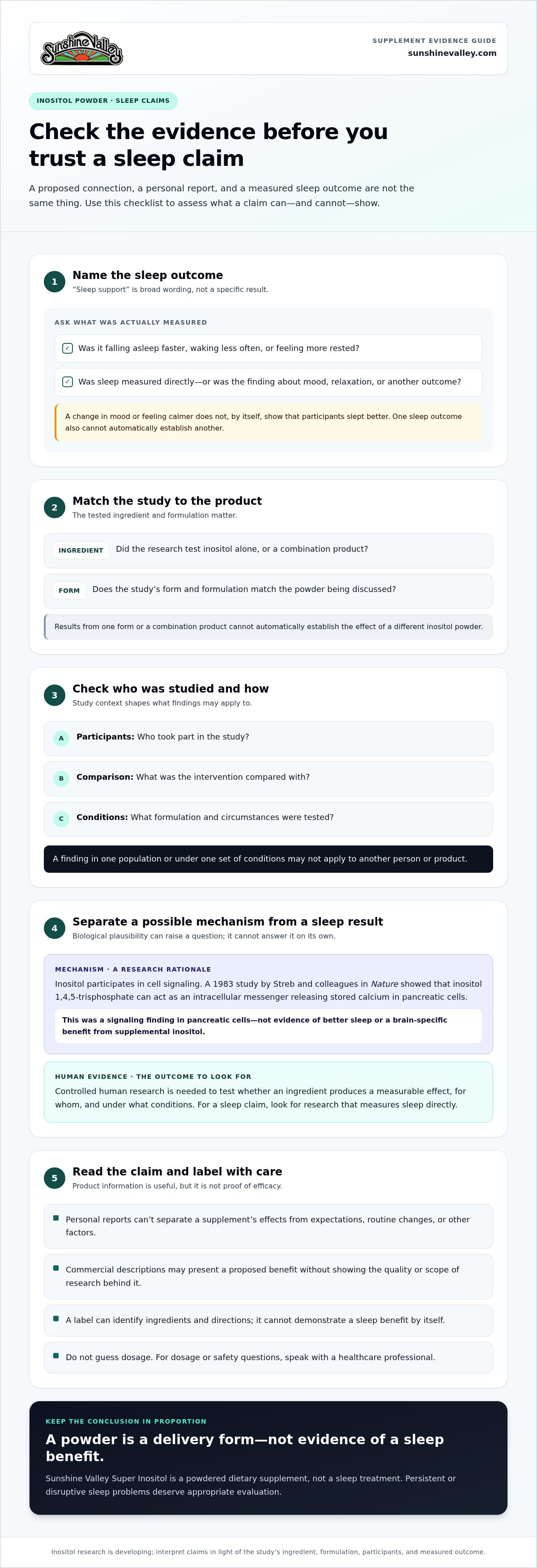
Sleep has several dimensions. Falling asleep faster, waking less often, feeling more rested, and meeting criteria for a diagnosed sleep disorder are distinct outcomes. Evidence about one can’t automatically establish an effect on the others. For example, a study reporting a change in mood wouldn’t by itself show that participants slept better.
What is the proposed connection between inositol and brain signaling?
In simple terms, cell signaling is a relay system: a cell receives a message and activates internal steps in response. A primary study by Streb and colleagues, published in Nature in 1983, showed that inositol 1,4,5-trisphosphate can act as an intracellular messenger that releases stored calcium in pancreatic cells. This establishes a signaling function in that experimental context, not a sleep effect or a brain-specific benefit from supplemental inositol.
Researchers have also considered how inositol-related signaling might intersect with neurotransmitter systems involved in mood and relaxation. These connections are complex. The same signaling pathways can serve different functions across tissues and circumstances, and a proposed interaction with a calming system doesn’t establish that a powder acts as a sedative. The body’s use of a compound isn’t equivalent to evidence that a supplement changes a meaningful outcome.
Why a plausible mechanism is not proof of better sleep
A laboratory result can help frame a question, but it can’t answer whether people fall asleep sooner or wake less during the night. To judge an inositol study, look at who took part, what formulation was tested, how it was compared, and which outcomes researchers measured. Findings in one population or from a combination product may not apply to another group or to inositol alone.
These distinctions matter when considering inositol powder for sleep support. A mood-related change, a participant’s impression of feeling calmer, and a measured improvement in sleep are not interchangeable findings. The most useful evidence would measure sleep directly and clearly describe the intervention and comparison group. Until then, proposed brain pathways are a rationale for further research, not confirmation of benefit.
Biological plausibility can suggest how an effect might occur, but only well-designed human research can show whether it meaningfully improves sleep. You can review Sunshine Valley’s inositol powder as a product option while keeping product information separate from clinical evidence. Persistent sleep difficulties call for appropriate evaluation, not assumptions based on a supplement’s proposed mechanism.
What Research Says About Inositol for Sleep, and What It Cannot Yet Show
Evidence about inositol and sleep comes in different forms, and those forms don’t carry equal weight. A proposed mechanism can guide research, while a testimonial describes one person’s experience. Neither establishes that a supplement reliably improves sleep. The most relevant evidence comes from human studies that measure sleep directly and clearly describe the formulation tested.
| Evidence type | What it can tell you | What it cannot establish |
|---|---|---|
| Mechanistic rationale | Suggests biological questions researchers can investigate. | Whether taking inositol changes sleep in people. |
| Human research | Tests outcomes in a defined group using a specified intervention and comparison. | That results apply to every population, product, or sleep concern. |
| Testimonials | Describe an individual’s reported experience. | That inositol caused the experience or will have the same effect for others. |
| Commercial claims | Show how a product is presented to consumers. | That the claim is supported by ingredient-specific clinical evidence. |
How to judge the strength of inositol sleep research
Start with the outcome: did researchers assess sleep directly, or mood, anxiety, or another related measure? Then check the study population, participant number, duration, comparison group, dose, and whether the intervention contained inositol alone. These details help show what the findings apply to. A statistically significant result isn’t, by itself, proof of a large or broadly relevant benefit.
What does PMID 32933356 report?
The 2020 randomized controlled trial indexed as PMID 32933356 studied pregnant women. It compared 2,000 mg of myo-inositol daily for 10 weeks with a placebo and reported a statistically significant improvement in the total sleep quality score in the myo-inositol group. This finding relates to a specific population, form, and regimen, not to all adults.
That result warrants careful attention, but it has clear limits. Pregnancy-specific findings may not transfer to people who aren’t pregnant, and a sleep-quality score doesn’t establish treatment for insomnia or other diagnosed sleep disorders. The research summary available here doesn’t provide the participant count or effect size, so those details shouldn’t be guessed. One trial can’t settle questions about long-term use or other formulations.
Inositol alone, blends, and customer reviews
A combination formula containing inositol and other ingredients can’t show which ingredient contributed to a reported outcome. Customer reviews have a different limitation: they lack the controls needed to separate a supplement’s effect from expectations, other routine changes, or natural variation. For inositol powder for sleep support, compare a product claim only with research that matches the ingredient, formulation, population, and sleep outcome.
Bottom line: Current evidence is insufficient to conclude that inositol reliably improves sleep across populations or treats sleep disorders. Read preliminary findings in context, and distinguish testimonials and promotional wording from controlled human research.
How to Evaluate Inositol Powder for Sleep Support Responsibly
Start with a clear goal, not a promise on a label. Use this sequence to assess an inositol powder while keeping the limits of the sleep research in view.
- Clarify your goal. Identify what you hope to address, such as difficulty falling asleep or frequent waking. These are different concerns, and a supplement claim doesn’t diagnose their cause.
- Review the evidence. Look for human research that measures the sleep outcome you care about. Check whether the study tested inositol alone or a combination, and whether its participants and formulation resemble your situation.
- Inspect the label. Read the named ingredient, serving directions, and other listed ingredients. Treat sleep-related wording as a claim to evaluate, not proof that the product produces that result.
- Consider personal suitability. Account for your health circumstances and other products or medications you use. Seek individualized guidance when relevant, rather than relying on a general online dose.
What to check on an inositol powder label
Read the full label, not just the front panel. Confirm the ingredient name, serving directions, and any additional listed ingredients. Assess a blend as a blend, rather than assuming it works like inositol alone. Compare sleep claims with studies that match the ingredient and outcome. Powder is a delivery form, not a guarantee of effectiveness, purity, or suitability.
Follow the directions for the product you have. Don’t convert a dose used in a study into a personal recommendation or assume a serving from one formulation applies to another. For separate information on reading dosage guidance, see how to take inositol powder.
When sleep concerns call for professional advice
Speak with a qualified healthcare professional or pharmacist before use if you take medication, are pregnant, or have an existing health condition. They can help consider your individual circumstances and potential interactions. Seek professional advice for sleep problems that are persistent, severe, or worsening, rather than attempting to manage an underlying issue with a supplement alone.
Supplements aren’t substitutes for diagnosis or evidence-based care. If you’ve reviewed the evidence and considered your personal suitability, explore Sunshine Valley’s Super Inositol as a powdered dietary supplement. Don’t assume a sleep outcome from the product format or name.
Sunshine Valley Super Inositol: A Powder Option, Not a Sleep Treatment
Research and product information answer different questions. Research can help assess whether an ingredient affects a measured outcome; product details help you understand what you’re considering. Sunshine Valley offers Super Inositol, a powdered inositol dietary supplement. It is an option for shoppers considering an inositol powder, but its availability doesn’t establish that it improves sleep or treats insomnia.
That distinction is central to responsible supplement use. You may choose to consider a supplement after weighing the evidence, your circumstances, and the label directions. That choice is different from expecting a guaranteed result. Sleep can be affected by many factors, and a product description can’t determine the cause of an individual’s sleep difficulty.
What Sunshine Valley’s inositol powder is, and is not
Super Inositol is Sunshine Valley’s powdered inositol dietary supplement. Keep the product description distinct from claims about sleep: its name and powder form don’t establish a particular dose, clinical outcome, or sleep benefit. It is a dietary supplement, not a medical consultation or prescription medication, and it shouldn’t substitute for assessment or care when persistent sleep problems need attention.
For shoppers, this distinction makes product evaluation clearer. Consider the supplement as an ingredient option, then assess its label and suitability in light of the research discussed here. The fact that a product is available doesn’t mean it has been tested in a clinical trial for every advertised use. Choosing a powder doesn’t guarantee that it will be appropriate for every person.
Quality and manufacturing context for supplement shoppers
Sunshine Valley emphasizes premium-quality ingredients, state-of-the-art manufacturing, and strict hygiene standards. These practices describe the company’s approach to supplement production. They aren’t clinical evidence and don’t demonstrate that Super Inositol improves sleep. The company was founded in 1956, which provides business context rather than proof of a health outcome.
Manufacturing information and clinical evidence answer different questions. The former concerns production standards described by a company; the latter asks whether a defined product produces a measured effect in people.
If you’ve reviewed the evidence and considered whether a supplement fits your circumstances, explore Sunshine Valley Super Inositol as a powdered dietary supplement. Read the product information carefully, follow its stated directions, and keep expectations measured. An informed choice isn’t a promise of better sleep.
Make Your Next Step Evidence-Led
Before adding a supplement to your routine, decide what you hope to learn from it and how you’ll judge whether it suits you. Keep expectations realistic, follow the product’s directions, and seek professional guidance if sleep difficulties persist or your health circumstances raise questions. An informed choice leaves room for uncertainty; it doesn’t depend on a guaranteed result.
If you’re considering inositol powder for sleep support, treat the phrase as a reason to examine the evidence and product details, not as a promise of better rest. Sunshine Valley emphasizes premium-quality ingredients and strict hygiene standards. Its history began in 1956. These points offer context about the company, not proof of a sleep effect.
When you’re ready to review the product, explore Sunshine Valley Super Inositol. A measured, well-informed decision is a sound place to begin.
Frequently Asked Questions
Can inositol powder help you sleep?
It’s possible, but evidence doesn’t establish that inositol powder reliably helps people sleep. A result from one group or setting shouldn’t be treated as a prediction for everyone. If you’re considering it, decide what change you’re looking for, such as fewer awakenings, and don’t assume a product marketed for sleep will deliver that result. Persistent sleep problems deserve professional attention rather than repeated supplement trials alone.
How does inositol affect sleep?
There isn’t an established, predictable sleep effect of inositol that can be applied to every user. If you’re tracking your experience, distinguish sleep onset, nighttime awakenings, and how rested you feel the next morning. These can change independently. Keep a simple sleep diary and note other changes, such as caffeine timing or a new supplement, so you don’t attribute a difference to inositol without considering other possible explanations.
Is inositol a sleep medication?
No. Inositol is sold as a dietary supplement, not as an established sleep medication. The FDA has not reviewed or approved it to treat insomnia or another disease. Its GRAS status for certain food uses is not approval as a treatment. Don’t replace prescribed care or delay assessment of a sleep disorder because a supplement is described as calming or sleep-supportive.
What is the best time to take inositol for sleep support?
There’s no universally established bedtime schedule for inositol as a sleep aid. Follow the directions on the specific product rather than borrowing timing or amounts from a different formula or study. If you use it, choose a consistent time that fits those directions and record it alongside your sleep diary. Don’t take an extra serving simply because sleep hasn’t changed on a particular night.
Can you take inositol powder with other supplements or medication?
There isn’t one safe answer for every combination. Before adding inositol, show a clinician or pharmacist the product label and a complete list of your medications and supplements, including occasional-use products. This is especially prudent during pregnancy or with an existing health condition. Don’t stop or adjust a prescribed medication to accommodate a supplement without guidance from the professional managing your care.
How can you tell whether an inositol sleep claim is supported by research?
Look for a published human study that names the inositol form and product tested, identifies the comparison group, and measures a sleep outcome directly. Check whether the study examined sleep as a primary outcome or reported it incidentally. A claim based on a blend, customer review, or general discussion of brain function doesn’t show that inositol alone produced a sleep effect. Match the evidence to the exact claim before relying on it.



Leave a comment
This site is protected by hCaptcha and the hCaptcha Privacy Policy and Terms of Service apply.