



What if a compound takes part in brain signaling, but taking it has not been shown to improve brain health? That distinction matters when asking what does inositol do for the brain. Inositol is involved in cellular signaling, but this biological role alone does not show that an inositol supplement produces a particular mental or neurological benefit.
It can be difficult to separate mechanisms, early research, and established treatments. This article explains inositol’s role in brain cells, what human studies suggest about mood and other brain-related outcomes, and where the evidence remains limited.
You’ll learn how inositol helps relay signals inside cells, how to interpret research findings, and what to discuss with a qualified healthcare professional before considering a supplement. Sunshine Valley’s Super Inositol is a powdered product option for people considering inositol. Its availability is not evidence of a brain-health effect.
Key Takeaways
- Inositol contributes to brain-cell communication, but its presence in the brain does not prove that a supplement provides a benefit.
- When asking what does inositol do for the brain, distinguish its known role in cellular signaling from claims about mental or neurological outcomes.
- Assess human research by checking who was studied, what outcome was measured, and whether the findings apply beyond that study.
- Use a clear evidence check when evaluating brain-health claims, and remember that supplements are not substitutes for diagnosis or prescribed care.
- If considering inositol, read the product label and discuss relevant questions with a qualified healthcare professional.
What Does Inositol Do for the Brain? Its Role in Cells
Inositol is a naturally occurring, sugar-like compound involved in cell structure and signaling. It is found in human tissues, including the brain, and in foods such as fruits, beans, grains, and nuts. The brain’s use of inositol is part of normal biology. That fact does not, by itself, establish that taking an inositol supplement improves brain function or treats a health condition.
Inositol helps cells relay signals by contributing to phosphoinositide molecules that transmit messages within cells and help regulate cellular activity. These signaling pathways are relevant to brain cells, but their biological activity is not the same as a demonstrated clinical benefit from supplementation. For a broader overview of its forms and functions, see Inositol's Role in Cell Signaling and Biological Functions.
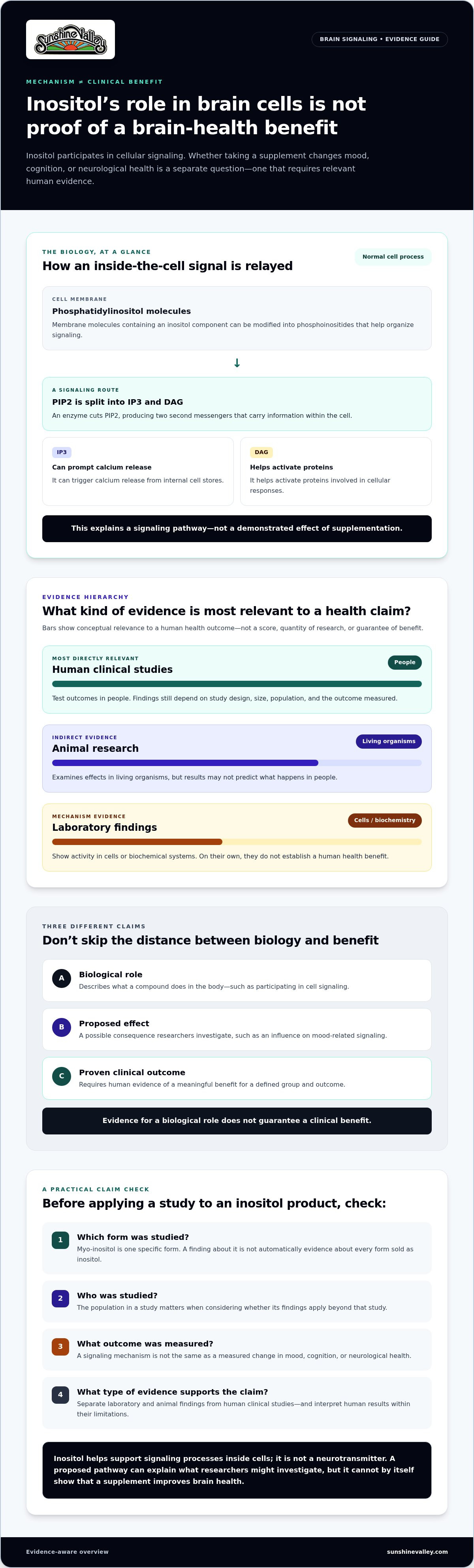
Three levels of evidence help put claims in perspective. A biological role describes what a compound does in the body. A proposed effect is a possible consequence researchers investigate, such as an influence on mood-related signaling. A proven clinical outcome requires human evidence showing a meaningful benefit for a defined group and outcome. Evidence of the first does not guarantee the third.
Is inositol a vitamin, neurotransmitter, or brain nutrient?
Inositol is sometimes called “vitamin B8,” but it is not officially classified as a vitamin. The body can make it from glucose, and it is also present in foods and tissues. Inositol is not a neurotransmitter. Rather than carrying a message directly between nerve cells, it helps support signaling processes inside cells. Calling it a “brain nutrient” does not mean everyone needs a supplement or that it has a specific treatment effect.
What does myo-inositol mean?
Myo-inositol is one specific form, or isomer, of inositol. It is commonly discussed in human biology and supplement research, so studies on myo-inositol are not automatically evidence about every form sold under the broader name “inositol.” The form matters when interpreting a study or reading a supplement label. Check which form researchers examined before applying a finding to a different product or formulation.
In practical terms, the answer to what does inositol do for the brain depends on whether you mean its normal role in brain cells or the effects of taking it. Researchers study how inositol-related signaling pathways operate. That can help explain a possible mechanism, but it does not establish that a supplement will change mood, cognition, or neurological health. Those are separate questions that require relevant human studies.
This distinction is useful whenever a claim moves from “involved in signaling” to “supports brain health.” Ask what form of inositol was studied, whether the evidence came from cells, animals, or people, and what outcome researchers measured. Then look at the human findings and their limitations before drawing conclusions about potential benefits.
How Inositol Participates in Brain-Cell Signaling
A brain cell’s membrane is more than a protective boundary. It also contains molecules that help receive and relay messages. Think of a signal arriving at a cell as a message delivered to a control desk: membrane components help pass it inward, where other molecules carry it onward and influence cellular activity.
In phosphoinositide signaling, membrane phosphatidylinositol molecules are modified into signaling compounds, including IP3 and DAG, which help relay signals inside cells and regulate processes such as calcium release and protein activity. This pathway operates in many cell types, including neurons. It helps explain how cells communicate, but it does not show that consuming an inositol supplement can selectively change a brain response.
What phosphoinositide signaling does
Phosphatidylinositol is a membrane lipid with an inositol component. Cells can add phosphate groups to it, creating phosphoinositides that help organize signaling at the membrane. In one well-studied route, an enzyme cuts PIP2 into IP3 and DAG. IP3 can prompt calcium release from internal stores, while DAG helps activate proteins involved in cellular responses.
These products are often called second messengers: they carry information within a cell after an outside signal has been received. Enzymes and cellular conditions regulate the pathway. It is not a simple dial that supplement intake turns up or down.
How brain signaling research should be interpreted
Mechanism research helps identify how a pathway works and what questions to test next. But the type of evidence matters. A result in isolated cells may not occur in a whole organism. An animal finding may not translate to people, and neither alone establishes a human health benefit. Clinical studies need to test the supplement, form, population, and outcome in question.
For example, evidence that a signaling molecule participates in a neuron’s response does not establish that taking inositol improves mood, memory, or neurological health. To assess a claim, distinguish:
- Laboratory findings: Show activity in cells or biochemical systems.
- Animal research: Examines effects in living organisms, but may not predict human results.
- Human clinical studies: Test outcomes in people, with conclusions limited by study design, size, and population.
So, what does inositol do for the brain? It participates in cellular signaling pathways that help coordinate activity inside cells. Whether supplementation meaningfully changes a specific brain or health outcome is a separate question for human research. The pathway alone cannot answer it.
If you’re considering an inositol supplement, Sunshine Valley’s powdered Super Inositol is one product option. Assess the label and the research separately from any assumptions about brain effects.
What Human Research Says About Inositol and Brain Health
Human evidence is narrower than broad “brain support” claims suggest. Some small studies have examined inositol in people with depression, while other research has measured changes in brain chemistry rather than symptoms or daily functioning. These findings answer different questions and should not be treated as equal proof.
Do studies show benefits for mood or cognition?
Small clinical studies have reported possible improvement in depressive symptoms. For example, one study tested 12 grams of inositol daily for four weeks, and another small study reported improvement in 9 of 11 participants taking 6 grams daily. These results are preliminary. Small participant groups and short study periods make it difficult to know how reliable or broadly applicable the findings are. Some studies have also found no additional benefit when inositol was added to standard depression medication.
This does not show that inositol improves everyday mood for everyone, treats depression, or enhances cognition. The evidence described here does not establish a general cognitive benefit. A human imaging study in healthy participants found a temporary change in brain myo-inositol levels after high-dose intake. A change in a measured brain marker, however, is not proof of improved memory, mood, or function.
Why study results may not apply to everyone
Studies can differ in the form and amount of inositol tested, participants’ health conditions, treatment context, duration, and outcome measures. A result in people diagnosed with a condition may not apply to healthy adults or to someone pursuing general wellness. A small, short study can identify a possibility, but larger and replicated trials are needed to establish whether an effect is consistent and clinically meaningful.
A plausible biological mechanism can justify further research, but only well-designed human studies can demonstrate a meaningful clinical benefit. When interpreting a claim, ask whether it describes a pathway, a measured brain marker, or an improvement people actually experienced.
Evidence comparison
Mechanism research: Explains how inositol-related pathways may participate in cell signaling. It can suggest hypotheses, but does not show that supplements improve health outcomes.
Human studies: Include small studies of depressive symptoms and imaging research measuring brain chemistry. Findings are limited by study size, duration, population, and the outcomes tested.
Established clinical conclusions: The evidence described here does not establish inositol as a proven treatment for depression or as a way to improve cognition in the general population.
So, what does inositol do for the brain according to human research? Studies offer early, condition-specific clues, not a universal conclusion about supplement benefits. Keep the population, outcome, and limitations in view. Do not use supplement findings to replace diagnosis or prescribed care.
How to Evaluate Inositol Brain Claims and Safety
Supplement claims can move quickly from a biological explanation to a promise about mood, memory, or treatment. Pause to examine the evidence behind the specific claim. A mechanism may explain why researchers are interested in inositol, but it cannot establish that a supplement produces a meaningful benefit or is appropriate for a particular person.
A practical checklist for assessing brain-health claims
Use this sequence to assess a claim before relying on it:
- Identify the claim. Is it about normal cell signaling, a change in a laboratory marker, or a benefit such as symptom relief?
- Check the study type. Was the evidence from cell research, animals, or people? Human outcomes are more directly relevant to human health, though study quality still matters.
- Look at the population and comparison. Who took part, how many people were studied, and was inositol compared with a placebo or another approach?
- Read the outcome and limitations. Did researchers measure a meaningful change in symptoms or function? Consider the study’s duration and design, and whether its findings have been replicated.
Be especially cautious with claims that a supplement treats a diagnosed condition. A small or preliminary study may raise a useful question, but it does not establish a treatment recommendation. Ask whether the evidence supports the exact claim, not merely a related mechanism or a result in a different group.
When to discuss inositol with a healthcare professional
Seek individualized guidance before considering a supplement if you have a health condition, take medication, are pregnant, or are breastfeeding. A qualified healthcare professional can consider your circumstances and review whether a supplement is appropriate. Do not stop, replace, or adjust prescribed treatment based on supplement claims. Supplements are not substitutes for assessment, diagnosis, or ongoing care.
Safety information also needs context. Findings from a study using a particular form, amount, or participant group do not automatically establish safety for every person or product. If you experience a concerning symptom after taking a supplement, stop and seek appropriate medical advice. Do not assume that “natural” means risk-free or that a study’s findings apply to your situation.
For separate general product-use context, see the guide to taking inositol powder. Keep usage information distinct from evidence about brain effects. You can also explore Sunshine Valley’s Super Inositol as a product option, without treating its availability as proof of a health outcome.
The question “what does inositol do for the brain” has a biological answer, but supplement decisions call for a separate review of evidence, personal context, and care needs. A careful claim check and a conversation with a qualified professional can help keep those questions distinct.
Considering Inositol? Make an Evidence-Aware Supplement Choice
The evidence supports a clear but measured conclusion: inositol has a role in cellular signaling, and human studies have explored possible effects in specific settings. That does not establish that taking it improves cognition, mood, or neurological health for everyone. Research findings depend on the inositol form, the people studied, and the outcome measured. Keep those limits in view when considering a supplement.
Start by defining why you are considering inositol. Is the goal general supplement use, or are you hoping to address a symptom or diagnosed condition? The latter calls for individualized guidance, not assumptions based on a proposed mechanism or an early study. No supplement should replace assessment or prescribed care.
What to look for when considering a powdered supplement
Review the product label carefully. Check the ingredient name, serving information, directions, and other applicable labeling so you understand what the product states and can compare it with the research you are reading. If a study examined a particular form of inositol, do not assume its findings apply to every product described simply as inositol.
Manufacturing transparency and documented quality practices also matter when making an informed purchase. They can help you assess how a product is represented and produced, but they do not prove a clinical benefit. Sunshine Valley emphasizes premium-quality ingredients and strict hygiene standards. Treat manufacturing information and evidence of health outcomes as separate considerations.
Where Sunshine Valley’s Super Inositol fits
Sunshine Valley’s Super Inositol is a powdered inositol supplement for people considering inositol. The company was founded in 1956; that is part of its brand history, not clinical evidence. Neither a product’s availability nor a company’s history demonstrates that inositol improves mood, cognition, or neurological health.
Before choosing any supplement, consider whether its labeling is clear, whether the evidence addresses your intended use, and whether a qualified healthcare professional should review your circumstances. This is particularly relevant if you have a health condition, take medication, are pregnant, or are breastfeeding. Do not change prescribed treatment based on supplement information.
If you are considering a powdered inositol supplement, explore Sunshine Valley’s Super Inositol. Review the product information and keep expectations grounded in the limits of the evidence. For personal health decisions, discuss your questions with a qualified clinician.
Choose Your Next Step With Confidence
Before making a supplement decision, define what you hope to address. A clear question, such as whether a supplement is appropriate alongside your current care, can make a conversation with a qualified healthcare professional more useful. Bring the product label and any claims that prompted your interest. This keeps the discussion focused on your circumstances rather than broad promises about brain health.
If you’re considering inositol, keep the central distinction in mind: what does inositol do for the brain is not the same as asking what taking a supplement will do for you. You can consider both the biological research and the limits of evidence for personal outcomes. A proposed benefit is not a guarantee.
For readers considering inositol, Sunshine Valley’s Super Inositol is a powdered supplement option. Pair product information with evidence-aware expectations, and discuss personal health decisions with a qualified clinician.
Frequently Asked Questions
Can inositol cross the blood-brain barrier?
Inositol is present in brain tissue, and research suggests brain myo-inositol levels can change after intake. That does not mean every form or amount in a supplement reaches the brain in the same way, or that a change in brain levels leads to a noticeable benefit. The blood-brain barrier regulates movement between blood and brain. Evidence about transport or brain concentration alone cannot establish an effect on thinking, mood, or health.
Is inositol the same as vitamin B8?
No. “Vitamin B8” is an informal name sometimes used for inositol, but inositol is not officially classified as a vitamin. The body can produce it, and it is also present in food and tissues. The vitamin-like nickname does not mean inositol is an essential vitamin or that everyone needs to take it.
Can inositol replace antidepressants or other mental-health treatment?
No. Inositol should not replace antidepressants, psychotherapy, or other prescribed mental-health care. Research on inositol for mood has been limited and does not establish it as a substitute for standard treatment. Do not stop or change medication without guidance from the clinician who prescribed it. If you are considering an add-on supplement, discuss the specific product and your treatment plan with a qualified healthcare professional first.
Does inositol improve memory or concentration?
There is not sufficient evidence to say inositol improves memory or concentration in the general population. A change in a brain measurement or a result involving mood does not demonstrate better attention, recall, or everyday performance. If you have persistent difficulty concentrating or remembering things, consider discussing it with a healthcare professional. These symptoms can have many possible causes and may call for assessment rather than a supplement.
Can inositol cause side effects or interact with medications?
Inositol can cause mild digestive effects, such as nausea or bloating, particularly at higher intakes. Whether it interacts with a particular medicine can depend on the person and treatment, and available information may not answer every question about a combination. If you take medication, have a health condition, are pregnant, or are breastfeeding, ask a qualified healthcare professional or pharmacist to review your situation before using a supplement.
Can you get inositol from food?
Yes. Inositol occurs naturally in foods, including fruits, beans, grains, and nuts. These foods can be part of an ordinary varied eating pattern, but their inositol content does not make them a treatment for a brain or mental-health condition. Food sources also differ from supplements in form and amount, so findings from a supplement study should not be assumed to apply directly to a particular food or meal.



Leave a comment
This site is protected by hCaptcha and the hCaptcha Privacy Policy and Terms of Service apply.