




What if the most useful first step in managing sugar cravings with supplements is questioning the promise on the label? Cravings can feel frustrating, and conflicting claims about ingredients make it difficult to know what deserves your trust. It’s also reasonable to wonder whether a supplement is safe alongside medication or an existing health condition.
There’s no established supplement that reliably switches off sugar cravings. Appetite, eating patterns, sleep, stress, health conditions, and some medications may all play a part, so cravings alone can’t identify the cause. A product’s ingredient quality or intended use also doesn’t prove it will reduce cravings.
This guide explains how to assess supplement claims by looking at the evidence, the purpose of the ingredient, and relevant safety considerations. You’ll also learn which everyday factors may be worth addressing first, when to seek guidance from a qualified health professional, and how to make informed choices without treating supplements as a quick fix.
Key Takeaways
- Notice whether a craving differs from hunger, and look for patterns without judging yourself or trying to self-diagnose.
- When managing sugar cravings with supplements, prioritize human research that measures cravings directly, not just blood sugar or another outcome.
- Use a simple log of craving timing, meals, sleep, stress, and context to identify patterns worth exploring.
- Review supplement safety with a qualified health professional, especially if you take medication or have a health condition.
- Consider product quality and evidence of effectiveness separately: purity and manufacturing information don’t establish that a supplement reduces cravings.
Why Sugar Cravings Happen, and What Supplements Can and Cannot Do
Sugar cravings are common, and experiencing one isn’t evidence of poor discipline. A craving is a desire for a particular food, such as chocolate or a sweet drink. Hunger is a broader physical need for food and may be satisfied by different options. The two can overlap: you might feel hungry and want something sweet, or feel full but still want a specific treat.
How cravings differ from hunger and ordinary appetite
Consider the context. After a long gap between meals, a range of foods may sound appealing, which may reflect hunger. After smelling fresh pastries or seeing a familiar dessert, you might want that particular food even if you’ve eaten recently. Ordinary appetite can describe general interest in eating, while a craving is more focused and specific. These experiences vary, and none alone identifies a medical cause.
Timing, emotions, routines, and surroundings can shape what you want to eat. A sweet snack might become part of an afternoon break, or a stressful moment might prompt a familiar comfort food. Sleep and meal patterns may also influence appetite and food choices, but effects differ among people. For a broad overview of the science behind food cravings, consider how psychological and physiological influences can interact rather than assuming one explanation fits everyone.
It’s also wise not to treat a craving as proof of a nutrient deficiency or a blood-sugar problem. A craving is a feeling, not a diagnosis. If symptoms are persistent, distressing, or accompanied by other health changes, a qualified health professional can help assess the full picture.
Why a supplement is not a stand-alone solution
A proposed biological mechanism may sound plausible, but plausibility is only a starting point. An ingredient may, for example, be studied for a role in metabolism. That doesn’t establish that taking it changes how often people crave sweets or how intense those cravings feel. Evidence about blood glucose or another health measure is not automatically evidence about cravings.
A supplement claim describes a proposed benefit; a demonstrated clinical outcome requires reliable human research that measures that benefit directly. For managing sugar cravings with supplements, this distinction helps separate a product’s stated purpose from proven results. No supplement should be presented as a guaranteed way to stop cravings.
Supplements also can’t replace the basics of care. Regular, balanced meals may help you avoid going too long without eating; adequate sleep and practical stress support matter for overall well-being. These aren’t quick fixes, and they won’t explain every craving. They are sensible parts of a broader approach, not proof that you’ve found the cause.
Keep expectations measured. If cravings are new, persistent, disruptive, or occur alongside concerning symptoms, seek medical assessment rather than relying on a supplement. That step can help identify whether a health factor needs attention and whether a supplement is appropriate for your circumstances.
How to Judge the Evidence Behind Sugar-Craving Supplements
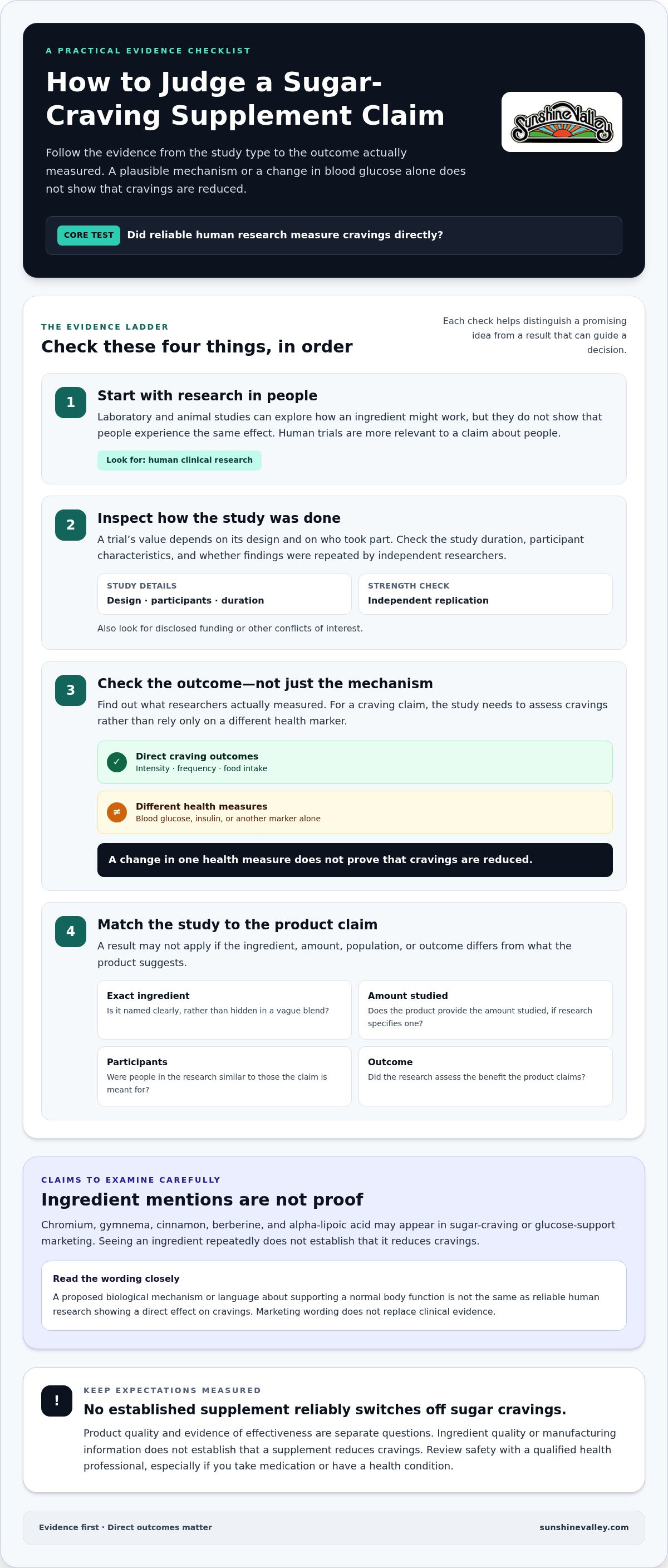
Supplement claims can sound convincing when they use scientific terms or cite a study. A practical way to assess them is to follow an evidence ladder: start with human clinical research, examine how well the study was designed, check whether it measured cravings directly, and look for independent replication. Each step helps separate a promising idea from a result that can reasonably guide a decision.
What supplement studies can, and cannot, show
Laboratory and animal studies can explore how an ingredient might work, but they don’t show that people experience the same effect. Human trials are more relevant, yet their value depends on study design, participant characteristics, duration, and whether findings have been repeated by independent researchers. Look for disclosed funding or other conflicts of interest, too. These details help you judge the strength and limits of a result.
Most importantly, check the outcome. Did researchers measure craving intensity, frequency, or food intake? Or did they measure blood glucose, insulin, or another marker? Evidence that an ingredient changes one health measure does not prove that it reduces cravings. A study about glucose may be relevant background, but it cannot answer a craving question unless cravings were assessed as an outcome.
How to read a craving-related product claim
Search results and product pages may group chromium, gymnema, cinnamon, berberine, or alpha-lipoic acid under sugar-craving or glucose-support language. Seeing an ingredient repeatedly doesn’t establish its effectiveness for cravings. Research on one outcome or population also may not apply to someone seeking help with a different outcome. Treat each ingredient claim as a question to investigate, not a conclusion.
Read the claim closely. Language about supporting a normal body function is not the same as evidence that a product treats a disease or reliably changes a symptom. In either case, marketing wording doesn’t replace clinical evidence. For broader context on the health implications of sugar intake, Harvard Health Publishing discusses sugar and health, but that information alone doesn’t establish that a supplement manages cravings.
Before giving a claim weight, check:
- Ingredient: Is the exact ingredient named, rather than a vague blend?
- Amount: Does the product provide the amount studied, if the research specifies one?
- Population and outcome: Were participants similar to the people the claim addresses, and did the trial measure cravings directly?
- Quality and replication: Was the study controlled and well described, and have independent researchers found similar results?
Testimonials, search rankings, and popularity can show what people are discussing, but they can’t establish a reliable effect. When managing sugar cravings with supplements, keep product information and evidence of outcomes separate. For ingredient and product details, Sunshine Valley’s powdered supplements include products such as Super Inositol and Super Mannitol. Their listed features don’t establish a craving benefit.
Compare Supplement Options by Purpose, Evidence, and Safety
Ingredient lists often combine supplements studied for metabolic outcomes with sweetening ingredients and products marketed for cravings. Compare each one by its intended purpose and the outcome actually studied. The table is a screening guide, not a ranking: evidence for sugar-craving relief remains insufficient to identify a supplement as a proven treatment.
| Ingredient | Claimed purpose | Evidence for cravings | Key safety question | Evidence source |
|---|---|---|---|---|
| Chromium | Often promoted for blood sugar or carbohydrate metabolism | Insufficient evidence here to conclude it reduces cravings. A glucose-related claim is not a craving result. | Could it interact with medication or be unsuitable given your health history? | NIH Office of Dietary Supplements, Chromium fact sheet |
| Cinnamon | Studied for possible effects on blood glucose and other health measures | Those outcomes don’t establish an effect on craving intensity or frequency. | Does the product contain a form or amount that raises concerns for you? | National Center for Complementary and Integrative Health, Cinnamon |
| Berberine | Marketed for metabolic health and blood glucose | Evidence for other outcomes should not be treated as proof of craving relief. | Could it interact with your medicines or be inappropriate during pregnancy? | National Center for Complementary and Integrative Health, information on berberine |
| Inositol | Studied for metabolic health, including gestational diabetes | Findings on metabolic outcomes do not show that it treats sugar cravings. | Is the ingredient and intended use suitable for your circumstances? | 2026 meta-analysis of 12 randomized trials in pregnant women, assessing gestational diabetes rather than cravings |
| Mannitol | Used as a non-nutritive sweetening ingredient | Its sweetening role is not evidence that it reduces cravings. | Could the amount cause digestive effects or be unsuitable for you? | U.S. FDA information on mannitol’s food uses and laxative warning |
Match the evidence to the outcome
Study populations and formulations matter. A result in pregnant participants, for example, can’t automatically be applied to everyone, and research on one form or amount doesn’t necessarily establish the effects of another. Before relying on a claim, check whether the research assessed cravings directly, who took part, and whether the product matches the studied ingredient. For background on product category and use, see this guide to taking inositol powder. It isn’t evidence that inositol manages cravings.
Mannitol and inositol are not interchangeable craving treatments. Mannitol is a sweetening ingredient; inositol is a supplement studied for other purposes. A product’s intended category doesn’t establish a craving benefit.
Screen for safety and suitability
Risks can depend on the ingredient, amount, health history, and combination products. If you’re pregnant, managing a health condition, or taking medication, discuss a supplement with a qualified clinician before use. Don’t change or stop prescribed treatment based on a product claim. For managing sugar cravings with supplements, evidence and personal suitability are separate questions, and both deserve careful consideration.
A Practical, Evidence-Informed Plan for Managing Sugar Cravings
A clear sequence can keep your response measured: observe first, make practical routine adjustments, then assess any supplement idea with evidence and safety in view. This approach won’t diagnose the cause of a craving or guarantee it will disappear. It can help you make thoughtful choices and recognize when a health professional’s input matters.
- Notice the pattern. For a short period, record when a craving occurs and what was happening beforehand. Include meal timing, sleep, stress, and context, such as a work break or seeing a particular food. Keep the log descriptive, not judgmental.
- Review your routine. Look for practical opportunities to eat regular, balanced meals and plan satisfying options for busy stretches. Notice whether poor sleep or a demanding day tends to coincide with cravings. Treat these as patterns to consider, not proof of a specific cause.
- Assess the claim. If considering a supplement, identify the ingredient and the benefit being claimed. Check whether human research measured cravings directly, rather than a different outcome, and whether the findings apply to the ingredient and population in question.
- Check safety before use. Consider your health history, medications, pregnancy status, and any other supplements or combination products. A qualified clinician or pharmacist can help assess whether an ingredient is suitable for you.
- Evaluate changes carefully. If you and a qualified professional decide a supplement is appropriate, keep track of what changes and when. Avoid starting several products at once, since that can make it difficult to understand what may be affecting you. Don’t stop prescribed treatment or use a supplement to self-treat a medical condition.
Track patterns before choosing a supplement
A simple log doesn’t need calorie counts or strict rules. Note the time, when you last ate, how you slept, your stress level, and what was happening around you. For example, you might notice cravings occur after a rushed lunch or during a regular evening routine. That observation isn’t a diagnosis, but recurring details can make a useful starting point for a conversation with a clinician.
Know when to seek individualized medical guidance
New, severe, persistent, or distressing symptoms merit professional assessment, especially if they occur with other health changes. Seek individualized advice before using supplements if you’re pregnant, take medication, or have a diagnosed health condition. Don’t assume cravings indicate diabetes, hypoglycemia, or a nutrient deficiency, and don’t try to manage a suspected condition with supplements alone.
If you’re comparing powdered supplements as part of your research, Sunshine Valley’s powdered supplement range includes products with clearly stated identities and attributes. Product information can help you understand what an item is; it doesn’t establish that it will change cravings. Keep the focus on evidence, suitability, and the broader pattern you’ve observed.
Choosing a Powdered Supplement With Clear Expectations
Once you’ve weighed the evidence and safety questions, product details can help you understand what a powder is and how it is presented. They answer a different question from clinical research. Purity, ingredient identity, and manufacturing information describe product attributes; they don’t demonstrate that a product changes cravings. Keeping those standards separate makes it easier to make an informed choice without reading a quality statement as a health outcome.
What product quality statements tell you
Sunshine Valley Foods is a GMP (Good Manufacturing Process) facility. Its listed powders are “100% PURE NO FILLERS NO CUTTERS,” gluten-free, non-GMO, and contain no artificial additives or preservatives. The company also states that its manufacturing processes follow top-level hygiene and high-level industry standards. These details describe manufacturing and composition; they are not evidence that a powder treats or reliably reduces sugar cravings.
That distinction is central to managing sugar cravings with supplements. A carefully described product may meet preferences for particular ingredient or manufacturing attributes, while the evidence for a specific health outcome remains a separate question. Read product information for what it states, and assess any craving-related claim against research that directly measures cravings.
Where Sunshine Valley powders fit, and where claims should stop
Sunshine Valley’s powdered supplement range includes Sunshine Valley® Super Inositol Powder Dietary Supplement and Sunshine Valley® Super Mannitol Powder Dietary Supplement. Super Mannitol is described as vegan. These details identify products and stated attributes; they don’t establish that either powder is a craving-management treatment or suitable for every person. Inositol and mannitol have different purposes and shouldn’t be treated as interchangeable simply because both are available as powders.
For ingredient-quality context, the mannitol powder quality standards guide can help explain what to consider about the ingredient itself. Quality information can support a product comparison, but it cannot substitute for clinical evidence about cravings or individualized safety advice.
Before choosing any supplement, keep three questions distinct: What is the ingredient? What product and manufacturing attributes are stated? What reliable evidence supports the outcome you want? If the evidence does not directly address cravings, treat that benefit as unestablished rather than assuming it from another use or mechanism.
Product information can help you review Sunshine Valley’s powdered range and its stated attributes. Use that information alongside evidence and, where relevant, guidance from a qualified health professional. Clear expectations support better decisions: product quality matters, but it does not promise a particular result.
Make Your Next Choice With Confidence
Your next step doesn’t need to be finding a product that promises to eliminate cravings. Instead, decide what you want from a supplement, identify what evidence would support that goal, and consider whether the ingredient is appropriate for your circumstances. If cravings persist or worry you, make professional guidance part of that decision rather than trying to solve the issue alone.
Thoughtful managing sugar cravings with supplements starts with clear expectations. A product can offer defined ingredients and quality information, while its effect on cravings remains a separate question. Keep those distinctions in view, and choose based on what is known rather than what a headline implies.
For a closer look at the brand’s powdered supplement range, explore Sunshine Valley® natural food supplements. Review the product details and choose with evidence, suitability, and realistic expectations in mind.
Frequently Asked Questions
Can supplements stop sugar cravings?
No supplement is established as a reliable way to stop sugar cravings. A product may be promoted for appetite, glucose, or metabolic support, but those claims don’t necessarily mean it has been shown to change cravings. If you’re considering a product, look for human research that measures craving outcomes and consider whether the studied ingredient and population match your situation. Don’t rely on a supplement to assess or treat an underlying health concern.
Which supplements are commonly marketed for sugar cravings?
Chromium, gymnema, cinnamon, berberine, and alpha-lipoic acid are among ingredients that may appear in products marketed for cravings or blood sugar support. Marketing categories can blur differences in purpose: an ingredient studied for a metabolic measure isn’t automatically shown to affect food cravings. Check the specific ingredient and the evidence cited for its claimed benefit, rather than relying on product popularity or a broad “sugar support” label.
Is there strong evidence that chromium reduces sugar cravings?
No, strong evidence that chromium reduces sugar cravings has not been established. Studies or claims related to glucose metabolism don’t directly answer whether people experience fewer or less intense cravings. If a product cites chromium research, check what outcome researchers actually measured and whether the study involved people similar to you. Treat a proposed benefit as uncertain unless relevant human research directly supports the craving claim.
How much supplement should I take for sugar cravings?
There isn’t an established supplement dose for treating sugar cravings. Don’t infer a dose from a study of a different ingredient form, health outcome, or participant group. If you’re considering a supplement for another intended purpose, follow the product’s directions and ask a qualified clinician or pharmacist whether it fits your circumstances. Be cautious about combining products, since ingredients can overlap and make your total intake harder to track.
Can sugar-craving supplements interact with medications?
Yes, some supplements may interact with medications, and the possibility depends on the ingredient and your individual circumstances. Before starting a product, show a clinician or pharmacist its full label, including the ingredient list and amount per serving, along with your medication list. This is especially important if you take multiple medicines or use combination supplements. Don’t stop, replace, or change a prescribed treatment based on a supplement claim.
What should I do if sugar cravings are persistent or suddenly change?
Arrange professional assessment if cravings become persistent, distressing, suddenly different, or occur alongside other new symptoms. A brief note of when the change began, recent routine changes, and any other symptoms can help you describe what’s happening. Don’t assume a sudden change means you have a particular condition, and don’t try to self-treat suspected diabetes or low blood sugar with supplements. Seek urgent care for severe or rapidly worsening symptoms.
Is mannitol or inositol a proven treatment for sugar cravings?
No, neither is established as a treatment for sugar cravings. Inositol has been studied for metabolic health, including gestational diabetes, but those findings don’t prove it reduces cravings. Mannitol is used as a non-nutritive sweetener, which is a different purpose. The FDA notes that foods with consumption that may exceed 20 grams of mannitol per day require a laxative-effect warning; this is not a supplement dose recommendation.



Leave a comment
This site is protected by hCaptcha and the hCaptcha Privacy Policy and Terms of Service apply.