




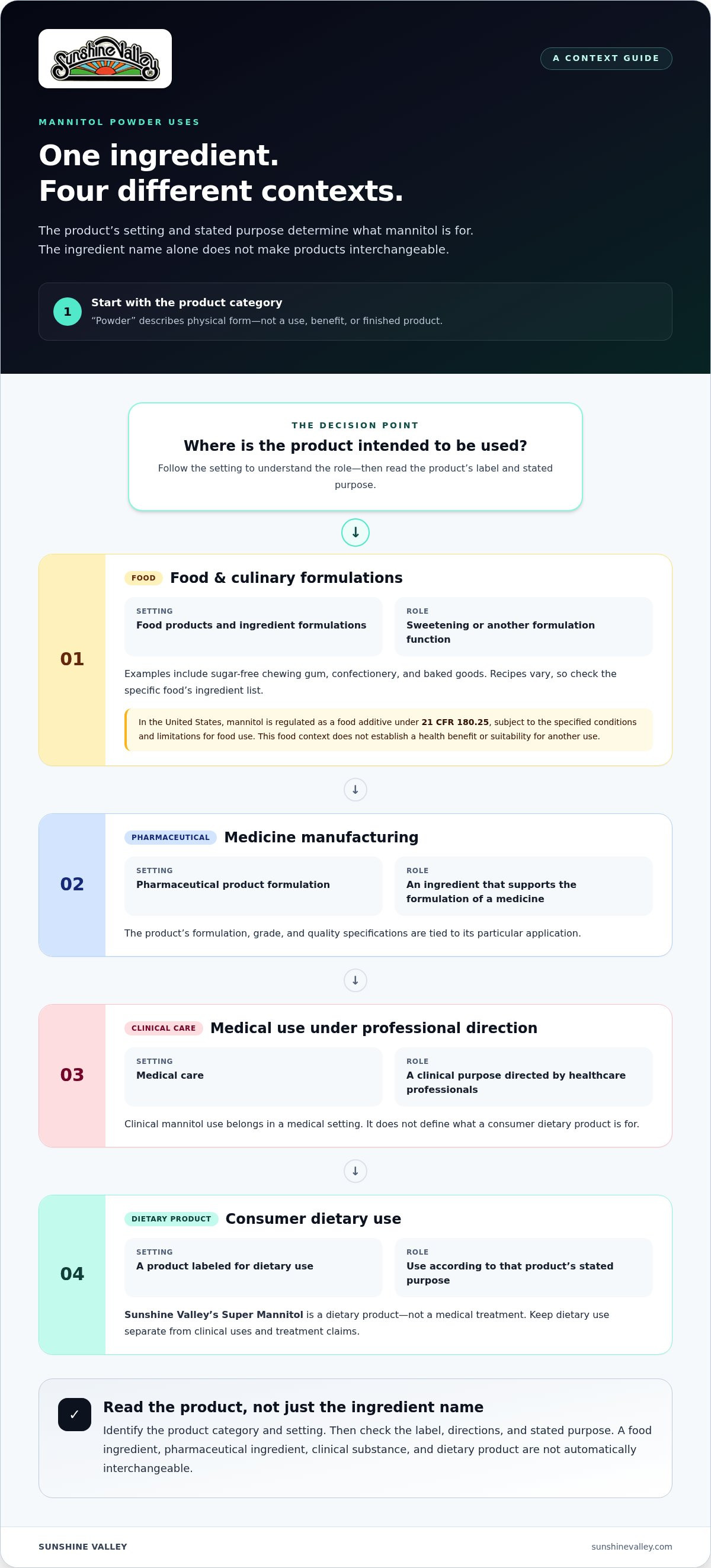
The same ingredient can serve as a sweetener in food, a formulation aid in medicine, or an ingredient in a dietary product. These mannitol powder uses may sound interchangeable, but each has a different purpose. A powder intended for one context shouldn’t automatically be used as though it belongs to another.
If you’ve seen mannitol described as a sugar substitute, supplement, or medical substance, the overlap can be confusing. The product’s intended use matters: mannitol in food or pharmaceutical formulations isn’t automatically equivalent to a dietary powder, and a dietary product isn’t a medicine or treatment.
This guide explains the main food, pharmaceutical, and dietary contexts, including why mannitol is used in each and what those uses do and don’t mean. It also explains where Sunshine Valley’s Super Mannitol fits: as a dietary product, separate from medical uses and treatment claims.
By the end, you’ll have a clearer framework for understanding mannitol powder uses and the considerations that matter before choosing a dietary product.
Key Takeaways
- Use the product’s stated purpose to interpret mannitol powder uses; food, pharmaceutical, and dietary applications have different roles.
- In food formulations, mannitol serves a technical ingredient function, not a promise of improved health.
- Clinical mannitol use belongs in a medical setting, where healthcare professionals direct its use.
- Before choosing a dietary powder, review its intended use, label clarity, and available product information. Sugar alcohols may also affect digestive tolerance.
- Sunshine Valley’s Super Mannitol is a dietary product. Keep that context separate from medical uses and treatment claims.
What Is Mannitol Powder Used For? Start With the Context
Mannitol is a sugar alcohol, a type of carbohydrate with some properties of both sugars and alcohols. It isn’t the kind of alcohol found in drinks. In powder form, it’s an ingredient, not necessarily a finished food, dietary supplement, or medicine. The mannitol powder uses you encounter depend on the product’s purpose and formulation.
Food makers may use mannitol for a sweetening or formulation role. Pharmaceutical products may include it as an ingredient that supports a medicine’s formulation, while clinical care can involve mannitol as a medical substance under professional supervision. A dietary product has its own stated purpose. The ingredient’s presence in one setting doesn’t establish a health benefit or make products interchangeable. For a broad overview of its applications, see Mannitol on Wikipedia.
The same ingredient can serve different functions because its formulation, grade, intended use, and oversight depend on the product and setting. When reading a product description, first identify the product category and its stated purpose. Don’t rely on the word “mannitol” alone to determine how a powder should be used.
| Application | Setting | Intended function |
|---|---|---|
| Food ingredient | Food and culinary formulations | Sweetening or another formulation role |
| Pharmaceutical ingredient | Medicine manufacturing | Support the formulation of a medicine |
| Clinical mannitol | Medical care | Used for a clinical purpose under medical direction |
| Dietary product | Consumer dietary use | Use according to the product’s stated purpose |
What does mannitol powder mean?
“Powder” describes physical form, not a use or benefit. Mannitol powder can be supplied as an ingredient for a particular formulation, but it isn’t automatically a ready-to-eat food, a finished supplement, or a medicine. These are different product categories with different purposes. Read the product identity, label, and intended-use information rather than treating the ingredient name as a complete description.
Why does mannitol appear in different settings?
Formulation is the key. A food developer, pharmaceutical manufacturer, and healthcare professional work toward different goals and within different requirements. The relevant grade, quality specifications, and oversight can therefore vary. A powder intended for dietary use shouldn’t be assumed suitable for a medical or manufacturing application. The same principle applies in reverse: a clinical use doesn’t define what a consumer dietary product is for.
Quality specifications are tied to the needs of a particular application. When comparing products, look for a clear product type and stated purpose, then consider what the available product information actually says. This makes it easier to distinguish an ingredient’s technical role from claims about health.
Sunshine Valley’s Super Mannitol is offered as a dietary product, not as a medical treatment. The next sections explain food and pharmaceutical applications separately, then outline what to review before choosing a dietary powder.
How Mannitol Is Used in Food and Culinary Formulations
In food, mannitol’s role is a formulation choice. It can be used as a sweetening ingredient, including in products developed as lower-calorie or sugar-free alternatives. The purpose is to contribute a particular functional quality to the food, not to provide a therapeutic effect or guarantee a health outcome.
Examples of food uses include sugar-free chewing gum, confectionery, and baked goods. That doesn’t mean every product in those categories contains mannitol. Recipes and ingredient lists vary, so check the label of a particular food to see whether it includes the ingredient.
What role can mannitol play in food?
Food manufacturers select ingredients according to how they perform in a specific formulation. Mannitol may contribute sweetness and can be used as a sugar substitute in certain foods. Its function is technical: it helps meet a formulation goal. It doesn’t, by itself, make a food nutritious, improve health, or act as a treatment.
In the United States, the FDA regulates mannitol as a food additive under 21 CFR 180.25, subject to the conditions and limitations specified for food use. That regulatory context applies to its use as a food ingredient. It shouldn’t be read as a blanket endorsement of every mannitol product, every amount, or any use outside food formulations. For regulatory details, refer to current FDA materials.
For consumers, the practical takeaway is to separate a formulation function from a nutrition claim. A food may use mannitol to achieve a particular sweetness or product design, but that fact alone doesn’t establish a health benefit. Nor does it establish that a separate powder is suitable for cooking or another purpose.
How is food use different from dietary use?
The product’s intended use matters. A food containing mannitol is a finished food, formulated and labeled for eating as that product. A dietary powder is a separate product category with its own labeling and stated purpose. Seeing the same ingredient name in both places doesn’t make the products interchangeable or show that a food-use ingredient is appropriate as a dietary product.
Check the ingredient list, directions, and product labeling. Identify whether you’re looking at a ready-to-eat food, an ingredient intended for food formulation, or a dietary product. Don’t infer a recommended use from the word “mannitol” alone. Although mannitol may occur in foods, that doesn’t establish how any individual will tolerate a particular product or amount.
If your interest is dietary use rather than culinary formulation, Sunshine Valley’s Super Mannitol powder is offered as a dietary product. Interpret its product information in that context, separately from mannitol used as a food ingredient.
Mannitol in Medicines and Clinical Care Is a Separate Use
Mannitol also has clinical applications, but these belong to medical care, not casual dietary use. In a clinical setting, a healthcare professional determines whether a medical product is appropriate and directs its use. That is fundamentally different from choosing a consumer dietary powder. A shared ingredient name doesn’t make the formulations, purposes, or levels of oversight equivalent.
| Setting | Product context | Who directs its use |
|---|---|---|
| Clinical care | A medical formulation used for a clinical purpose | Healthcare professionals |
| Dietary use | A consumer product labeled for dietary use | The consumer follows the product’s labeling and directions |
| Food formulation | An ingredient included in a finished food | Food manufacturers determine its role in the formulation |
What is the difference between medical and dietary mannitol?
Medical mannitol is used within a clinical plan and under professional supervision. Its formulation and route of administration are selected for that medical context. A dietary powder, by contrast, is a consumer product with its own stated purpose and labeling. It shouldn’t be treated as a substitute for a medical formulation or used to reproduce a clinical application.
This distinction matters even when two products share an ingredient name. Their form, formulation, intended use, and oversight can differ. The table summarizes those differences without suggesting that a dietary product has the same role or effect as mannitol used in medical care.
Why should medical claims not be transferred to supplements?
Evidence and claims apply to the product and setting being studied. A clinical use describes a specific medical application; it doesn’t show that a dietary powder produces the same effect or offers a general wellness benefit. The formulation, conditions of use, and professional oversight may all differ.
Context determines what a mannitol use claim means: a clinical application does not establish a benefit for a dietary product. When reading descriptions that place food, supplements, and medicine side by side, ask what kind of product is being discussed, what purpose is stated, and whether the claim refers to clinical care or consumer use. Don’t infer treatment value from a reference to medical applications.
For the same reason, the phrase mannitol powder uses needs context. It may refer to an ingredient in a formulation, a dietary product, or a medical application. Those categories shouldn’t be collapsed into one recommendation. Sunshine Valley’s Super Mannitol is a dietary product, not a medical treatment, and should be understood within that consumer context.
What to Consider Before Choosing Mannitol Powder for Dietary Use
A careful review starts with purpose, not promises. Before choosing a dietary powder, establish what the product is intended for and whether its label provides enough information to understand that use. The phrase mannitol powder uses can refer to different settings, so a product’s name alone isn’t a substitute for clear labeling.
- Confirm the intended use. Distinguish a dietary product from a food ingredient or a medical formulation.
- Read the ingredient and directions. Check that the stated ingredient and product purpose are clear, and follow the product’s own label.
- Review source information. Look for specific information about the product and its manufacturer rather than relying on broad claims.
- Separate quality language from health evidence. Terms about purity or manufacturing describe product attributes only when supported by details. They don’t establish a clinical benefit.
- Notice cautions and storage details. Read all label instructions, warnings, and handling information before deciding whether the product fits your needs.
How should readers interpret a mannitol powder label?
Start with the product identity: what ingredient is named, what type of product is it, and what use does the label state? Then assess claims individually. A statement about manufacturing or purity isn’t the same as evidence that a product delivers a health outcome. Don’t infer a certification, grade, or specification unless the label states it clearly and provides supporting information.
For a deeper look at how intended application affects product specifications, consult the article on mannitol quality standards. Different contexts can call for different quality criteria, so a reassuring-sounding claim still needs to be understood in relation to the product’s stated use.
What tolerance and safety points deserve attention?
Mannitol is a sugar alcohol, and sugar alcohols can affect digestive tolerance. Individual responses vary. The fact that an ingredient appears in food doesn’t guarantee that every person will tolerate a separate dietary product in the same way. Read the product directions and cautions, and don’t assume that a familiar ingredient is automatically suitable for every person or situation.
If you have a health condition, take medication, or have a specific dietary concern, discuss the product with a qualified healthcare professional. This can help when you’re uncertain whether a dietary product fits alongside existing care. Don’t use a dietary powder to self-treat a condition, change prescribed care, or reproduce a clinical use of mannitol.
Use the label and available product information to make a measured decision. Sunshine Valley offers Super Mannitol as a dietary product, not as a medical treatment. To review this dietary option, explore Super Mannitol in its stated product context.
Super Mannitol by Sunshine Valley: A Dietary Product, Not a Medical Treatment
Sunshine Valley’s Super Mannitol is a mannitol powder in the company’s powdered supplement range. It is a dietary product, not a prescription medicine or hospital-administered product. Its availability as a dietary product doesn’t imply that it treats a condition or reproduces a clinical application.
Interpret the product according to its stated dietary purpose, without transferring claims or expectations from food formulation or medical care. The wider range of mannitol powder uses describes different applications, not a single product that suits every context.
Where does Super Mannitol fit among mannitol uses?
Super Mannitol belongs in the consumer dietary-product category. That context matters when deciding whether the product aligns with your intended use. Read its product information as dietary-product information, not as evidence of a medical benefit. Clinical use involves a separate setting and professional oversight, and it shouldn’t be treated as a guide to using a dietary powder.
Before deciding, consider the questions raised in the previous section: Is the intended use clear? Does the information describe the product itself, or make a broader health claim? If your interest is connected to a health condition, medication, or treatment decision, discuss it with a qualified healthcare professional rather than using a supplement to replace medical care.
What can readers explore next?
Product information can clarify how a dietary product is presented and what its label states. Review those details in light of your intended use. Avoid assuming specifications, certifications, dosage, or outcomes that aren’t stated in the published information. A measured decision rests on clear product context, not on the fact that the same ingredient appears in food or clinical settings.
Sunshine Valley was founded in 1956 and emphasizes premium-quality ingredients, controlled manufacturing, and strict hygiene standards. These are company-level commitments, not product-specific specifications or proof of a health outcome. Readers interested in the company’s approach can also explore its information about hygienic supplement manufacturing.
If Super Mannitol fits the dietary context you’re considering, review the product information and compare it with your needs before deciding. Keep the distinction clear: a dietary powder is not a medical treatment, and product interest should begin with its stated purpose.
Make Your Next Step an Informed One
Before choosing any dietary product, consider the purpose you have in mind. The phrase mannitol powder uses can point to very different applications, so let the product’s stated context guide your decision rather than assumptions based on the ingredient name. If your question relates to a medical condition, medication, or treatment, bring it to a qualified healthcare professional.
For dietary interest, review the product information and consider whether it aligns with your intended use. Sunshine Valley’s Super Mannitol is a dietary product. Its details can help you make a considered choice without treating a powder as medicine or expecting unsupported outcomes.
Explore Super Mannitol and review its product information at your own pace. A clear understanding of purpose is a sound place to begin.
Frequently Asked Questions
What is mannitol powder commonly used for?
Mannitol powder is used in different ways depending on the product and setting. Food manufacturers may use it as a sweetening ingredient, pharmaceutical makers may include it in formulations, and clinical care has separate medical applications. The label helps identify which context applies. For example, seeing mannitol listed in a food’s ingredients doesn’t tell you the purpose or directions for a separate powder.
Is mannitol powder a sugar substitute?
Yes, mannitol can be used as a sugar substitute in some food formulations. That doesn’t mean every mannitol powder is intended for cooking or that all foods marketed as sugar-free contain it. Check the ingredient list of a finished food to see whether mannitol is present. For a separate powder, follow its stated product purpose rather than assuming it’s a culinary ingredient.
Can mannitol powder be used as a dietary supplement?
Some products, including Sunshine Valley’s Super Mannitol, are offered in a dietary-product context. Whether a powder suits your needs depends on its label and intended use, not simply on the ingredient name. Review the product information before making a decision. Don’t treat dietary mannitol as a medicine, use it to manage a health condition, or assume it provides a particular wellness effect.
What happens if mannitol causes digestive discomfort?
Digestive responses to sugar alcohols can vary, and discomfort is a reason to pause and reassess use. Follow the product’s labeling, and don’t increase use in an effort to push through symptoms. If discomfort is severe, persistent, or concerning, seek advice from a qualified healthcare professional. They can consider your symptoms and circumstances rather than relying on general information about the ingredient.
Is medical mannitol the same as mannitol powder sold for dietary use?
No. A medical formulation is used in a clinical context under professional direction, while a dietary powder is a consumer product with its own stated purpose. Their formulation, directions, and oversight may differ. Never substitute a dietary powder for a medical product or try to use it for a clinical purpose. A shared ingredient name doesn’t establish that two products are interchangeable.
How should I store mannitol powder?
Follow the storage instructions printed on the specific product’s label, since directions can vary by formulation and packaging. As a general handling practice, keep the container properly closed and protect the powder from moisture and contamination. Don’t use it if the packaging or product appears damaged or its condition has changed unexpectedly. If the label gives specific storage directions, those take priority.
Does mannitol powder have a proven wellness benefit?
The fact that mannitol has food or medical applications doesn’t prove that a dietary powder delivers a general wellness benefit. Claims need to apply to the particular product and use being discussed. Read any stated benefit carefully and distinguish product information from evidence of a health outcome. If you’re considering mannitol for a health concern, discuss that concern with a qualified healthcare professional.

Leave a comment
This site is protected by hCaptcha and the hCaptcha Privacy Policy and Terms of Service apply.