




Can a supplement meaningfully ease joint pain without treating the underlying arthritis? Interest in msm for joint pain and arthritis relief is understandable, especially when claims sound more certain than the research. Studies suggest MSM may modestly improve pain or function for some people with osteoarthritis, particularly in the knee. The evidence has limits, and results aren’t guaranteed.
If you’re weighing MSM, you need more than testimonials. Consider what clinical studies measured, who took part, and what remains uncertain. This guide separates potential symptom benefits from unproven claims so you can consider MSM alongside established joint-health approaches, not as a replacement for appropriate care.
We’ll review the research, compare MSM with other options, and cover reported side effects and questions to raise with a qualified healthcare professional. You’ll also find practical points to check on a supplement label before deciding whether MSM belongs in your routine.
Key Takeaways
- Separate MSM’s role as a dietary supplement ingredient from arthritis medicines. Joint pain can have different causes.
- When assessing msm for joint pain and arthritis relief, look at who was studied, which outcomes were measured, and where the evidence remains limited.
- Compare supplements with clinician-guided care and other joint-health strategies without assuming combination products work better for everyone.
- Before trying MSM, clarify your diagnosis, review medicines and health conditions with a qualified clinician, and check the product label carefully.
- Sunshine Valley Super MSM is a powdered dietary supplement. Check its current label details without treating it as an arthritis treatment.
MSM for Joint Pain and Arthritis: What It Is and Isn't
Methylsulfonylmethane, commonly shortened to MSM, is a sulfur-containing compound sold as a dietary supplement. For a general overview of its chemical properties and reported uses, see Methylsulfonylmethane (MSM). MSM products may be marketed for joint comfort, but that does not make them arthritis medicines or show that they change the course of joint disease.
MSM is a dietary supplement that may be studied for possible support of joint comfort. It is not a proven arthritis treatment or a substitute for care recommended by a clinician. This distinction matters when evaluating claims about msm for joint pain and arthritis relief. A proposed biological explanation is not the same as dependable pain relief demonstrated in people. Research findings also can’t predict whether a particular person will respond.
What is MSM, and why is it discussed for joint comfort?
Researchers have explored whether MSM may influence processes related to inflammation and oxidative stress. These are proposed explanations, not established effects in people with joint pain. Even if a mechanism appears plausible in laboratory research, it doesn’t prove that taking MSM will reduce symptoms or protect a joint. Those questions depend on human evidence, including who participated, what MSM was compared with, and which outcomes researchers measured.
Does joint pain always mean arthritis?
No. Joint pain is a symptom, not a diagnosis. It can be associated with arthritis, but it can also follow injury or overuse, or involve nearby tissues. Arthritis itself includes different conditions. Osteoarthritis involves changes to joint structures over time, while rheumatoid arthritis is an autoimmune condition in which the immune system affects the joints. These conditions aren’t interchangeable, and findings for one shouldn’t automatically be applied to another.
A clinician can assess symptoms and determine whether further evaluation is needed. Consider seeking medical advice if pain persists, worsens, limits daily activity, or comes with other concerning symptoms. Knowing the likely cause helps you weigh options and reduces the risk of relying on a supplement when another form of care may be needed. Consider MSM evidence within that broader picture, not as a reason to self-diagnose or delay assessment.
What Research Says About MSM for Arthritis and Joint Pain
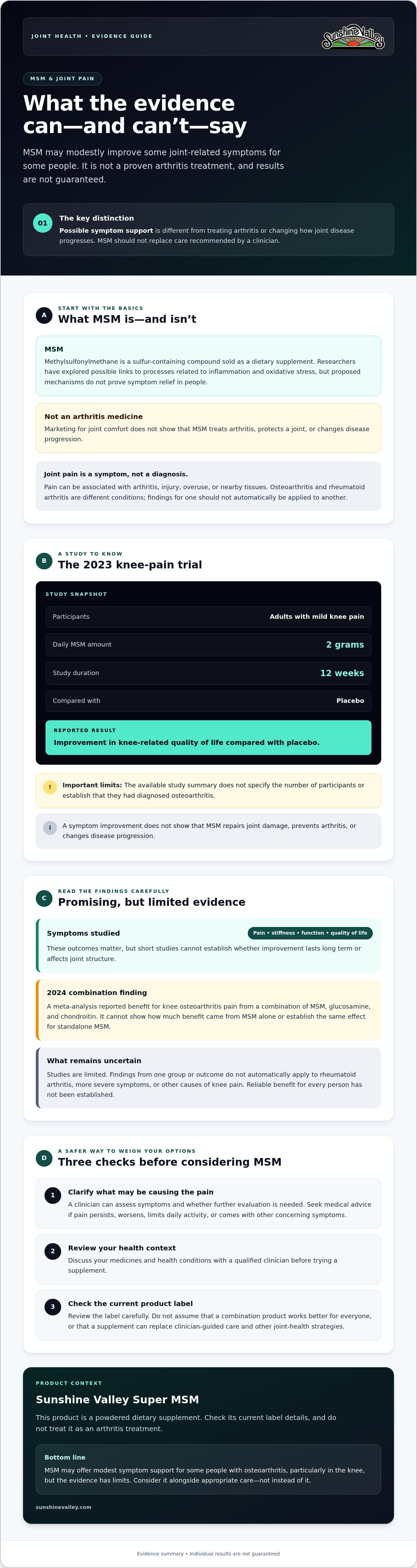
Research on MSM has examined possible changes in symptoms, not whether the supplement prevents arthritis or repairs joint damage. A 2023 randomized, double-blind, placebo-controlled trial studied adults with mild knee pain who took 2 grams of MSM daily for 12 weeks. Researchers reported improvement in knee-related quality of life compared with placebo. The available study summary doesn’t specify the number of participants or establish that they had diagnosed osteoarthritis, so the result shouldn’t be generalized to all arthritis or joint pain.
What have clinical studies measured?
Studies may assess pain, stiffness, physical function, or quality of life. These outcomes matter to people living with symptoms, but a change in a symptom score is not evidence that a supplement changes the underlying disease. Short trials also can’t establish whether any improvement lasts over the long term or whether MSM affects joint structure or arthritis progression.
The National Center for Complementary and Integrative Health provides an overview of the research on MSM for osteoarthritis. Its summary offers useful context: studies are limited, and small or short investigations can’t establish a reliable benefit for every person.
How strong and consistent is the evidence?
The placebo-controlled design of the 2023 trial helps distinguish reported changes from expectations, but one study is not enough to establish consistent effectiveness. Its findings apply to the group and outcome studied, not automatically to people with rheumatoid arthritis, more severe symptoms, or other causes of knee pain.
A 2024 meta-analysis reported benefit from a combination of MSM, glucosamine, and chondroitin for knee osteoarthritis pain. That result concerns the combination and can’t show how much benefit came from MSM alone. It also doesn’t establish that the same effect would occur with a standalone MSM supplement.
Evidence summary: MSM has shown promising but limited results for certain joint-related symptoms. It hasn’t been shown to reliably relieve pain for everyone or to alter arthritis progression. That distinction is central to evaluating claims about msm for joint pain and arthritis relief. If you’re reviewing a specific product after considering the evidence, you can learn about Sunshine Valley’s Super MSM, then check its current label and discuss use with a qualified healthcare professional.
MSM Compared With Other Joint-Pain Options
Supplements aren’t interchangeable, and popularity doesn’t establish effectiveness. For knee osteoarthritis, a 2024 meta-analysis reported that a combination of MSM, glucosamine, and chondroitin reduced pain. A combination result can’t show that each ingredient works equally well alone or that the finding applies to other causes of joint pain. The Arthritis Foundation’s guide to supplements for arthritis offers additional context for discussing these products.
How does MSM compare with other supplements?
Compare the condition studied, the outcomes measured, and whether an ingredient was tested alone or in a combination. The evidence doesn’t establish a universal winner. For a product-focused overview, Sunshine Valley’s article Premium MSM Powder: The Ultimate Guide to Purity and Wellness (2026) may provide background, but product information isn’t proof of clinical benefit.
| Option | Intended role | Evidence and limitations | Discuss with a clinician |
|---|---|---|---|
| MSM | Supplement studied for joint symptoms | Some human research reports symptom-related benefits; evidence is limited and doesn’t establish disease modification. | Whether it fits your diagnosis, medicines, and health history. |
| Glucosamine or chondroitin | Supplements studied for osteoarthritis symptoms | Findings vary by study and formulation. Combination evidence can’t establish the effect of either ingredient alone. | What evidence applies to your condition and the specific product. |
| Movement or physical therapy | Support mobility and function | These are care strategies, not supplements; an appropriate plan depends on symptoms and individual ability. | Which activities or professional support are suitable for you. |
| Medication or other treatment | Manage a diagnosed condition or symptoms | Options and risks depend on the diagnosis and personal circumstances. | Expected benefits, risks, and how treatment will be monitored. |
How does supplement use fit with arthritis care?
MSM shouldn’t replace prescribed treatment or a professional assessment. If you’re considering msm for joint pain and arthritis relief, identify the outcome you want to discuss, such as pain during a daily activity or improved function, and ask how to assess progress. Discuss movement, physical therapy, medication, and any supplement with a qualified clinician. Your diagnosis, preferences, and health history all matter.
How to Evaluate MSM Safely Before Trying It
A careful decision starts with your health, not a product claim. Before considering msm for joint pain and arthritis relief, clarify what may be causing your symptoms, review your current care plan, and ask a qualified healthcare professional whether MSM is appropriate for you. This is especially important if you have a health condition or take prescription medicines or other supplements.
What should you ask a healthcare professional?
Bring a complete list of medicines and supplements, and mention allergies and relevant health conditions. Ask whether MSM is suitable alongside your diagnosis and treatment, what unwanted effects to watch for, and when to stop use and seek advice. You can also agree on a specific outcome to monitor, such as whether a usual daily activity becomes easier. Don’t stop or change prescribed treatment to try a supplement without professional guidance.
There isn’t a dose recommendation here. Study amounts aren’t automatically appropriate for an individual or a particular product. If a clinician agrees that trying MSM is reasonable, follow the directions and warnings on the current product label, and ask your clinician or pharmacist about anything unclear.
How can you assess a supplement label?
Read the full label before use. Check that it identifies the ingredient, provides serving directions and warnings, and lists manufacturer contact details. Compare those details with your clinician’s guidance, and don’t assume that label wording or marketing claims establish a product’s suitability for your circumstances.
Quality claims deserve scrutiny. Look for accessible documentation that explains what was assessed, by whom, and for which product. If a company names a certification or testing program, confirm the claim with the relevant organization or documentation. Evidence of manufacturing controls or product quality does not demonstrate that MSM relieves pain or treats arthritis.
Sunshine Valley offers Super MSM as a powdered dietary supplement and describes its manufacturing as in-house, with strict hygiene standards. Product-specific dosage, formulation, certification, and clinical outcome details haven’t been provided here, so check the current label and available documentation rather than inferring them. Sunshine Valley’s article titled Hygienic Supplement Manufacturing: The Clinical Standard for Pure Wellness may offer further manufacturing background, but manufacturing information isn’t proof of a health effect.
After discussing suitability with a qualified professional, review Sunshine Valley’s Super MSM and assess its current label details before making a decision.
Considering Sunshine Valley Super MSM: A Careful Next Step
After reviewing the evidence and discussing supplement use with a qualified healthcare professional, you may want to assess a specific product. Sunshine Valley Super MSM is a powdered dietary supplement. It isn’t an arthritis treatment, and choosing it shouldn’t substitute for diagnosis, prescribed care, or a clinician’s advice. Evaluate claims about msm for joint pain and arthritis relief separately from the details on any product label.
What can readers verify before choosing Super MSM?
Check the current product label and any available supporting documentation before deciding. Confirm the ingredient identity, serving directions, warnings, and manufacturer contact details. If any information is unclear or doesn’t align with your clinician’s advice, ask for clarification before use. Don’t infer a dose, purity level, certification, or testing process from general product descriptions.
Sunshine Valley says it uses premium ingredients, manufactures in-house, and follows strict hygiene standards. The company has operated since 1956. These are brand and manufacturing details, not clinical evidence that MSM relieves joint pain or treats arthritis. Quality documentation may help explain how a product is made or assessed, but it can’t establish that it will improve symptoms or suit your health needs.
What is a sensible next step?
Compare the product information with your clinician’s guidance and your circumstances, including your diagnosis, current medicines, and care plan. If symptoms remain unexplained, worsen, or raise questions about treatment, prioritize medical advice rather than relying on a supplement. A qualified healthcare professional can help interpret the label, discuss whether trying MSM is appropriate, and advise what changes or unwanted effects to monitor.
A measured decision doesn’t require a promise of relief. It means understanding what’s known about the supplement, what the available product information confirms, and what remains uncertain. To review Sunshine Valley’s offerings and available product details, visit the Sunshine Valley website. Consider that information alongside professional guidance, without assuming a particular result.
Make Your Next Joint-Health Decision with Care
Research suggests MSM may help some people with certain joint symptoms, but the evidence is limited. It doesn’t establish reliable relief for everyone or show that MSM changes arthritis progression. Supplements also aren’t interchangeable with clinician-guided care, movement, or other approaches.
If you’re considering msm for joint pain and arthritis relief, first discuss your diagnosis, medicines, and health needs with a qualified healthcare professional. Then review the current product label and any available documentation. These steps help you assess a supplement without assuming its claims guarantee an outcome.
Sunshine Valley, founded in 1956, lists Super MSM as a powdered dietary supplement. The company emphasizes premium ingredients and strict hygiene standards, but these details aren’t proof of arthritis treatment or symptom relief. For product information, review Sunshine Valley’s supplement offerings.
A well-informed choice starts with clear evidence, careful questions, and advice suited to you. Take the time to choose a next step that supports your health with confidence.
Frequently Asked Questions
Can MSM help with arthritis pain?
MSM may ease some joint symptoms for some people, but reliable relief hasn’t been established. Studies, including research involving people with knee symptoms, have reported potential improvements in measures such as pain or function. The findings are limited and don’t guarantee an individual response. Evidence about msm for joint pain and arthritis relief also doesn’t show that MSM prevents arthritis or changes its progression.
Is MSM proven to treat osteoarthritis?
No. Some studies suggest MSM may modestly improve osteoarthritis symptoms, particularly in the knee, but that isn’t proof that it treats the disease itself. Symptom measures, such as pain or function, don’t show that MSM repairs cartilage or changes joint structure. The evidence remains limited, so MSM shouldn’t replace an assessment or treatment plan from a qualified healthcare professional.
How long does MSM take to work for joint pain?
There’s no established timeframe for MSM to relieve joint pain, and some people may not notice a benefit. A 2023 placebo-controlled study examined daily use over 12 weeks in adults with mild knee pain, but the study duration doesn’t prove when an effect begins or how long it lasts. Ask a qualified clinician whether and how to monitor symptoms if you’re considering a trial.
Is MSM safe to take with arthritis medication?
Ask a qualified healthcare professional or pharmacist before combining MSM with arthritis medication. Safety and interaction information may not cover every medicine, health condition, or supplement combination. Share a complete list of what you take, including nonprescription products, and review the product label’s warnings. Mild digestive upset has been reported in some studies. Seek professional advice if you notice an unwanted effect.
Can MSM replace prescribed arthritis treatment?
No. MSM is a dietary supplement, not a substitute for prescribed arthritis treatment, diagnosis, or medical follow-up. Don’t stop or change a prescribed medicine because you’re considering MSM. Ask your healthcare professional how any supplement would fit with your care plan and what symptoms or functional changes to track. If treatment isn’t helping or symptoms worsen, discuss that directly with your clinician.
What should I look for in an MSM supplement?
Check that the label clearly identifies MSM and provides serving directions, warnings, and manufacturer contact details. Review available quality documentation, and verify any claimed certification with the organization named. Quality or manufacturing information doesn’t prove clinical benefit. Sunshine Valley offers Super MSM as a powdered dietary supplement, but check its current label and documentation for product-specific details rather than assuming a dose, certification, or effect.
Can MSM help rheumatoid arthritis?
There isn’t enough evidence to conclude that MSM helps rheumatoid arthritis. Findings from studies involving knee pain or osteoarthritis can’t be assumed to apply to rheumatoid arthritis, which is a distinct condition. MSM shouldn’t replace disease-specific care or prescribed medication. If you have rheumatoid arthritis and are considering a supplement, discuss it with your healthcare professional, including possible risks alongside your medicines and current treatment plan.



Leave a comment
This site is protected by hCaptcha and the hCaptcha Privacy Policy and Terms of Service apply.