




What if the apparent “egg quality” benefit of inositol applies mainly to a specific fertility context? Claims about inositol benefits for egg quality often draw on research in people with PCOS, but those findings don’t automatically apply to everyone. And improvements in ovulation or embryo measures aren’t, by themselves, proof that an egg’s underlying quality has improved.
If you’re weighing conflicting supplement claims, that distinction matters. Egg quality isn’t captured by one simple test. Fertility specialists may consider indicators such as egg maturity and embryo development during treatment. Each offers useful information, but none makes every outcome interchangeable.
This article explains what the evidence does and doesn’t show, including how findings for PCOS differ from the limited evidence for people with regular cycles and no known insulin resistance. You’ll also learn how claims about myo-inositol and D-chiro-inositol compare, why popular ratios don’t guarantee results, and what to discuss with a clinician before starting a supplement.
Key Takeaways
- Learn why “egg quality” can’t be reduced to one routine test, and how it differs from other fertility outcomes.
- Understand what research on inositol benefits for egg quality can and can’t tell you about different fertility situations.
- Compare myo-inositol, D-chiro-inositol, and combination products by the details that matter, not by marketing claims.
- Use a focused discussion framework to assess whether the available evidence fits your diagnosis, treatment plan, and health history.
- Assess ingredient identity and label information separately from claims about clinical results when evaluating a supplement.
Inositol Benefits for Egg Quality: What Does the Evidence Actually Measure?
Claims about inositol benefits for egg quality can blur several distinct fertility outcomes. A study may report changes in ovulation, hormone or metabolic markers, or IVF laboratory measures. These findings can be relevant, but they don’t all measure the same thing. A change in one outcome doesn’t automatically prove that an egg’s biological competence improved.
For a foundational overview of the compound and its different forms, see Inositol. That background is separate from clinical evidence about fertility outcomes.
For additional context, watch this video from the Center for Human Reproduction:
What does egg quality mean in fertility care?
Egg quality refers to an oocyte’s capacity to mature and support fertilization and early embryo development. It is not the same as ovarian reserve, which concerns the estimated quantity of eggs remaining. Nor is it interchangeable with egg count, ovulation, fertilization, or pregnancy. These are related steps or indicators, not synonyms.
There’s no single routine test that directly and comprehensively measures the quality of every egg. Fertility teams interpret available findings in context, including age, diagnosis, and treatment circumstances. A test or IVF laboratory observation may provide part of the picture, but it can’t offer a complete personal assessment on its own.
What outcomes have inositol studies examined?
Research in people with PCOS has examined outcomes such as insulin-related and hormonal markers, menstrual regularity, and ovulation. These findings may matter for reproductive health, but they are not direct measurements of oocyte competence. For example, improved cycle regularity doesn’t by itself establish improved egg quality or a higher chance of pregnancy.
Some research has also assessed IVF outcomes. A 2025 systematic review and meta-analysis in women with PCOS undergoing IVF reported possible improvements in mature-oocyte rate and embryo quality with myo-inositol pretreatment. These are more direct treatment-related measures, but they still don’t establish that inositol improves egg quality in every population or increases pregnancy rates in all settings. The study population, treatment protocol, and outcome selected all matter.
The central distinction is simple: evidence for a related reproductive outcome is not automatically evidence of better egg quality. When reviewing a claim, check what researchers measured, who took part, and under what conditions.
How Might Inositol Relate to Reproductive Health, Especially with PCOS?
Inositol is involved in cell-signaling processes, including pathways that help cells respond to insulin. Researchers study whether supplemental inositol may influence these processes in PCOS, a condition that can involve irregular ovulation and insulin resistance. This provides a biological reason to investigate inositol, not proof that supplementation improves egg quality.
Why does PCOS appear so often in inositol research?
PCOS is associated with a range of reproductive and metabolic features, and insulin resistance occurs in some people with the condition. When insulin signaling is disrupted, it may interact with hormone regulation and ovulatory function. That makes PCOS a central focus of inositol research, but the condition varies. Findings in one group don’t necessarily apply to every person with PCOS.
Human studies have examined outcomes such as metabolic and hormonal markers, menstrual regularity, and ovulation. These can be clinically relevant, yet a change in one doesn’t establish that oocytes are more competent or that pregnancy is more likely. To judge evidence for inositol benefits for egg quality, consider both the population studied and the specific outcome measured.
Evidence summary: In people with PCOS, research suggests possible effects on metabolic and ovulatory outcomes. It doesn’t establish a universal egg-quality benefit or show that the findings apply to people without PCOS. The Society of Obstetricians and Gynaecologists of Canada’s 2025 position statement also found insufficient evidence to recommend specific inositol preparations or dosing for PCOS.
Myo-inositol and D-chiro-inositol: what is known?
Myo-inositol and D-chiro-inositol are distinct forms of inositol. Both are studied in metabolic and reproductive contexts because inositol-related compounds participate in cell signaling. A review available through the National Center for Biotechnology Information discusses myo-inositol’s proposed reproductive roles, including follicle development. These mechanisms help frame research questions, but they aren’t evidence that every form or combination produces a clinical benefit.
Studies vary in participant diagnosis, formulation, and measured outcome. Some focus on metabolic markers or cycles, while others investigate fertility treatment measures. Results from one formulation or PCOS group shouldn’t be treated as proof for a different product, population, or outcome. The linked review of myo-inositol as a potential supporter of fertility provides background, but a review isn’t a personalized treatment recommendation.
There’s no universally established ratio or regimen that applies to everyone. If you’re considering Sunshine Valley’s Super Inositol, check the current label and ingredient information, then discuss whether the available evidence fits your diagnosis and care plan with your clinician.
Myo-Inositol, D-Chiro-Inositol, and Other Fertility Claims: How to Compare Them
Comparing inositol products by headline ratio alone can hide important differences. Ask who was studied, which form and formulation participants received, and what outcome researchers measured. This matters because research on a supplement in people with PCOS doesn’t automatically show the same effect in people without PCOS or with another fertility diagnosis.
| Form | Study context and outcomes | Evidence limits to check |
|---|---|---|
| Myo-inositol | Frequently studied in people with PCOS, including research on metabolic markers, menstrual cycles, ovulation, and some IVF outcomes. | Results depend on the participants and outcome. Changes in cycles or metabolic markers don’t alone demonstrate improved egg quality. |
| D-chiro-inositol | Studied in metabolic and reproductive contexts, both alone and alongside myo-inositol. | Evidence can’t be assumed to match myo-inositol research. Check the dose, population, and outcome in each study. |
| Combination products | Some studies examine products containing both forms, including research in PCOS and fertility treatment. | Different ratios and study designs make comparisons difficult. A result from one combination doesn’t establish that it’s best for everyone. |
Does a combined inositol formula have better evidence?
Not automatically. A combination may be compared with another formulation in a direct trial, or it may be studied in a separate group under different conditions. Those designs don’t answer the same question. Before applying a result, check whether participants had PCOS, what the product contained, how outcomes were assessed, and whether researchers directly compared formulas. A commonly marketed ratio isn’t proof of a universal preference. Current guidance remains cautious about recommending a specific preparation for PCOS.
That distinction is central to claims about inositol benefits for egg quality. A study reporting ovulation or cycle changes addresses a different outcome from one measuring mature oocytes during IVF. Neither should be presented as a guaranteed effect on egg quality or pregnancy.
How do supplement claims differ from fertility-treatment evidence?
A supplement study doesn’t establish equivalence to fertility assessment or clinician-directed treatment. Supplements shouldn’t replace evaluation or prescribed care. Ask your clinician how a study’s population and measured outcome relate to your diagnosis, age, and treatment plan. For separate information about use and dosage context, see this guide to how to take inositol powder. Follow product-label information and discuss supplement use with your care team, particularly if you’re undergoing fertility treatment.
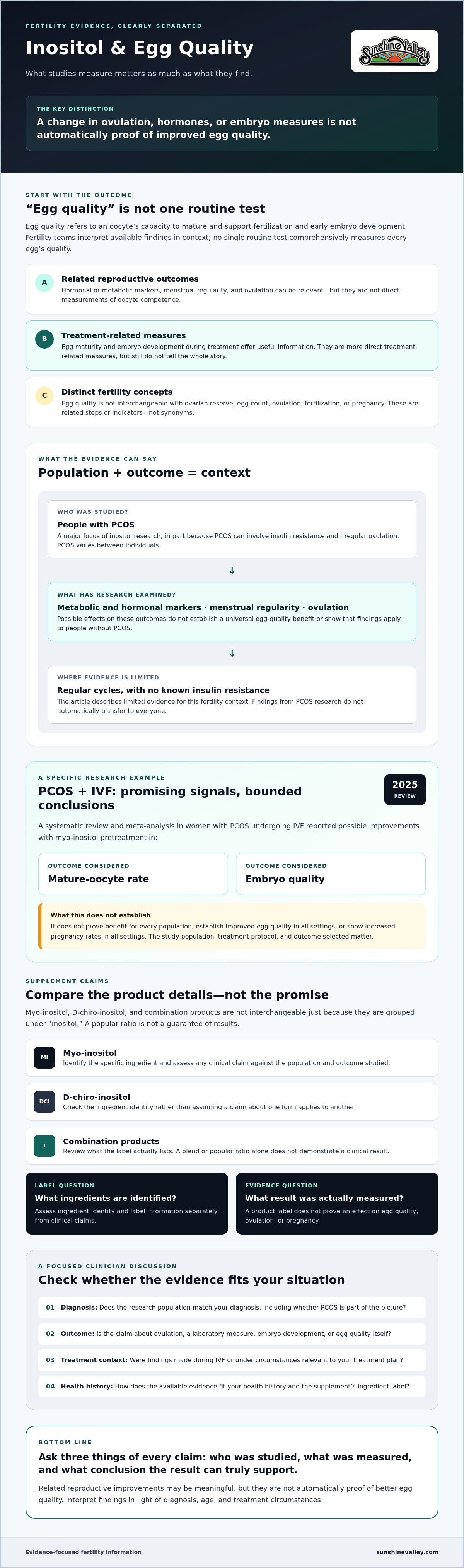
How to Assess Whether Inositol Fits Your Fertility Situation
A useful discussion starts with your clinical context, not a headline claim. Research may focus on people with PCOS, while your diagnosis, age, health history, or fertility treatment could differ. Use this framework to organize questions with a qualified clinician. Interpret fertility test results in context rather than using them alone to assess egg quality.
- Clarify the diagnosis. Ask what your evaluation shows and whether PCOS, insulin resistance, or another factor is relevant. If a diagnosis hasn’t been established, ask what assessment is appropriate.
- Name the intended outcome. Is the goal related to cycle regularity, ovulation, a metabolic marker, or an IVF measure? Ask what inositol might reasonably address in your documented situation. These outcomes aren’t interchangeable, and none should be assumed to mean improved egg quality.
- Check the evidence fit. Ask whether the studies apply to your diagnosis, age, treatment plan, and health history. Find out whether the research measured the outcome you care about or a related marker.
- Review current care. Share your medications, supplements, existing conditions, and pregnancy plans. Ask about possible interactions and whether starting a supplement could affect your current treatment plan.
- Agree on follow-up. If use is being considered, ask how benefits and side effects would be evaluated, what symptoms to watch for, and when the decision should be reviewed.
When should you review a supplement decision promptly?
Seek professional guidance if you have concerns about infertility or are receiving fertility treatment. Before combining a supplement with medication or treatment, ask your clinician or pharmacist to review the full list of products you take. Severe, unexpected, or concerning symptoms warrant prompt professional assessment.
You don’t need to settle the question based on online claims alone. Ask directly: “What outcome would we be looking for in my case, and how would we know whether this is appropriate?” That keeps the discussion focused on your care rather than a generalized promise about inositol benefits for egg quality.
If you’re reviewing a supplement as part of that conversation, you can review Sunshine Valley’s Super Inositol and check its current label and ingredient information. Product details don’t establish a fertility benefit, so discuss suitability with your clinician.
Choosing an Inositol Supplement Without Mistaking Purity for Proof
A clearly identified ingredient and careful manufacturing information can help you assess a supplement as a product. They don’t establish that it improves egg quality. Keep these questions separate: What does the label say is in the container? What clinical evidence supports the outcome being claimed?
What can label and manufacturing details tell you?
Review the current label and product documentation rather than relying on a headline or a general quality statement. Check for:
- Ingredient identity: Is the inositol form clearly named, or is the ingredient information too general to assess?
- Serving details: Are the amount per serving and directions stated clearly? Check these against the current label rather than assuming a dose based on another product or study.
- Handling and manufacturer information: Are storage instructions and responsible manufacturer details available? Look for quality-control claims only when product-specific documentation supports them.
Manufacturing and hygiene standards support product assurance. They aren’t clinical evidence that a supplement changes ovulation, egg quality, conception, or pregnancy outcomes. For additional context, read the guide to hygienic supplement manufacturing, and review the separate inositol powder dosage and health guide for use-related information. Any guidance still needs to fit the specific product label and your clinician’s advice.
Where does Sunshine Valley Super Inositol fit?
Sunshine Valley offers Super Inositol as a powdered supplement. Its availability shouldn’t be taken as proof of the inositol benefits for egg quality. Before making a decision, verify the current product label, ingredient form, serving information, and any relevant quality documentation. Don’t assume details that aren’t confirmed on the product information.
If you’re considering an inositol supplement, share its label with your clinician or pharmacist, especially if you’re in fertility treatment or take other supplements or medication. They can help assess whether the product is suitable for your situation. After reviewing the evidence and product details, you can explore Sunshine Valley as one option, without treating product quality as a promise of fertility results.
Make Your Next Fertility Decision With Clearer Evidence
The evidence around inositol benefits for egg quality depends on who was studied and what researchers measured. Findings in people with PCOS may relate to ovulation, metabolic markers, or IVF outcomes, but they don’t prove a universal improvement in egg quality or apply automatically to other fertility situations.
Before considering a supplement, check whether its ingredient and serving details are clear, then discuss its suitability, potential interactions, and follow-up with your clinician. Product identity and manufacturing standards matter, but they aren’t proof of a fertility outcome.
Sunshine Valley offers Super Inositol and emphasizes manufacturing quality and hygiene standards. Review the current product information carefully, without assuming it delivers a specific reproductive benefit. Explore Sunshine Valley Super Inositol as one option to discuss with your care team.
Clear questions and careful evidence review can help you move forward with greater confidence, one decision at a time.
Frequently Asked Questions
Can inositol improve egg quality?
It’s not established that inositol improves egg quality for everyone. Research has examined different outcomes, including metabolic markers, ovulation, and IVF measures such as mature-oocyte rate or embryo quality, especially in people with PCOS. These findings may be relevant, but they don’t prove a universal benefit or guarantee improved pregnancy chances. Ask what a study measured and whether its participants and treatment setting match your situation.
Does inositol help egg quality in people with PCOS?
Inositol may affect some reproductive or metabolic outcomes studied in people with PCOS, but direct evidence for improved egg quality remains limited. Research has reported possible changes in ovulation and, in IVF settings, mature-oocyte or embryo measures. Those outcomes aren’t interchangeable. The Society of Obstetricians and Gynaecologists of Canada’s 2025 position statement found insufficient evidence to recommend a specific preparation or dose for PCOS. Discuss the evidence for your circumstances with your clinician.
What is the difference between myo-inositol and D-chiro-inositol?
Myo-inositol and D-chiro-inositol are distinct forms of inositol involved in cell-signaling processes. Both have been studied in metabolic and reproductive contexts, but evidence for one form can’t automatically be applied to the other. Research varies in formulation, participant diagnosis, and measured outcome. A combination product or a marketed ratio isn’t inherently better for every person. Check the exact ingredient information and discuss how it relates to your clinical context.
Can inositol improve egg quality without PCOS?
There isn’t meaningful trial support showing that inositol improves conception rates for people with regular cycles and no insulin resistance, and evidence for egg-quality benefits in this group is limited. Findings from PCOS studies shouldn’t be assumed to apply to other fertility situations. If you’re considering a supplement, ask a clinician whether your diagnosis, health history, and intended outcome resemble those studied before making a decision.
How long does inositol take to affect fertility?
There’s no established timeline that predicts when inositol will affect fertility or egg quality. Some research protocols assess outcomes after a period of use, but study duration doesn’t prove that an individual will experience the same effect or when. Ask your clinician what outcome would be monitored, how it would be assessed, and when to review the decision. Don’t delay fertility evaluation while waiting for a supplement to work.
Is inositol safe to take while trying to conceive?
Whether inositol is appropriate while trying to conceive depends on the person, product, and broader care plan. The 2025 Society of Obstetricians and Gynaecologists of Canada statement described potential for harm as low, while finding insufficient evidence to recommend specific preparations or dosing for PCOS. Share the product label and a list of your medications and supplements with a clinician or pharmacist, especially if you have health conditions or pregnancy plans.
Should I take inositol with fertility medication or IVF treatment?
Don’t add inositol to fertility medication or an IVF plan without first checking with your fertility clinician or pharmacist. Research on inositol before IVF doesn’t establish that every formulation is suitable alongside every treatment. Share the exact product label, other supplements, and medications you use. Your care team can consider your diagnosis, treatment schedule, and health history, then advise whether use and follow-up are appropriate for your situation.



Leave a comment
This site is protected by hCaptcha and the hCaptcha Privacy Policy and Terms of Service apply.