



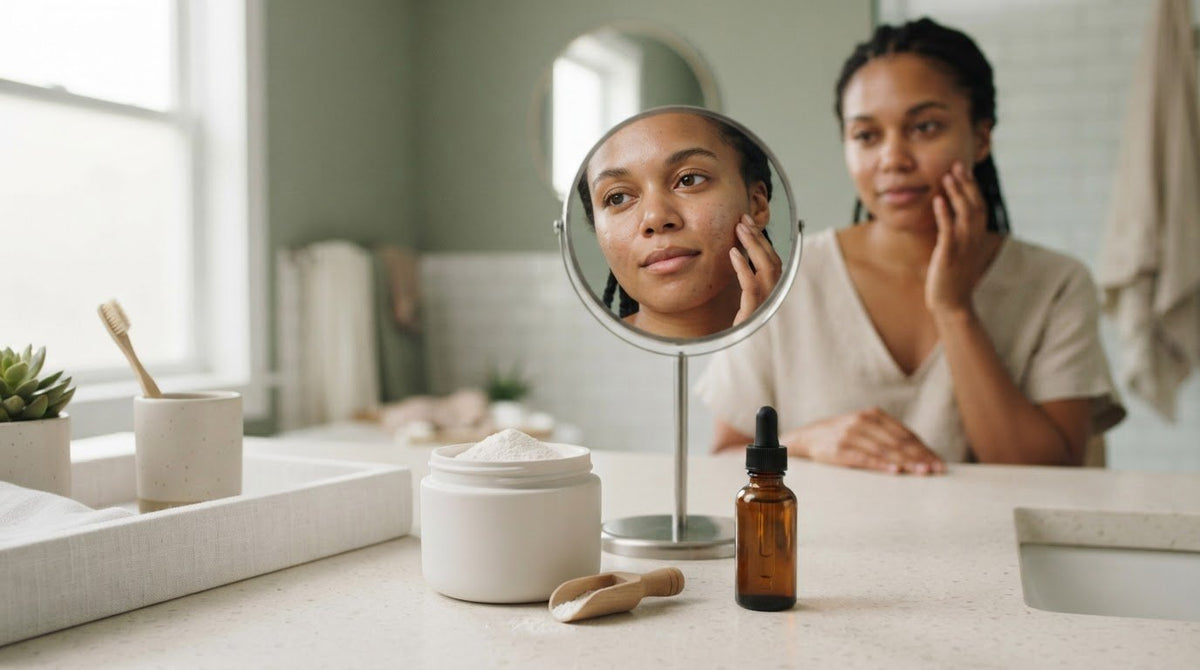
Can a scoop of niacinamide powder make pores look smaller? It’s an appealing idea, especially when skincare claims about “shrinking” pores are hard to separate from evidence. But niacinamide powder for reducing pore size raises an important distinction: research on niacinamide applied to skin does not establish that taking a dietary powder has the same effect.
Pore appearance depends on several factors, including oil, congestion, and the skin’s natural structure. Topical niacinamide may affect some of these factors, but pores are normal openings that cannot be permanently closed. Dietary niacinamide is a different route of use, so cosmetic results should not be assumed from taking a supplement.
This guide explains what niacinamide can and cannot do for pore appearance, how topical products differ from oral powder, and what to consider before choosing a supplement. Sunshine Valley’s Super Niacinamide is a dietary product, not a topical skincare treatment. We’ll keep that distinction clear while covering evidence, realistic expectations, and why product information and safe-use directions matter.
Key Takeaways
- Visible pore size can change in appearance, but pores are normal skin openings, not structures that skincare can permanently close.
- Evidence about topical niacinamide does not establish that taking niacinamide powder for reducing pore size will produce the same result.
- Match the product route to your goal, and look for research that specifically examines oral use and pore-related outcomes.
- Before choosing a dietary powder, review its product information and applicable use directions rather than treating it as a DIY skincare ingredient.
- Super Niacinamide is a powdered dietary supplement from Sunshine Valley, a company founded in 1956; its heritage is not evidence of pore-related effects.
What does “reducing pore size” mean, and what determines pore appearance?
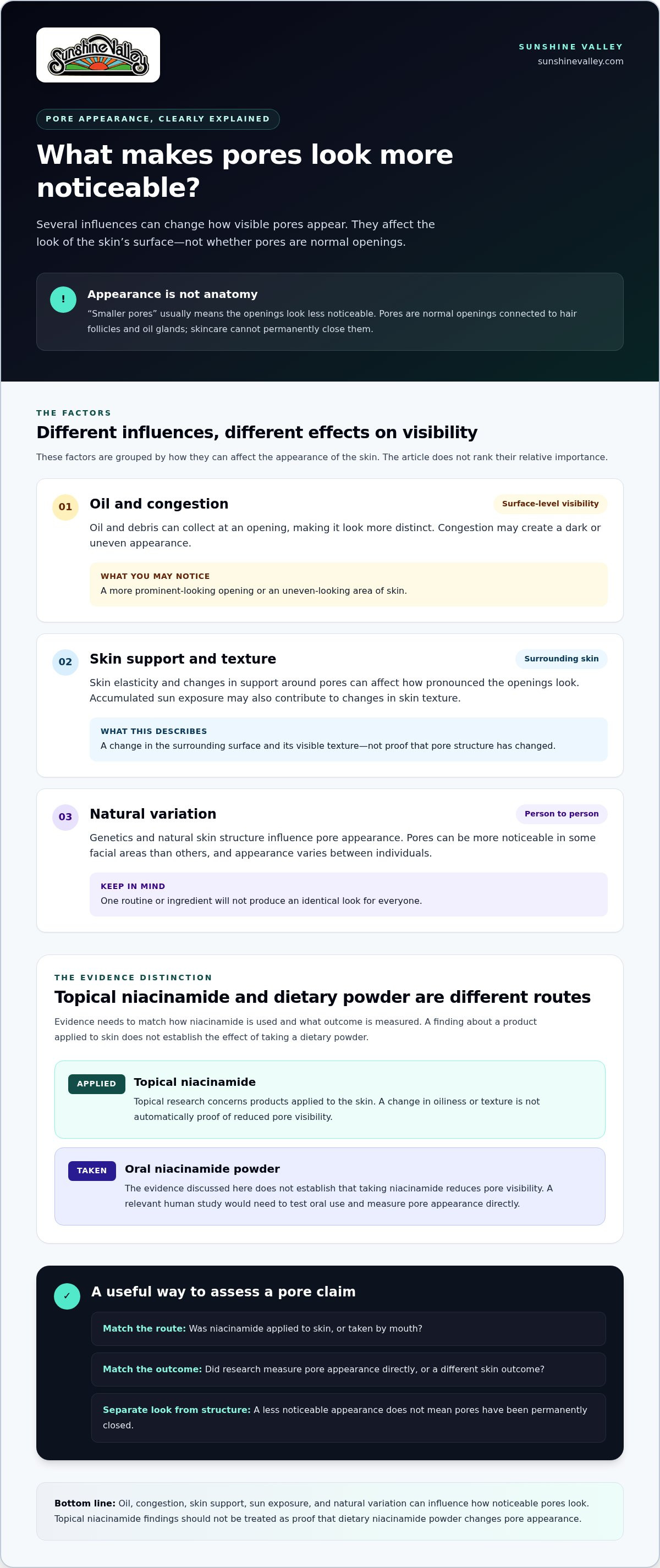
Can you actually make pores smaller? Usually, “smaller” describes how noticeable the openings look, not a reduction in their number. Pores are normal openings in the skin connected to hair follicles and oil glands. Their visibility varies from person to person, so a close-up mirror view cannot tell you that your skin has more pores or that an ingredient has changed their physical structure.
That distinction matters when assessing claims about niacinamide powder for reducing pore size. Niacinamide is a form of vitamin B3; its general properties and uses are summarized in Niacinamide (Vitamin B3). But information about the ingredient alone does not show that an oral supplement changes pore structure or appearance.
For a look at how niacinamide is discussed in topical skincare, watch this video review. It concerns a serum, not a dietary powder, so keep the difference in route of use in mind.
Visible pore size is influenced by several factors, including genetics, oil production, skin structure, and accumulated sun exposure. These can affect how defined or uneven the skin’s surface looks, but they do not mean pores are dirty or need to be “closed.” When assessing a claim, ask whether it measures a change in pore appearance or demonstrates a change in the skin’s anatomy.
- Oil and congestion: Oil and debris can collect at an opening and make it look more prominent.
- Skin support: Changes in elasticity and accumulated sun exposure can affect visible texture around pores.
- Natural variation: Pores may be more noticeable in some facial areas than others, and their appearance varies between individuals.
Why do some pores look more noticeable?
Oil can make pore openings look more distinct, while congestion may create a visible dark or uneven appearance. Skin elasticity affects the surrounding surface, and changes in skin support can make openings appear more pronounced. Sun exposure accumulated over time may also contribute to changes in texture. These factors vary across the face and between people, so one routine or ingredient will not produce an identical look for everyone.
Can any ingredient literally shrink pores?
Skincare claims generally refer to a change in appearance, not permanent anatomical shrinkage. Some cosmetic effects may be temporary, such as a smoother look after oil is reduced or makeup blurs texture. Other visible changes may develop gradually with consistent topical care. Pore appearance is how noticeable an opening looks; physical pore structure is the underlying skin feature. Neither type of claim should be assumed to apply to dietary supplements.
That is why evidence about topical skincare and evidence about oral niacinamide need to be considered separately. A claim about visible pores does not, on its own, establish that taking a powder will alter pore structure or make pores look smaller.
Does niacinamide help pores, and what evidence applies to dietary powder?
The evidence depends on how niacinamide is used and what researchers measure. A topical skincare study tests a product applied to the skin. A study of oral niacinamide tests ingestion. Although both involve niacinamide, they do not establish the same outcome: a concentration in a serum cannot be converted into a supplement dose, and a visible skin change after topical use does not prove that oral use produces it.
That distinction is central to evaluating niacinamide powder for reducing pore size. A claim about the ingredient’s general properties, or about topical skincare, is not direct evidence for a dietary powder. To support an oral pore-related claim, human research would need to test niacinamide taken by mouth and measure pore appearance as an outcome. Evidence about general vitamin B3 roles answers a different question.
What does topical niacinamide research tell us?
Topical research can inform claims about products applied to skin, but findings need to be considered alongside the route, concentration, study duration, and measured outcome. A change in oiliness or overall texture, for example, is not automatically proof of a measured reduction in pore visibility. Without a specific primary study to cite and assess, precise figures or timelines should not be presented as established results here.
Even a well-designed topical study would remain evidence about topical use. It cannot show that a dietary powder works similarly, because the route, exposure, and conditions being studied differ.
What remains uncertain about oral niacinamide and pores?
The key question is whether human studies of oral niacinamide specifically measured pore appearance. The evidence discussed here concerns topical cosmetic findings, not a direct oral trial with that outcome. It therefore does not establish that taking niacinamide reduces pore visibility. This is a limit on the cosmetic claim, not proof that niacinamide has no nutritional role.
Direct human evidence that oral niacinamide reduces pore appearance is not established here. To assess a claim, look for a published human study that clearly states:
- Niacinamide was taken orally, rather than applied to skin.
- Pore appearance was measured directly, not inferred from another skin outcome.
- The study reports its participants, product or dose, duration, and results.
Be cautious of advice that transfers a topical percentage, application routine, or expected timeline to a dietary supplement. Those details describe a skincare formulation and its use, not directions for an oral powder. For a dietary product, follow its own product information rather than adapting a serum routine.
Sunshine Valley’s Super Niacinamide powder is a dietary supplement, not a topical treatment. Its product information is the reference for applicable use directions; it should not be used as a DIY skincare ingredient. Product quality and careful manufacturing matter when choosing a supplement, but they do not demonstrate a pore-related outcome.
Niacinamide powder vs. topical niacinamide: which option fits your goal?
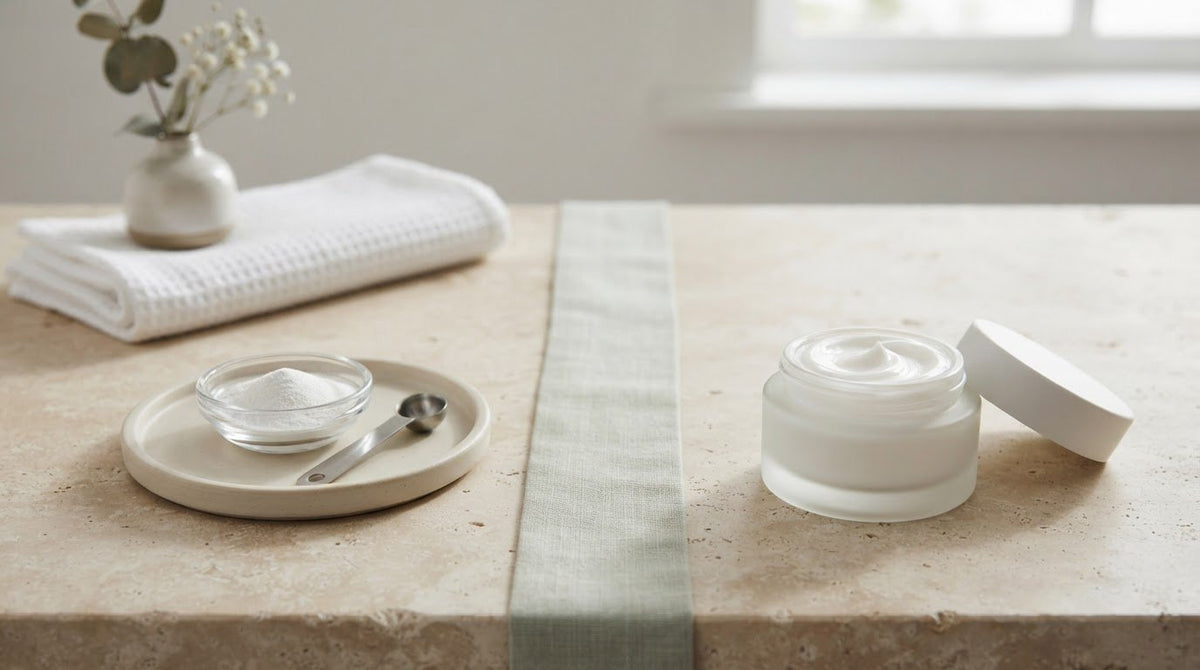
The right format depends on your goal. A topical niacinamide product is formulated for application to skin. Dietary niacinamide powder is intended for supplement use. Similar ingredient names do not make these products interchangeable, and evidence about one route should not be used to promise results from the other.
For a pore-focused skincare goal, the research discussed in skincare sources concerns topical products. If your interest is niacinamide powder for reducing pore size, look for evidence that specifically tests oral use and measures pore appearance. The distinction is clearer in a side-by-side comparison:
| Factor | Topical niacinamide | Dietary niacinamide powder |
|---|---|---|
| Route | Applied to the skin in a formulated skincare product. | Taken as a dietary supplement according to its product directions. |
| Intended use | Skincare, with claims tied to the finished product and its formulation. | Dietary use, not use as a serum or facial treatment. |
| Pore-specific evidence | This is the route discussed in pore-focused skincare research. | The evidence described here does not establish a pore-related result from oral use. |
| Key caution | Results and tolerability can depend on the formula and individual skin. | Do not transfer topical percentages or routines to a supplement. |
How do the routes of use differ?
Topical products are formulated for skin application, while dietary powders are made for ingestion. Their intended uses, directions, and evidence are route-specific. A topical concentration describes the amount in a skincare formula, not an oral serving. Likewise, a routine designed for a serum does not provide directions for a supplement powder. Use each product only as intended, and do not treat dietary powder as a DIY cosmetic ingredient.
Evidence for niacinamide applied to skin cannot automatically support a claim about niacinamide taken by mouth. The route matters because it defines what the research actually tested.
How should readers assess pore-related claims?
Pause at a broad claim such as “supports smaller-looking pores” and check what evidence supports it. Useful details include the route of use, the people studied, the outcome measured, and the study duration. A testimonial may describe one person’s experience, but it is not the same as a controlled clinical outcome. A proposed ingredient mechanism also does not, by itself, demonstrate a visible result.
- Does the evidence test a topical product or an oral supplement?
- Did researchers measure pore appearance specifically?
- Are the population and study duration stated?
Be wary of promises that pores will be permanently closed or eliminated. A credible claim should describe the result actually measured and avoid extending it to a different product format. Sunshine Valley’s Super Niacinamide dietary powder is intended as a dietary supplement; its product information provides applicable use directions.
How to make a safe, evidence-aware choice about niacinamide powder
Start with a clear goal. If you’re considering niacinamide powder for reducing pore size, separate the cosmetic claim from the product’s intended dietary use. A careful choice means checking what the evidence actually supports, reading the label, and not adapting skincare instructions for a supplement.
A practical checklist before choosing
- 1. Define your goal and route. Are you seeking a topical skincare product or considering a dietary supplement? If pore appearance is your goal, remember that evidence for one route does not establish an effect from the other.
- 2. Look for evidence that matches the claim. For an oral pore-related claim, seek human research on niacinamide taken by mouth that measures pore appearance specifically. General information about vitamin B3 or studies of products applied to skin do not answer that question.
- 3. Read the complete product label. Confirm the ingredient identity, serving directions, warnings, and storage instructions. Check that the product is clearly intended for dietary use. Do not infer a serving amount from a topical product’s concentration or use directions.
- 4. Follow the stated directions and consider your circumstances. Use the product only as its label directs. If you take medication, are pregnant, have a health condition, or remain uncertain about suitability, seek guidance from a qualified clinician before use.
What should you check on a dietary supplement label?
Read the label as a set of practical instructions, not as proof of a cosmetic outcome. Confirm that the ingredient name is clear, then review how the product is directed to be used, along with any warnings and storage guidance. A dietary powder should be identified for dietary use. An ingredient name alone does not establish a benefit for pores, and the powder should not be used as a facial treatment or mixed into skincare.
Look for claims that are specific and proportionate to the evidence. A product description can identify what a supplement contains and how it is intended to be used; it cannot replace research measuring the particular result you’re considering. Avoid assuming that words such as “pure,” “premium,” or “high quality” establish a clinical effect. A testimonial or proposed biological explanation is not proof that pores will look different.
When should you ask a clinician before use?
Individual circumstances can affect whether a supplement is appropriate. A qualified clinician can consider your medications, pregnancy, health conditions, and potential interactions in context. This is especially useful when you have more than one concern or the label does not resolve your questions. Keep the discussion focused on safe dietary use; a supplement should not be treated as a way to diagnose or manage a skin condition.
Sunshine Valley’s Super Niacinamide is a powdered dietary supplement. For its applicable use directions, view Super Niacinamide product information. Choose it for dietary use, not as a pore treatment, and base cosmetic expectations on evidence that directly tests the relevant route and outcome.
Super Niacinamide powder: understand the product and choose your next step
Sunshine Valley’s Super Niacinamide is a powdered dietary supplement. Its intended category is clear: dietary use, not a facial serum or topical pore treatment. If you’re considering niacinamide powder for reducing pore size, keep that distinction in view. A product’s ingredient and format do not establish that it changes pore appearance.
Sunshine Valley was founded in 1956 and emphasizes premium ingredients and careful manufacturing, including strict hygiene standards. These details offer context about the company’s heritage and approach to production. They are not evidence that taking niacinamide powder reduces pores or treats a skin concern. Assess product information and cosmetic claims separately.
What can readers expect from a dietary niacinamide product?
Expect a dietary supplement powder, with use directions and applicable cautions provided through its product information and label. Review those instructions before use, and do not repurpose the powder as a skincare ingredient. The product category tells you how it is intended to be used; it does not establish a pore-related cosmetic outcome. Keep expectations tied to evidence for the route and result being claimed.
A practical next step is to read the product details for what is stated, including ingredient identity and directions. Avoid filling in information that is not given, such as a serving amount, an application method, or a promised skin result. If you have questions about whether a dietary supplement suits your personal circumstances, a qualified clinician can help assess them.
How can you continue researching niacinamide?
For broader nutritional context, Sunshine Valley’s article Niacinamide Vitamin B3 Powder: A Guide to High-Purity Nutritional Support explores niacinamide as a dietary ingredient. The article Hygienic Supplement Manufacturing: The Clinical Standard for Pure Wellness provides further context on the company’s manufacturing emphasis. These resources can help you understand the product category and production approach, but neither should be treated as proof of a pore-related result.
As you read, keep three questions in mind: Is the information about dietary or topical use? Does it describe a measured outcome, or only an ingredient’s general properties? Does it make a claim that goes beyond the evidence presented? These checks help separate useful product details from cosmetic promises.
- For dietary use: Review Super Niacinamide product information and follow its label directions.
- For pore appearance: Look for research that directly tests the route and outcome in question.
- For personal concerns: Consult a qualified clinician, particularly if you take medication, are pregnant, have a health condition, or are uncertain about use.
Super Niacinamide can be considered as a dietary supplement on its stated terms, without assuming a skincare benefit. Explore its product information for applicable directions, and seek professional guidance when your individual circumstances call for it.
Choose your next step with clear expectations
Let your goal guide your next choice. If you’re considering niacinamide powder for reducing pore size, treat that as a claim to evaluate, not an expected result. Choose a product for its intended use, rely on evidence that matches that use, and avoid changing directions to pursue a cosmetic effect.
If dietary niacinamide is relevant to your needs, review the product information and label directions. For questions about personal suitability, medications, pregnancy, or a health condition, a qualified clinician can help you weigh your circumstances. Clear information is a better basis for a decision than a promise that sounds certain.
Sunshine Valley’s Super Niacinamide is a powdered dietary supplement. The company’s emphasis on premium-quality ingredients and strict hygiene standards reflects its approach to manufacturing, not proof of a pore-related result. Explore Sunshine Valley Super Niacinamide for product information and applicable directions.
Informed choices do not require dramatic promises. Take the next step that fits your goal, and keep your expectations grounded.
Frequently Asked Questions
Can taking niacinamide powder make pores look smaller?
Taking niacinamide powder has not been established as a way to make pores look smaller. Topical skincare and oral supplements are different routes, so a result measured after applying a serum cannot prove an effect from taking a powder. For a pore-related claim, look for human research that tests oral niacinamide and measures pore appearance directly. A supplement’s nutritional context is separate from evidence for a cosmetic result.
Is niacinamide powder the same as a niacinamide serum?
No. Both may contain niacinamide, but their formulations and intended routes differ. A serum is made for topical use, while a dietary powder is intended for consumption according to its label. Do not use supplement directions to create a skincare routine or assume serum instructions apply to a supplement. Evidence should match the product route: research on skin-applied niacinamide does not establish results from oral use.
Can you put dietary niacinamide powder on your face?
Do not treat a dietary supplement as a facial product unless its labeling specifically directs topical use. Products intended for skin application are formulated for that route; a dietary powder’s ingredient name alone does not establish that it is appropriate for facial use. Choose a product formulated and labeled for topical skincare instead, and avoid DIY mixtures. If irritation or a persistent skin concern is troubling you, seek advice from a qualified professional.
How much niacinamide should you take for pore appearance?
No pore-focused amount is established here, so do not select a serving based on skincare concentrations or a desired cosmetic result. Follow the dietary supplement’s own label directions, and do not exceed or adapt them to pursue a pore effect. Individual circumstances matter. If you take medication, are pregnant, have a health condition, or are uncertain about supplementation, ask a qualified clinician before use.
Does niacinamide powder cause flushing like niacin?
Niacin and niacinamide are different forms of vitamin B3, so information about one should not automatically be applied to the other. That distinction does not mean a specific niacinamide product is guaranteed to be free of side effects. Follow the product’s label warnings. If you experience symptoms, take medication, or have personal risk factors that concern you, discuss the product with a clinician or pharmacist.
Can niacinamide supplements interact with medications?
Possible interactions depend on the person, the medication, and how the supplement is used, so a general answer cannot establish what is safe for you. Before starting niacinamide powder, show the complete product label to a clinician or pharmacist, especially if you take prescription medicines or manage an ongoing health condition. They can review your circumstances and help identify whether any precautions or follow-up are appropriate.


Leave a comment
This site is protected by hCaptcha and the hCaptcha Privacy Policy and Terms of Service apply.