




What if a vitamin used in skin care might also help when taken by mouth? Potential oral niacinamide benefits for acne include reduced inflammation and oil production, but that doesn’t make oral supplements interchangeable with topical treatments. Niacinamide, also called nicotinamide, is vitamin B3, and evidence for acne includes clinical findings on topical use as well as more limited information about oral use.
If you’re considering a supplement, it helps to separate what’s biologically plausible from what clinical studies have actually shown. This article explains how oral niacinamide may affect acne, how its evidence compares with topical research, and what safety considerations matter when choosing a supplement. You’ll also learn why niacinamide and niacin aren’t the same form of vitamin B3, and when it’s sensible to discuss supplementation with a healthcare professional. The aim is a clear, measured view of what niacinamide may offer, without treating it as a proven standalone acne solution.
Key Takeaways
- Understand how niacinamide may influence acne-related inflammation and oil production.
- See how clinical findings on topical nicotinamide differ from the evidence for oral supplements.
- Learn why niacinamide and niacin are distinct forms of vitamin B3, and why the difference matters when choosing a supplement.
- Review key safety considerations, including when health conditions or medications make professional advice important.
- Discover how Sunshine Valley Super Niacinamide fits into a considered approach to supplementation.
Anti-inflammatory effects
Nicotinamide, also called niacinamide, is vitamin B3 and has anti-inflammatory action. For acne, the proposed relevance is reduced inflammation and oil production, although oral and topical evidence differ.
Effects on Skin Inflammation and Acne
Niacinamide may reduce acne-related redness and swelling and help regulate oil production in the skin. Excess oil and inflammation are both associated with acne lesions. However, the available evidence does not establish that oral niacinamide treats every type of acne or its lasting marks. It also does not show that it works equally for clogged pores, inflammatory acne, or acne scars.
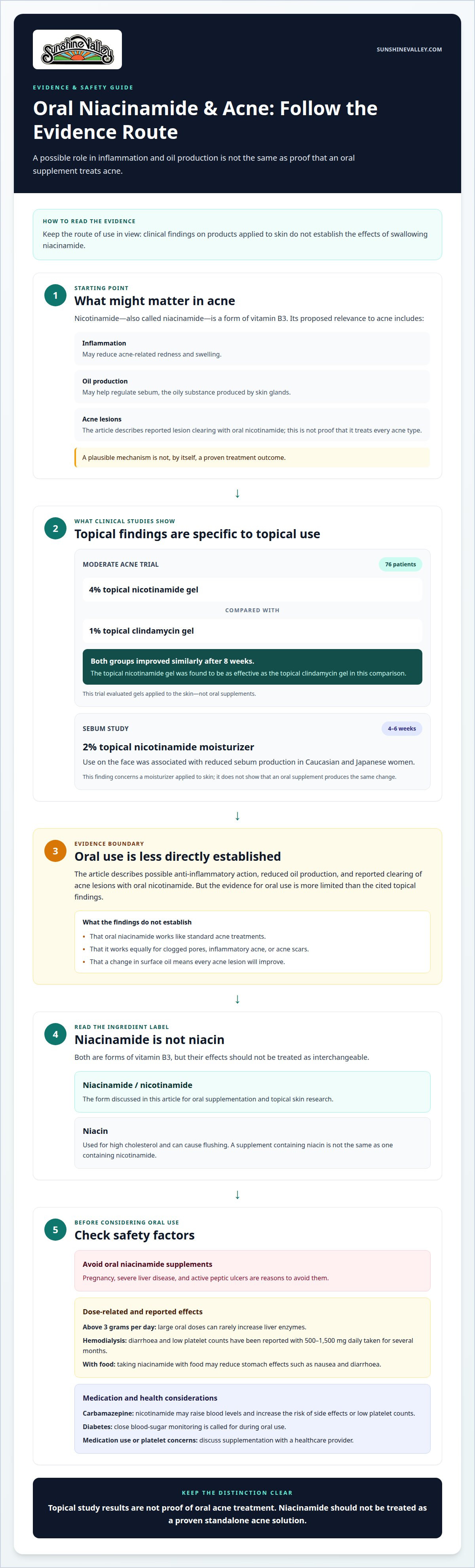
Oral nicotinamide and topical niacinamide are not supported by identical evidence. A controlled trial in 76 patients found that 4% topical nicotinamide gel was as effective as 1% topical clindamycin gel for moderate acne; both groups improved similarly after eight weeks. That comparison concerns topical products, not oral supplements. It also doesn’t establish that oral niacinamide works like standard acne treatments.
Niacinamide and Niacin Supplements
Niacinamide and niacin are different forms of vitamin B3, despite their similar names. Niacin is used for high cholesterol and can cause flushing, unlike niacinamide. This distinction matters when reading supplement labels: a product containing niacin isn’t the same as one containing nicotinamide, and their effects shouldn’t be treated as interchangeable.
Oral niacinamide supplements may cause side effects. Taking niacinamide with food may reduce stomach effects such as nausea and diarrhoea. Large oral doses above 3 grams per day can rarely increase liver enzymes. People receiving hemodialysis have also reported diarrhoea and low platelet counts with 500-1,500 mg daily taken for several months.
Medication interactions matter, too. Nicotinamide may raise blood levels of carbamazepine and increase the risk of side effects or low platelet counts. If you take medication, discuss supplementation with a healthcare provider, especially if platelet levels are a concern.
Pregnancy, severe liver disease, and active peptic ulcers are reasons to avoid oral niacinamide supplements. Diabetes calls for close blood-sugar monitoring during oral use. Kidney disease is not one uniform category in the available safety information: the specific concern described is hemodialysis, for which reported adverse effects include diarrhoea and low platelet counts.
For oral nicotinamide, the stated effects include anti-inflammatory action and reduced oil production, alongside the reported clearing of acne lesions. In other words, its described relevance to acne is not limited to inflammation alone: reduced oil production and lesion clearing are also part of the stated effect. These claims concern oral nicotinamide, the form discussed here, and should be read as the specific effects reported rather than as a claim about every vitamin B3 product.
How does nicotinamide work?
Nicotinamide may affect acne by helping regulate sebum, the oily substance produced by skin glands. This proposed effect may help explain a possible biological role, but it is not proof of a treatment outcome.
Regulating Acne-Related Oil Production
Sebum helps maintain skin, but excess oil can contribute to acne. Niacinamide may help regulate oil production, which is why researchers have examined its possible role in acne-related skin health. This mechanism offers one explanation for potential benefits, not proof that oral supplements reduce breakouts or replace established acne treatments.
The route matters. A topical study found that applying a 2% nicotinamide moisturizer to the face for 4-6 weeks reduced sebum production in Caucasian and Japanese women. That finding concerns a product applied to skin, not oral nicotinamide. It therefore cannot show that swallowing a supplement produces the same change in oil levels.
Sebum Production and Pores
Sebum travels through follicles and reaches the skin surface through their openings, commonly called pores. When excess oil combines with dead skin cells, it can contribute to blocked follicles and acne lesions. This helps explain why oil regulation may matter, especially for oily skin, but it does not establish that changing sebum alone resolves every acne concern.
Oil production is only one part of acne. Blocked pores and inflammation also matter, so a change in surface oil does not necessarily mean every lesion will improve. Someone with clogged pores, for example, may need a different approach from someone whose main concern is inflamed spots. Skin shine alone is not a complete measure of acne activity.
Nicotinamide is a form of vitamin B3. Its proposed effect on sebum should be considered separately from its other roles in skin health. The available topical finding provides a measured example of oil reduction, while oral effects on acne-related oil production remain less directly established. That distinction is useful when weighing supplement claims against evidence for products applied to skin.
Inflammatory acne may involve redness and swelling, while comedonal acne involves clogged pores. Since sebum is just one contributing factor, a possible effect on oil does not establish equal benefits for these forms. Discuss persistent or changing concerns with a healthcare provider, who can consider acne type, existing treatments, and medical history.
For readers considering a supplement, powdered niacinamide is one way to explore oral use. Keep the distinction clear: topical evidence about sebum doesn’t establish the effects of an oral product, and a supplement shouldn’t be treated as a proven acne treatment.
Choosing niacinamide supplements
Oral niacinamide supplements vary in dose and form, so read the label to identify the ingredient clearly. For acne, the key is to choose a measured supplement without treating it as a proven replacement for established care.
Selecting Oral Niacinamide Supplements
Niacinamide, also called nicotinamide, is vitamin B3; niacin is a different form. Oral nicotinamide appears in multivitamins at 20-30 mg and in 500-mg tablets. Those formats make the amount per serving important: read the label for the form and dose, then count any niacinamide already present in other supplements.
For oral niacinamide supplements, the stated limit is 1 gram per day. Higher-dose studies for other conditions do not establish a suitable acne dose. For example, research on preventing non-melanoma skin cancers, including squamous cell cancers, used 500 mg twice daily. That study context is different from acne, pigmentation, or changing the skin’s appearance.
Safety depends on personal health and medications. If you are pregnant or breastfeeding, have a health condition, or take medication, discuss niacinamide with a healthcare provider before use. This is particularly relevant because nicotinamide may raise carbamazepine levels and side-effect risks, and may increase the risk of low platelets.
Oral Supplements and Acne
Oral supplements and topical products deliver niacinamide differently, so findings for one route do not establish effects for the other. Research on topical products has examined acne and pigmentation, but those findings do not show that an oral supplement produces the same changes. Keeping the routes distinct helps align claims about skin appearance and acne with the evidence.
Oral niacinamide may help treat acne, but the available evidence is less direct than evidence from topical acne studies. If someone uses it for acne, the suggested assessment period is twelve weeks; results from daily supplements may appear within a few weeks to months. That timeframe is not a reason to increase the dose beyond the 1-gram daily limit.
Some safety information describes nicotinamide as generally well tolerated below 3 grams per day, but that broader threshold is not an acne dosing target. The practical supplement limit remains 1 gram daily. Oral supplements can cause flushing, nausea, or diarrhoea, and larger doses have been associated with increased liver enzymes. A clear label, total daily intake, medication list, and health history all matter before starting.
Niacin, unlike niacinamide, is used for high cholesterol and can cause flushing, so keep the two forms of vitamin B3 distinct when comparing labels.
Clinical evidence for acne treatment
Clinical findings distinguish topical acne trials from studies of oral niacinamide for other conditions. That distinction helps clarify what the evidence can and cannot establish about supplements.
Studied Oral Niacinamide Dose
The acne trial evidence described here concerns topical treatment, not an oral niacinamide dose. In a controlled trial, 76 patients with moderate acne used 4% topical nicotinamide gel or 1% topical clindamycin gel.
Both groups had a similar reduction in acne after eight weeks. This is a useful comparison between topical treatments, but it doesn’t establish an oral dose for acne. A separate study used 500 mg twice daily for 12 months to examine prevention of new non-melanoma skin cancers in high-risk patients. That skin cancer research addresses a different medical goal, not acne.
Other skin findings also need context. Research on redness, wrinkles, or skin cancer prevention should not be treated as direct evidence that niacinamide supplements clear acne. The route, condition studied, and outcome measured all shape what a study can tell you.
Time to Acne Improvement
For oral niacinamide used for acne, the suggested assessment period is twelve weeks. Reported timing for results from daily supplements ranges from a few weeks to months, so do not confuse a short-term change with a clear treatment response.
Topical evidence has its own timeline: a comparison of nicotinamide and clindamycin gels assessed acne after eight weeks. That result does not predict how quickly an oral supplement might work or prove that oral niacinamide matches the effects of topical medication.
Review studies with their specific endpoints. An article in Dermatologic Therapy, volume 30, issue 5, reviews nicotinamide’s role in acne treatment. A review can help frame the evidence, while a controlled trial compares treatments under defined conditions. Neither design should be confused with research on unrelated outcomes, such as skin hydration, pigmentation, or prevention of skin cancer.
For practical interpretation, separate three questions: Was the study about acne? Was niacinamide taken orally or applied topically? What outcome and timeframe did researchers measure? The 76-patient trial answers those questions for topical acne treatment, while the 500 mg twice-daily study concerns skin cancer prevention. Those findings support different conclusions.
These acne trials do not establish niacinamide supplements as a substitute for medical acne care. Persistent breakouts, scarring, or worsening redness call for a treatment plan that considers acne type and severity. The evidence supports careful distinctions, not transferring a dose or result from one condition to another.
Oral niacinamide and acne
Oral niacinamide is an area of interest for acne, but the evidence needs careful interpretation. Distinguish a proposed effect on skin from clinical studies that measured acne outcomes after supplementation.
Niacinamide is a water-soluble form of vitamin B3. Oral supplements deliver it through the digestive system, unlike topical products applied directly to skin. That difference matters: findings about topical oil production or acne don’t establish the same effects from an oral supplement. The route of use is essential context when considering the oral niacinamide benefits for acne.
The strongest acne comparison in the available clinical findings involved topical treatments, not oral supplements. Separately, oral nicotinamide has been studied for skin cancer prevention: a clinical trial used 500 milligrams twice daily for 12 months in people with a history of non-melanoma skin cancer. That research addressed prevention of new cancers, not acne lesions, oil production, or acne scars. Its results shouldn’t be carried over to acne.
Other research also illustrates why the condition studied matters. Niacinamide studies related to delaying type 1 diabetes used daily doses of 1 gram to 3 grams over four months to four years. Those doses and durations describe diabetes research, not an acne regimen. A study’s ingredient alone doesn’t make its findings relevant to every skin or health concern.
For acne, the practical question is whether daily supplementation corresponds with a meaningful change over time. Allow twelve weeks before judging whether it has worked; reported results may appear within a few weeks to months. Track breakouts and changes in skin appearance rather than assuming that findings about cancer prevention predict acne improvement.
Supplement safety remains part of that decision. Oral niacinamide can cause flushing, nausea, or diarrhoea, while taking it with food may reduce stomach effects. People who are pregnant or breastfeeding, have health conditions, or take medications should discuss use with a healthcare provider. The supplement ingredients and total daily intake also matter, especially when several products contain vitamin B3.
Overall, oral niacinamide may be considered as a supplement, but studies of other conditions don’t establish its acne effects. When weighing oral niacinamide benefits for acne, keep the intended use, dose, health history, and medication list in view. Explore niacinamide supplement options as part of an informed approach to supplementation.
Sunshine Valley: Super Niacinamide
Sunshine Valley Super Niacinamide offers a powdered niacinamide supplement for readers considering oral vitamin B3. It’s a straightforward option to explore after weighing the evidence, supplement form, and personal safety factors discussed above.
Research on oral niacinamide remains distinct from findings on topical acne treatments, so the supplement should not be presented as a proven acne treatment. Sunshine Valley emphasizes premium-quality ingredients, state-of-the-art manufacturing, and strict hygiene standards. Consider these product qualities alongside the label and your individual supplement needs.
If you’re considering Super Niacinamide as part of your supplement choices, contact Sunshine Valley to learn more.
Make your next step a considered one
Whether to use niacinamide for acne is a personal decision shaped by your goals, current routine, and health considerations. Keep the potential oral niacinamide benefits for acne in perspective: interest in supplementation can be a reason to learn more, not a promise of a particular skin outcome.
Sunshine Valley offers Super Niacinamide, alongside Super Mannitol, Super Inositol, and Super Lactose. If you’re considering a supplement, decide what fits your needs and discuss health or medication concerns with a healthcare provider. A thoughtful choice starts with clear information and realistic expectations.
Contact Sunshine Valley to learn more about its supplement offerings and take your next step with care.
Frequently Asked Questions
What is niacinamide?
Niacinamide is a form of vitamin B3, also called nicotinamide. It’s found in foods such as lean meats, fish, nuts, and legumes, and is also available in supplements and topical skin-care products. The form matters: niacinamide is not the same as niacin, another form of vitamin B3. Check the ingredient name on a label to identify which one a product contains.
What conditions does Nicotinamide treat?
Nicotinamide has been studied for several different health concerns, but study results depend on the condition and how it’s used. Oral nicotinamide has been studied for preventing new non-melanoma skin cancers in high-risk patients, while acne findings include research on topical use. Studies in other areas, such as type 1 diabetes, don’t establish that it treats those conditions. It isn’t a substitute for prescribed care.
What are the benefits?
Potential benefits depend on whether niacinamide is taken orally or applied to skin. Research has examined topical use for acne and sebum, while other findings suggest nicotinamide may support skin hydration by reducing water loss through the epidermis. One study found increased production of ceramides, which help support the skin barrier. These findings concern specific outcomes and do not prove a general skin benefit.
What is it?
Nicotinamide is the chemical name often used for niacinamide, a form of vitamin B3. On a supplement label, either name may identify this ingredient. Niacin is another form of vitamin B3, but it’s not interchangeable with niacinamide and can cause flushing. If a multivitamin or separate supplement contains vitamin B3, read the ingredient line to distinguish niacinamide from niacin.
Does oral niacinamide help treat acne, and what does clinical research show?
Oral niacinamide may help acne, but clinical evidence does not establish it as a proven oral acne treatment. A controlled study of topical nicotinamide gel found similar acne reductions to topical clindamycin after eight weeks. That result applies to topical treatments, not supplements. Oral studies on skin cancer prevention address a different outcome. Consider the route, condition, and measured result when interpreting a study.
What are the side effects and risks of taking oral niacinamide?
People may respond differently to oral supplements, so pay attention to how you feel when taking niacinamide. People with severe liver disease or active peptic ulcers should avoid oral supplements. Pregnancy, breastfeeding, diabetes, and medication use call for particular caution. Nicotinamide may affect carbamazepine levels and increase the risk of low platelets. Discuss use with a healthcare provider if any of these circumstances apply.
How much does oral niacinamide cost in the United States, and how can supplement quality be assessed?
To assess quality, look for stated testing and manufacturing standards: Sunshine Valley reports a GMP-certified facility and rigorous testing for purity and potency.


Leave a comment
This site is protected by hCaptcha and the hCaptcha Privacy Policy and Terms of Service apply.