




Could a vitamin B3 ingredient help calm visible redness as well as support the skin barrier? Niacinamide may help ease inflammation and strengthen the barrier, which is why niacinamide for reducing skin redness and inflammation has a place in dermatology and skincare. Its effects are supportive, not a stand-alone treatment for moderate to severe acne.
It’s understandable to want a gentle option when skin looks flushed, feels reactive, or is dealing with acne-related marks. Niacinamide, also called nicotinamide, is a water-soluble form of vitamin B3. Its potential benefits include supporting hydration and helping skin appear calmer, though results and tolerance depend on the formula and the individual’s skin.
This article explains how niacinamide may work, what it may and may not do for redness, acne, and irritation, and how to approach topical use with care. You’ll also learn why concentration and the rest of your skincare routine matter when choosing a product for sensitive or redness-prone skin.
Key Takeaways
- Niacinamide may support the skin barrier and hydration, which can help skin feel less reactive.
- For redness-prone or sensitive skin, lower concentrations may be a gentler starting point; stronger formulas can be more irritating.
- Niacinamide may support acne care by helping regulate oil and calm inflammation, but it isn’t a stand-alone treatment for moderate to severe acne.
- Introduce a new topical product carefully, patch-testing first and watching for itching, burning, or increased redness.
- Consistency matters: the time it takes to notice changes can vary with the formula and your skin’s response.
Skin-barrier support and hydration
The skin barrier helps limit water loss and shields skin from external stress. Niacinamide may support barrier function, which is important when dryness and reactivity accompany redness.
Hydration depends on how well the outer skin layer retains water, not only on how much moisture a product adds. Hyaluronic acid can attract water, while barrier lipids help reduce water loss. Niacinamide may support ceramide production, complementing rather than replacing moisturizing ingredients. For example, a moisturizer with humectants and barrier-supporting ingredients can address both water attraction and retention.
A dermatologist can assess persistent redness and help shape a personalized skincare routine. This can be useful when redness continues despite simplifying products that may be irritating.
Barrier Damage and Redness
Barrier damage weakens the outer skin layer’s ability to retain water and limit contact with external irritants. When that layer is compromised, dryness can make skin feel tight or sensitive, and everyday products may feel uncomfortable. For redness-prone skin, this can create a cycle: irritation affects comfort, and a weakened barrier leaves skin more reactive to further stress. Gentle cleansing and regular moisturizing help limit avoidable strain.
Niacinamide and Barrier Lipids
Barrier lipids, including ceramides, help form the skin’s protective outer structure. A 2000 study reported that nicotinamide increases the biosynthesis of ceramides and other stratum-corneum lipids, supporting the epidermal permeability barrier. Authors of the lab research found that niacinamide increased glucosylceramide synthesis 7.4-fold. This finding describes lipid synthesis in laboratory research, not a guaranteed visible result for every person. The practical point is that niacinamide may support the skin’s own barrier processes, while a moisturizer helps maintain surface comfort.
Barrier Support for Redness-Prone Skin
For redness-prone skin, barrier support means reducing avoidable irritation while maintaining hydration. A simple routine can be easier to tolerate than layering several strong products: cleanse gently, apply moisturizer, and introduce new skincare one product at a time. Niacinamide may also help reduce the appearance of post-acne marks; Authors of the lab research found that niacinamide inhibited melanin transfer by 35 to 68 percent in lab models. That result concerns pigmentation pathways, not a measure of redness reduction.
When skin feels dry or reactive, assess the whole routine rather than relying on one ingredient. A cleanser that leaves skin tight, frequent exfoliation, or several active formulas used together can add stress. Pairing a niacinamide product with moisturizer may support hydration and barrier care. If a product causes persistent discomfort or worsening redness, stop using it and seek a dermatologist’s guidance on a routine suited to your skin.
Does Niacinamide Help With Acne?
Topical niacinamide may support acne care by helping regulate oil production and calm inflammation. Concentration matters: a stronger formula isn’t automatically a better fit, especially for irritation-prone skin.
Concentration and Tolerability
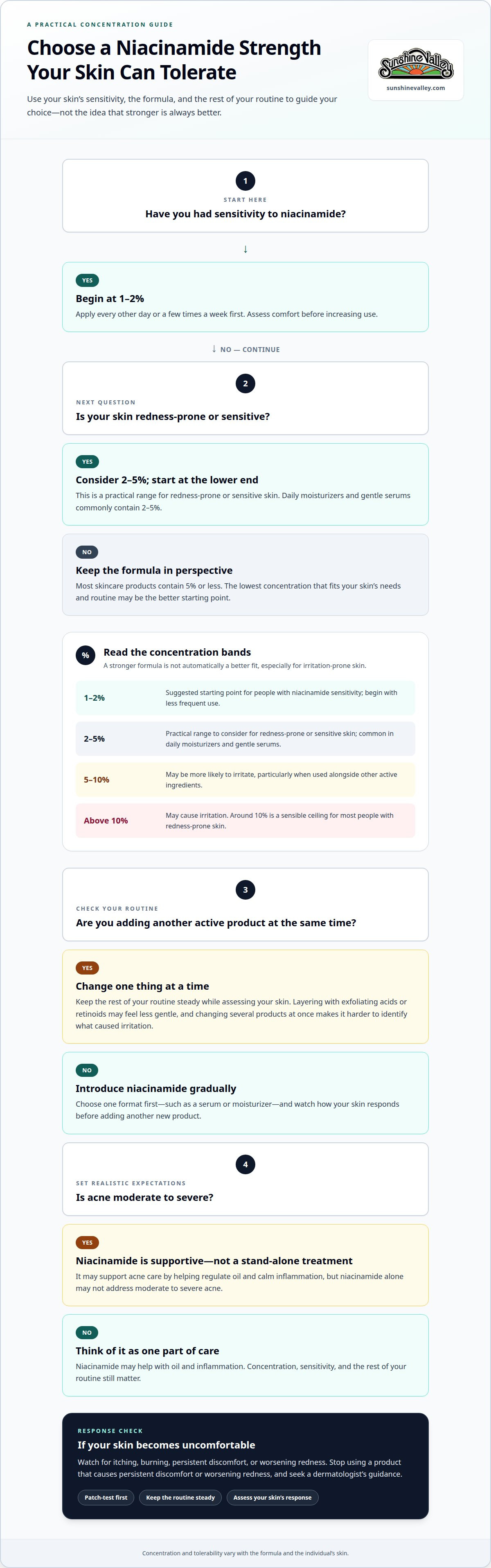
Concentration is the proportion of niacinamide in a skincare formula, and it can affect how comfortable the product feels. Daily moisturizers and gentle serums commonly contain 2-5%, while products with 5-10% may be more likely to irritate, particularly alongside other active ingredients. Most skincare products contain 5% or less. For sensitive skin, choosing a lower concentration helps limit the chance of overloading a routine.
The ingredient is only one part of the formula. A serum layered with exfoliating acids or retinoids may feel less gentle than a moisturizer with fewer active ingredients. For example, starting niacinamide while also increasing exfoliant use makes it harder to identify what caused irritation. Add one new product at a time, and keep the rest of your routine steady while assessing your skin’s response.
Acne care also calls for realistic expectations. Niacinamide may help with oil and inflammation, but it isn’t a stand-alone cure for moderate to severe acne. The right approach depends on acne severity, sensitivity, and the other products in your routine. If breakouts are persistent or severe, niacinamide alone may not address all your skin concerns.
Suggested Concentrations
For redness-prone or sensitive skin, 2-5% is a practical concentration range to consider. Products in the 2-5% range are common in daily moisturizers and gentle serums, and are typically well-tolerated. Starting at the lower end can help a person assess comfort before choosing a stronger formula. The right balance is the lowest concentration that fits the skin’s needs and routine.
People with niacinamide sensitivity are advised to start with 1-2%, applying it every other day or a few times a week before increasing use. Around 10% is a sensible ceiling for most people with redness-prone skin; formulas above 10% may cause irritation. Higher concentrations aren’t required simply because acne is present.
Check the concentration on the product label and consider its format. Niacinamide is available in serums, moisturizers, toners, and masks. A moisturizer may suit someone seeking a straightforward daily product, while a serum may fit a routine that already includes a separate moisturizer. Choose one format first, introduce it gradually, and avoid starting several active products at once. This measured approach helps distinguish irritation from changes related to acne itself.
Use for rosacea, acne, and skin irritation
Topical niacinamide may help calm inflammation associated with acne, rosacea, and eczema. Its role is supportive: it can complement skincare, while irritation from other active ingredients still needs attention.
Irritation from Other Actives
Retinol and glycolic acid can irritate skin, and niacinamide may soothe irritation caused by these exfoliating ingredients. This matters for sensitive skin, where starting several active products at once makes it harder to identify the source of discomfort. Until your skin has adapted, avoid using niacinamide on the same day as strong exfoliating acids or retinoids. Reintroduce products gradually rather than layering them together.
For example, if a routine includes glycolic acid and retinol, adding a niacinamide product on a separate day can make changes easier to track. Keep the rest of the routine gentle and consistent during this adjustment. Niacinamide is a form of vitamin B3, but its presence doesn’t prevent every reaction to another ingredient. Product strength, formula, and the number of active products can all affect comfort.
Recognizing and Troubleshooting Irritation
Possible signs of sensitivity include itching, mild burning, and visible redness. Niacinamide is generally considered gentle for topical use, but an allergic reaction can rarely occur. If redness appears after applying a new product, consider whether another active ingredient, such as retinol or glycolic acid, was introduced at the same time. This can help you adjust your routine more effectively.
If discomfort starts, stop using the newest product and simplify your routine. Use gentle cleansing and moisturizer while your skin settles, rather than adding another active ingredient to counter the reaction. Avoid strong exfoliating acids and retinoids until your skin has adapted. If itching, burning, or redness persists, worsens, or repeatedly returns, seek a dermatologist’s assessment, especially if rosacea or eczema is a concern.
For acne-prone skin, niacinamide may support care by helping regulate oil production and ease inflammation. It isn’t a stand-alone cure for moderate to severe acne, and persistent breakouts may call for a broader care plan. With rosacea, the aim is to support comfort and reduce visible reactivity, not to assume niacinamide treats the condition itself. Track changes in redness and sensitivity as you introduce products.
A measured routine helps protect skin function: introduce one new product at a time, avoid combining it immediately with strong retinoids or acids, and watch for new symptoms. If a formula causes a reaction, pause it instead of increasing use. This approach makes it easier to distinguish a response to niacinamide from irritation linked to another product or an underlying skin condition.
Daily use and patch testing
To patch test niacinamide for sensitive or inflamed skin, apply a small amount to the inner arm or behind the ear and wait 24 hours. Watch for itching, burning, or redness before applying the product to your face.
For regular skincare, apply topical niacinamide after gentle cleansing, once or twice daily. If you use a serum, apply it to clean, dry skin before moisturizer. This order keeps the routine straightforward and helps you notice how your skin responds to the ingredient rather than to several new products at once.
Niacinamide is a form of vitamin B3, and topical use is generally considered gentle. Rare reactions can include an allergic response, itching, mild burning, or redness. A patch test is especially useful when skin is reactive or prone to sensitivity, but it cannot guarantee that facial skin will respond identically. Treat new discomfort as a reason to pause and reassess.
Introduce the product in phases. After patch testing, apply it to a small area of your face before using it across your face. Keep other skincare products familiar during this period. For example, don’t add a new exfoliant on the same day you begin niacinamide; otherwise, it may be difficult to tell which ingredient affected your skin.
If applying it to a small area of your face feels comfortable, increase coverage while keeping your routine simple. Use it once daily at first, then move to twice daily if your skin tolerates that schedule. General topical-use guidance allows once- or twice-daily application after gentle cleansing. Follow the individual product’s directions, since formulas and instructions can differ.
Pay attention to changes after each application. Mild, brief sensations differ from persistent burning; continued itching, new redness, or increasing discomfort calls for a pause. Avoid applying more product to try to speed up results. Let your skin settle, and don’t resume use while irritation remains noticeable.
Once niacinamide is part of a stable routine, keep track of how often you use it and any visible changes. A simple note, such as recording application days and redness, can help reveal a pattern. If a reaction returns each time you use the product, stop using it and seek advice from a dermatologist, particularly if inflamed skin remains sensitive.
Niacinamide’s potential to reduce redness and inflammation
Topical niacinamide may help ease inflammation associated with visible redness, including redness around acne breakouts. For people considering niacinamide for reducing skin redness and inflammation, its role is supportive: it may complement a routine rather than replace care for an underlying skin condition.
Inflammation can contribute to the red appearance of active breakouts and marks that remain after acne settles. Post-inflammatory erythema refers to lingering red marks; post-inflammatory hyperpigmentation refers to darker marks. Niacinamide may help improve the appearance of both, but these terms describe different changes. Distinguishing them can clarify what you hope a skincare ingredient will address.
A 12-week split-face study found that topical niacinamide reduced red blotchiness. The study also reported changes in fine lines, hyperpigmented spots, and sallowness. Separately, a 2025 Delphi consensus selected niacinamide among 23 skincare ingredients for redness and dark spots. These findings support interest in the ingredient, but don’t establish identical results for every formula or routine.
Concentration and consistent use both matter. For redness and sensitivity, 2-5% is a suggested range. Some people may notice a subtle calming effect within a week or two, while a noticeable reduction in overall redness and reactivity may take 4-8 weeks. Assess changes over time rather than judging the routine after one application.
A niacinamide serum can be applied before moisturizer. Niacinamide also appears in moisturizers, toners, and masks. Choose a format that fits your existing routine, then keep other products stable while observing changes. This can make it easier to tell whether redness, breakouts, or texture changes alongside consistent use. If discomfort increases after introducing a product, pause it rather than adding more active ingredients.
Niacinamide versus azelaic acid: Niacinamide may support barrier function and ease inflammation, but the information here doesn’t establish that it works better than azelaic acid. The relevant choice depends on the skin concern, tolerance, and how an ingredient fits your existing routine.
The potential of niacinamide for reducing skin redness and inflammation comes from its supportive role in skincare, not a promise to resolve every cause of redness. It may suit a routine focused on calmer-looking skin, but it isn’t a universal answer for persistent redness, severe breakouts, or every texture concern. Track visible changes and consider your whole routine, including products that may contribute to irritation.
Sunshine Valley: Super Niacinamide
Sunshine Valley’s Super Niacinamide offers a way to explore niacinamide as a supplement ingredient, distinct from the topical skincare products discussed above. The evidence on skin redness concerns topical use, so don’t assume a supplement produces the same effects on skin.
If you’re considering niacinamide for another purpose, clarify how the product fits your needs and follow its directions. Sunshine Valley® also offers Super Mannitol, Super Inositol, and Super Lactose. These are separate offerings, not substitutes for dermatological care or topical products.
For persistent redness or inflammation, seek a dermatologist’s advice about appropriate care. Contact Sunshine Valley to learn more about Sunshine Valley® Super Niacinamide.
Choose a thoughtful next step for your skin
If you’re considering niacinamide for reducing skin redness and inflammation, treat it as one possible part of a considered skincare routine, not a substitute for understanding persistent redness. Keep track of product changes and symptoms. A dermatologist can assess ongoing or worsening redness and distinguish sensitivity from acne-related marks or another skin concern.
Keep topical skincare separate from supplements. Evidence about topical niacinamide does not establish that a supplement will reduce facial redness. Sunshine Valley offers Sunshine Valley® Super Niacinamide, Super Mannitol, Super Inositol, and Super Lactose. Review product directions and consider whether a supplement suits your goals rather than expecting a particular skin result.
If you’d like product information, contact Sunshine Valley today. A clear understanding of your skin’s needs can help you choose a sensible next step.
Frequently Asked Questions
What is niacinamide and why is it used in dermatology?
Niacinamide, also called nicotinamide, is a water-soluble form of vitamin B3 used in topical skincare. Dermatology uses it as a supportive ingredient because it may help maintain the skin barrier and ease inflammation. For example, a formula might be considered when someone wants to address both dryness and visible redness. It isn’t a prescription medication or a substitute for assessing persistent skin symptoms.
How Does Niacinamide Calm Redness?
Niacinamide may calm redness by supporting barrier function and helping reduce inflammation. A more resilient barrier can better retain moisture and limit irritation from external stressors. Redness linked to acne may also look calmer as inflammation eases. These effects relate to appearance and skin comfort; they don’t establish niacinamide as a treatment for every cause of facial redness, including an underlying skin condition.
What Does Niacinamide Do for Skin?
Topical niacinamide may support hydration, barrier function, and a more even-looking complexion. It may also help reduce the appearance of dark spots and red marks left after acne. These changes are different from removing textural scars, such as pitted or rolling scars. When planning a routine, consider the main concern you’re targeting, the product’s formula, and how your skin responds with consistent use.
Can I use niacinamide with vitamin C?
Niacinamide and vitamin C can be included in the same skincare routine, but introduce them separately so you can observe your skin’s response to each. For example, keep one ingredient in your morning routine and the other at night while you assess comfort. If either product causes persistent itching, burning, or increased redness, pause it. Follow each product’s directions and avoid adding several new actives at once.
Can You Layer Niacinamide With Other Actives?
Niacinamide can be part of a routine with other active ingredients, but layering choices affect tolerability. Retinoids and strong exfoliating acids, such as glycolic acid, can contribute to irritation. Until your skin has adapted, use niacinamide on a different day from strong acids or retinoids. Introduce one product at a time, keep the rest of your routine stable, and pause an ingredient if discomfort develops.
How long does niacinamide take to work?
Visible changes from daily niacinamide use are generally assessed over four to twelve weeks. Some people may notice a subtle calming effect within a week or two, while a noticeable reduction in overall redness and reactivity may take four to eight weeks. Timing varies with the product and routine. Track changes under similar lighting and note new products to make gradual shifts easier to assess.
Niacinamide: Does It Live Up to the Buzz?
Niacinamide has useful supportive roles, but it isn’t a cure-all. It may help support the skin barrier and hydration, ease inflammation, and improve the appearance of some acne-related marks. Its value depends on the concern, formula, and how well it fits your routine. It won’t treat every cause of redness or textural acne scars, so judge it by the specific skin change you want to address.
How does topical niacinamide reduce skin redness and inflammation?
Topical niacinamide may reduce visible redness by helping ease inflammation and support the skin barrier. This can matter when redness accompanies acne or sensitivity, since irritation and barrier stress can affect comfort and appearance. Niacinamide may also help lessen red marks left after acne. Persistent redness, worsening symptoms, or repeated irritation warrants a dermatologist’s assessment to identify the underlying concern.



Leave a comment
This site is protected by hCaptcha and the hCaptcha Privacy Policy and Terms of Service apply.