




A “pure” or “minimal” label isn’t a substitute for reading the ingredient list. For peace of mind with pure ingredients, review the full list, note ingredients relevant to your sensitivities, and consider the product’s directions, warnings, and available batch information. A shorter list may be easier to scan, but it doesn’t by itself show whether a product suits you.
It’s understandable to want clear labels and reassurance about what goes into a product. Look beyond marketing claims: identify additives, consider potential allergens in botanical ingredients, and distinguish ingredient transparency from information about contaminants. This article explains how to read labels carefully, compare claims such as “pure” and “minimal,” and understand what ingredient lists can and can’t tell you. You’ll also learn what to look for when exploring products with simpler formulas, so you can make a more informed choice.
Key Takeaways
- Read the complete ingredient list rather than relying on “pure” or “minimal” claims alone.
- Consider potential allergens, additives, directions, warnings, and available batch information when assessing a product.
- Compare “natural,” “organic,” and “pure” as distinct claims, and look for clear details about what each one means.
- Use relevant certifications and U.S. regulations as context, while recognizing that a label claim doesn’t replace ingredient review.
- Compare products by their ingredients, formulation, and amount provided; a higher price alone doesn’t establish greater purity.
Brands offering products with pure or minimal ingredients
Brands use “pure” and “minimal” in different ways, so compare the full formula with the claim. Consider where the ingredients come from and what information the brand provides about quality and contaminant controls.
Brands with Minimal Ingredient Formulas
A minimal formula contains a limited selection of ingredients chosen for specific roles. Fewer listed ingredients can make a label easier to review, but the count alone doesn’t establish purity or suitability. A short list may still include an ingredient that matters to you. Focus on each ingredient’s identity and purpose, not a low count as a guarantee.
Look for specific, verifiable details beside broad language. Whole Foods Market, for example, bans more than 240 ingredients commonly used in beauty and body products. That policy is a retailer standard for those product categories, not proof that every item sold there has a minimal formula. It also illustrates why readers should identify exactly what a brand’s claim covers: one product, a product range, or a retailer’s screening policy.
Compare like with like. Check whether a “minimal” claim refers to the ingredient list, packaging, fragrance, or a particular ingredient the brand excludes. A brand that names excluded substances gives you a clearer basis for comparison than one relying only on “clean” or “pure.” That clarity can make it easier to compare products across categories.
- Match the claim to the exact product and its full ingredient list.
- Note whether “minimal” describes a shorter formula or a named exclusion.
- Separate retailer policies, such as Whole Foods Market’s beauty and body standards, from a manufacturer’s own claims.
Questions About Sourcing and Testing
Questions about sourcing and testing ask a brand to explain ingredient origins and quality checks. These details matter because “pure” alone doesn’t describe how ingredients are obtained or assessed. Consider whether the brand identifies ingredient sources, explains its quality criteria, and provides information about testing ingredients or finished products for relevant contaminants.
Ask specific questions: “Where is this ingredient sourced?” “What checks are used for incoming ingredients?” “Does testing apply to each batch or selected batches?” You can also ask how the brand handles results that fall outside its quality criteria. Clear answers describe a process rather than simply repeating a marketing term or promising exceptional quality.
Compare the response with the product label and the claim being made. If a brand describes a formula as fragrance-free, for example, ask what that means for the specific product. For a product marketed as minimal, consider which ingredients serve key functions and why they’re included. Direct answers help distinguish a documented quality approach from a claim that offers little detail.
Checking ingredient lists for additives, allergens and contaminants
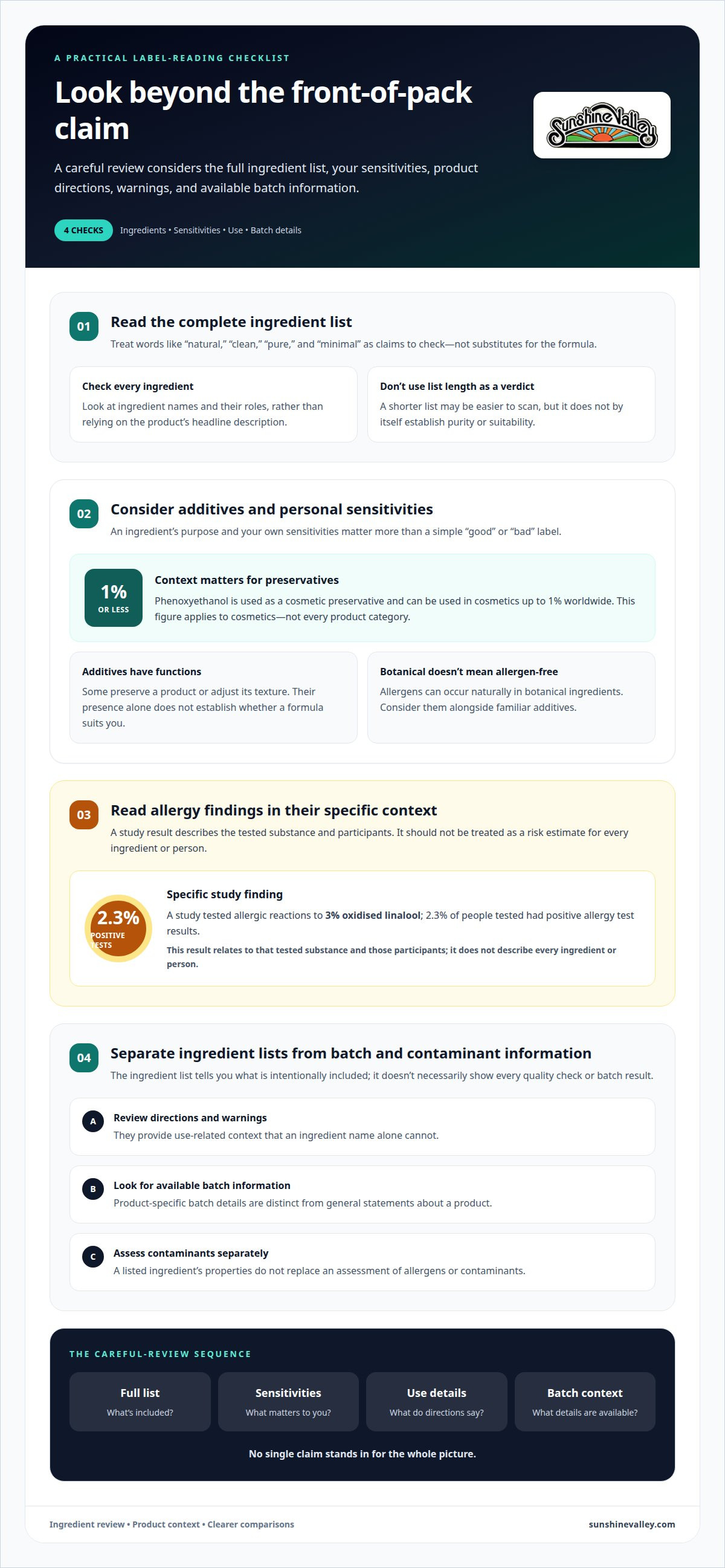
A careful label review looks beyond the front-of-pack claim. Read the full ingredient list, then consider your sensitivities, the product’s directions and warnings, and any available batch information. These details help distinguish what a formula contains from what marketing language suggests.
Start with ingredient names and functions. Additives may serve purposes such as preserving a product or adjusting its texture, so their presence alone doesn’t establish whether a formula is suitable. Phenoxyethanol, for example, is used as a cosmetic preservative, and it can be used in cosmetics up to 1% worldwide. That figure applies to cosmetics, not every product category. Check the context before applying it to a label.
Allergens can occur naturally in botanical ingredients. A study tested allergic reactions to 3% oxidised linalool; 2.3% of people tested had positive allergy test results. That result relates to the tested substance and participants. It doesn’t describe the risk for every ingredient or person. A botanical origin, therefore, doesn’t automatically mean an ingredient is free from allergy concerns.
Contaminants require a different assessment from listed ingredients. An ingredient list identifies what is intentionally included, but it doesn’t necessarily describe every quality check or batch result. Sweet almond oil’s fatty-acid composition, for instance, doesn’t replace assessment of allergens or contaminants. Look for available batch information and distinguish it from general statements about a product.
- Read the full list. Don’t stop at “natural,” “clean,” or “minimal” on the package.
- Consider your own sensitivities. Pay attention to botanical ingredients as well as familiar additives.
- Review directions and warnings. These provide context that an ingredient name alone cannot.
- Look for batch details. Available batch information can add product-specific context beyond general claims.
For a practical review, consider the complete ingredient list alongside directions, warnings, and any available batch information. These details support an informed assessment without making a single claim stand in for the whole picture.
For a next step, explore supplement ingredient options alongside the label details that matter to you.
Differences between natural, organic and pure ingredient claims
“Natural,” “organic,” and “pure” describe different ideas, not interchangeable qualities. Their meaning depends on the product, the scope of the claim, and any supporting standard.
Meaning of Natural, Organic, and Pure Claims
“Natural” generally points to an ingredient’s origin or processing, while “organic” refers to production under an organic standard. “Pure” may describe an ingredient’s composition or a product’s formulation, but the word alone doesn’t provide a shared definition. “Clean” is also used broadly. These distinctions matter because a claim about one ingredient doesn’t necessarily describe the whole product.
Consider a face cream labelled “natural.” That word doesn’t tell you whether every ingredient is naturally derived, how ingredients were processed, or whether the product contains a potential allergen. An “organic” claim also needs context: identify the ingredient or product it applies to, then look for the named certification and its scope. “Pure” may refer to one ingredient, not a formula free from every additive.
The risk of relying on “pure ingredients” marketing is assuming the phrase establishes quality, safety, or suitability by itself. It may leave key details unclear, such as which ingredients the claim covers or what “pure” means for that formula. Compare the wording with the full ingredient list, product directions, warnings, and any named supporting standard.
Use a simple comparison: write down the exact claim, what it applies to, and what evidence accompanies it. For example, “made with organic ingredients” isn’t the same as a certification applying to the whole product. This distinction helps you assess the claim without treating a prominent front-label phrase as a complete description.
Certifications and Regulations Supporting Claims
In the United States, a named certification can define a standard and its scope, but the logo alone doesn’t explain what was certified. The Food and Drug Administration (FDA) and Federal Trade Commission (FTC) are relevant agencies to recognize when considering product labels and advertising. Broad words like “pure,” “natural,” and “clean” alone aren’t proof of FDA or FTC certification.
Those three words don’t convey one universal certification. Check the exact certification name, the product or ingredients covered, and the explanation supporting the claim. If a package makes an organic claim, look for specific certification details rather than assuming “organic” describes every ingredient. A clear scope makes claims easier to compare across products.
- Identify the claim: Is it “natural,” “organic,” “pure,” or “clean”?
- Define its scope: Does it apply to one ingredient or the entire formula?
- Look for support: Is a certification or specific standard named?
- Compare the evidence: Does the product information explain what the claim means?
What certifications or regulations support pure ingredient claims in the United States?
A “pure” claim doesn’t name a certification or explain a regulatory standard. In the United States, assess the specific claim, any certification named on the package, and the evidence supporting the wording. A label term alone can’t tell you what was evaluated or which parts of a product the claim covers.
Begin with the exact wording. “Pure ingredient” might refer to one ingredient, while “pure formula” may suggest a broader claim. The phrases aren’t interchangeable. Look for a certification’s full name and the standard it represents. Then determine whether it applies to an ingredient, the finished product, or a particular production practice.
A seal without a clear name gives you little to compare. For example, a package might display a generic leaf symbol beside “pure.” That image alone doesn’t identify a certifying organization, its criteria, or the formula covered. A named certification and an explanation of its scope provide more useful context than a symbol by itself.
Regulatory support and voluntary certification are different kinds of information. A regulation establishes requirements within its scope; a certification indicates that a defined standard applies. Neither should be assumed from words such as “natural,” “clean,” or “pure.” Check the specific product category and claim before treating a mark as proof of a particular quality.
- Read the full claim. Note whether it describes one ingredient or the finished product.
- Identify the certifier. Look for a complete organization name, not only a logo.
- Find the standard’s scope. Determine what ingredient, product, or practice it covers.
- Compare claim and evidence. See whether the explanation supports the wording used on the package.
For example, if a product says “made with pure botanicals,” identify which botanicals the claim refers to. Check whether an accompanying certification evaluates those ingredients or another aspect of production. A certification related to one ingredient shouldn’t be read as covering every ingredient in the formula.
Keep the product category in view. A certification created for one type of product may not answer questions about another. Likewise, a regulation that applies to a specific claim or category shouldn’t be treated as a universal purity standard. Check that the named organization, its criteria, the product covered, and the label wording all correspond.
This approach doesn’t require technical expertise. It helps separate a named standard from broad marketing language and gives you a consistent way to assess claims across products. If a label offers no certification, focus on the precise claim and the supporting information provided.
Pure vs. Conventional Products: Price Comparison
“Pure” and “conventional” labels don’t establish a consistent price difference. A product’s cost depends on its ingredients, sourcing, manufacturing, packaging, and quantity. Compare specific products and formulas rather than assuming a purity claim automatically means a higher price or better value.
Start with products serving the same purpose. For example, compare two face moisturizers with similar amounts and intended uses. Review their ingredient lists, fragrance claims, and any named standards alongside package size. A specialty botanical or certification may help explain a difference, but it doesn’t prove the product is more suitable for you.
Unit cost can make package comparisons clearer. Divide the listed price by the product amount, using the same unit for each option. A larger package may cost less per unit, while a smaller one may be easier to use before its recommended period after opening. This comparison describes value by quantity, not ingredient quality or personal suitability.
Formula length isn’t a reliable shortcut for estimating price, either. A short ingredient list can include costly-to-source ingredients, while a longer formula may contain common components. For example, compare the actual ingredients in two fragrance-free lotions instead of treating a short list as proof of lower production costs. The label explains the formulation, but not every expense behind it.
Other product details can affect the comparison. A glass container, specialized processing, or certification can contribute to a product’s positioning, but each claim needs context. Check what a certification covers, whether package amounts differ, and whether the products make comparable claims. Don’t treat “natural,” “clean,” or “pure” as price categories with fixed meanings.
- Match the category: Compare products with the same intended use, such as two moisturizers.
- Compare quantity: Use the same unit to understand cost per amount.
- Review the formula: Look at named ingredients and their roles, not only the front label.
- Separate price from proof: A higher price doesn’t establish purity or suitability by itself.
A practical decision uses both cost and product details. For example, if two options have similar package amounts, compare their ingredient lists and the claims each one supports. If you’re weighing ingredient choices alongside cost, explore ingredient-focused options as part of your comparison.
Sunshine Valley
Sunshine Valley offers ingredient-focused options for readers comparing supplement labels and formulas. Its range includes Sunshine Valley® Super Mannitol, Sunshine Valley® Super Inositol, Sunshine Valley® Super Lactose, and Sunshine Valley® Super Niacinamide. These products may be relevant when you’re considering specific ingredients as part of an informed purchasing decision.
Use the principles in this guide to assess any product: review its ingredient information and consider whether it fits your needs. A “pure” or “minimal” description shouldn’t replace that assessment. Sunshine Valley’s offerings provide a place to begin exploring individual supplement ingredients.
Contact Sunshine Valley to discuss its ingredient-focused offerings.
Make Your Next Choice With Confidence
Let your priorities guide the next step. If you’re considering supplements, peace of mind with pure ingredients starts with choosing options that fit your needs and reviewing each product’s information carefully. Sunshine Valley offers Sunshine Valley® Super Mannitol, Sunshine Valley® Super Inositol, and Sunshine Valley® Super Lactose for those exploring these ingredients.
Keep the decision practical: focus on the ingredient you’re seeking and the product details that matter to you. A clear, considered choice is more useful than relying on a broad claim alone.
Contact Sunshine Valley to learn more about its ingredient offerings. Take the time you need to choose with care.
Frequently Asked Questions
How can I check ingredient lists for additives, allergens and contaminants?
Start with the exact product version, since similarly named products may have different formulas. Read the full list and serving directions, then note ingredients you already know you need to avoid. For contaminant questions, look for product-specific batch details or testing information. If the label doesn’t explain a term, note its exact wording so you can ask the manufacturer about that ingredient.
Why does checking ingredients matter?
Reviewing ingredients helps you choose based on your needs rather than relying on a front-label claim. For example, someone avoiding dairy should pay attention to lactose and other dairy-derived ingredients. Someone with a known sensitivity may also need to consider botanical or fragrance components. A label can help identify relevant information before purchase, but it can’t predict how every individual will respond.
What does “peace of mind with pure ingredients” mean?
For many shoppers, peace of mind with pure ingredients means having clear information about what a product contains and why. It isn’t a technical grade or a universal promise. For example, a simple ingredient name may make a formula easier to understand, while “pure” alone doesn’t explain sourcing, testing, or personal suitability. The useful standard is transparency that supports an informed choice.
Which products or brands use the phrase “peace of mind with pure ingredients”?
The phrase itself doesn’t identify a specific product or brand. It’s descriptive wording, not a product name. A brand may express similar ideas using its own label language, so compare the exact claim on a product with the ingredient information provided. Don’t assume a product uses the phrase or meets a particular standard just because it contains one ingredient or has a short list.
What ingredients are considered pure or clean in consumer products?
There isn’t one universal ingredient list that makes every consumer product “pure” or “clean.” The meaning depends on the product and the claim. A single-ingredient product, for example, may be straightforward to identify, but that alone doesn’t establish sourcing or quality. Assess ingredients by their names, roles, and relevance to your needs rather than treating “clean” as a fixed category.
How can consumers verify ingredient purity and product safety?
Use the product label as a starting point, then look for specific quality information tied to the product or batch. Useful details include the scope of testing, the contaminants assessed, and whether results apply to the ingredient or finished product. A general quality statement doesn’t answer those questions by itself. Keep the product name and batch details together when reviewing supporting documentation.
What common allergens or harmful ingredients should consumers watch for?
There’s no single list that applies to every person or product. Dairy-derived lactose may matter to someone with lactose intolerance, while others may need to consider fragrance components or botanical ingredients. An additive’s presence alone doesn’t establish that it’s harmful. Focus on known sensitivities, product warnings, and the role of each ingredient. People with specific health conditions should consult a healthcare provider before use.



Leave a comment
This site is protected by hCaptcha and the hCaptcha Privacy Policy and Terms of Service apply.