




What if a supplement’s clean-sounding label tells you very little about what has been tested? If you’re focused on avoiding heavy metals in supplements, that uncertainty is understandable. Contamination can enter at different points, from raw ingredients to manufacturing, while broad phrases such as “pure” or “lab-tested” don’t reveal which metals were measured, in which product, or at what level.
The clearest choice isn’t necessarily the one with the strongest purity claim. It’s the one supported by specific, relevant evidence. This guide explains common sources of heavy metals, what general safety language can and can’t establish, and how testing details can make product comparisons more meaningful.
You’ll learn what to look for in product-specific results, including a certificate of analysis, how to interpret labels and third-party certifications, and where regulatory standards fit in. Use the checklist to assess powdered supplements and other products without assuming that a polished label or a single test claim tells the whole story.
Key Takeaways
- For avoiding heavy metals in supplements, prioritize current, product-specific test documentation over broad purity claims.
- Check which contaminants a lab result measures and whether it applies to the product batch you’re evaluating.
- Read quality seals within their stated scope. A certification doesn’t automatically verify every product detail or contaminant.
- Use a repeatable checklist to compare labels, testing information, and ingredient claims before choosing a supplement.
- Sunshine Valley emphasizes premium ingredients, state-of-the-art manufacturing, and strict hygiene standards as part of its approach to supplement quality.
Avoiding Heavy Metals in Supplements: Understand the Concern Before You Choose
Heavy metals are elements that may be present as contaminants in supplement ingredients or finished products. Lead, cadmium, arsenic, and mercury are often discussed in testing. Their presence deserves attention, but detecting an element alone doesn’t tell you how much someone may consume, how often they’re exposed, or what health risk that exposure may pose.
Hazard describes a substance’s potential to cause harm; risk considers the likelihood and level of harm under specific exposure conditions. For supplements, interpretation depends on the substance, amount, frequency of use, other sources of exposure, and individual circumstances. A result is a reason to examine the details, not by itself a diagnosis or proof that a product caused harm. For foundational context on how certain metals can affect the body, see Metal toxicity.
Which heavy metals are commonly discussed in supplements?
Lead and cadmium can enter the environment and may be taken up by some crops. Mercury occurs in different forms and can reach people through various environmental pathways. Arsenic is technically a metalloid, but it’s often included in discussions of heavy-metal contaminants. It also exists in different forms: inorganic and organic arsenic don’t have the same significance, so a result reporting “total arsenic” may not provide the full picture. These substances aren’t interchangeable; their forms, sources, and exposure contexts differ.
How can heavy metals enter a supplement?
Contamination can arise at more than one point in the supply chain. Soil and water may contain naturally occurring or human-introduced contaminants. Crops can absorb elements as they grow, while other raw materials may carry residues from their origin or handling. Processing equipment, manufacturing water, or contact with surfaces can also contribute if controls are inadequate.
Natural doesn’t mean contaminant-free. A plant-derived ingredient may come from soil with varying conditions, and a mineral or other raw material has its own sourcing and processing considerations. At the same time, origin alone can’t establish the contaminant level in the finished supplement. That depends on the ingredient, manufacturing controls, and the specific product and batch. For anyone focused on avoiding heavy metals in supplements, the useful question isn’t simply whether an ingredient is natural or where it came from. It’s what relevant evidence says about the finished product.
How Heavy-Metal Testing Works, and What a Result Can Tell You
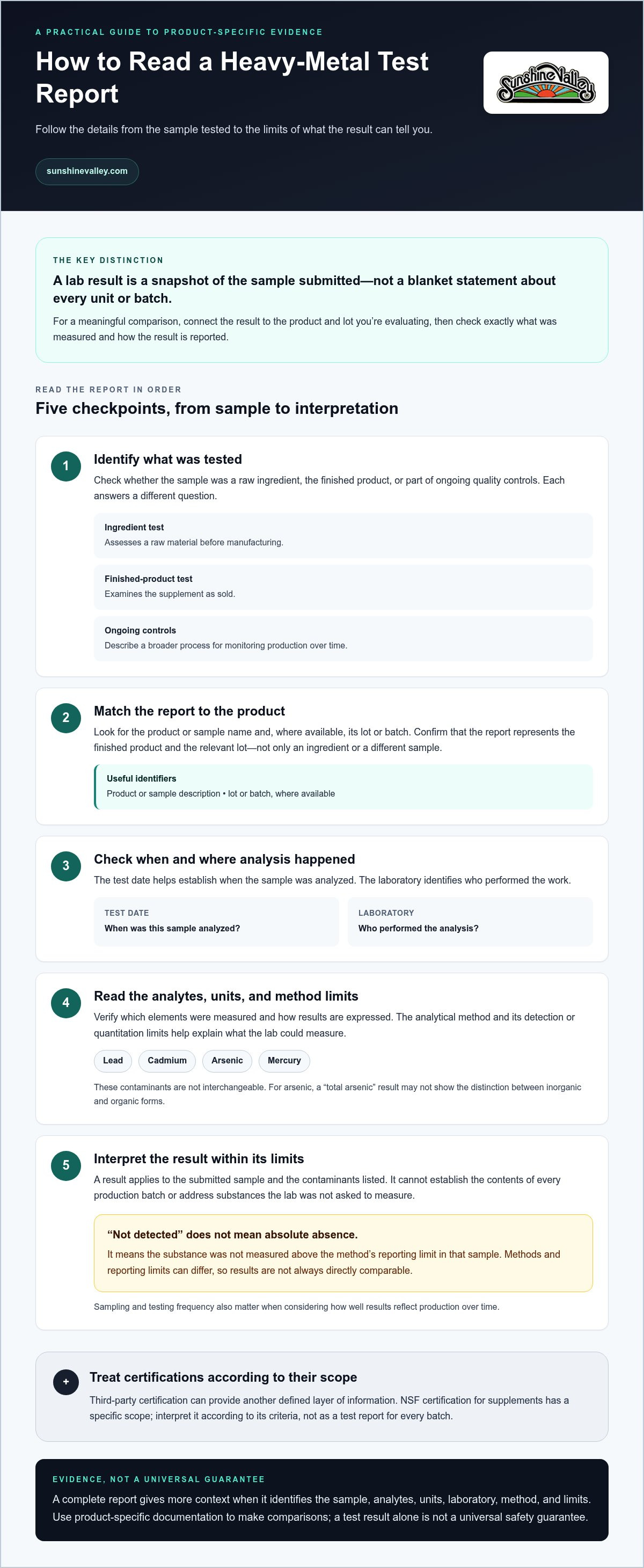
Laboratory analysis measures specified contaminants in a sample submitted for testing. The report is a snapshot of that sample, not a blanket statement about every unit a company makes. To interpret it, identify what was tested: an ingredient before manufacturing, a finished product, or samples taken as part of ongoing quality controls. Each answers a different question. Ingredient testing assesses a raw material; finished-product testing examines the supplement as sold; ongoing controls describe a broader process for monitoring production over time.
What should a useful test report identify?
Look for enough detail to connect the result to the product you’re evaluating. A useful report should identify:
- Product or sample: The name or description and, where available, the lot or batch.
- Test date and laboratory: These help establish when the sample was analyzed and who performed the work.
- Analytes and units: Check which elements were measured, such as lead or cadmium, and how results are reported.
- Method and limits: The analytical method and detection or quantitation limits help explain what the lab could measure and how to interpret a “not detected” result.
Confirm whether the report represents the finished product and the relevant lot, rather than only an ingredient or a different sample. Third-party certification can provide another defined layer of information. For example, NSF certification for supplements has a specific scope. Interpret it according to the certification’s criteria, not as a report for every batch.
What testing cannot prove on its own
A result applies to the sample submitted and the contaminants listed. It can’t establish the contents of every production batch, and it says nothing about substances the lab wasn’t asked to measure. Sampling and testing frequency also matter when considering how well results reflect production over time.
“Not detected” doesn’t mean absolute absence. It means the tested substance wasn’t measured above the method’s reporting limit in that sample. Reporting limits and laboratory methods can differ, so results aren’t always directly comparable. A result without its units, analyte list, and limits offers less context than a complete report.
For avoiding heavy metals in supplements, treat testing as product-specific evidence, not a universal safety guarantee. Sunshine Valley emphasizes premium ingredients, state-of-the-art manufacturing, and strict hygiene standards. These quality priorities provide context, while metal-specific conclusions require relevant test documentation. Explore the powdered supplement range with that distinction in mind.
Compare Supplement Quality Claims with Product-Specific Evidence
Supplement labels and quality statements can offer useful context, but they don’t all answer the same question. “Premium” may describe an ingredient standard, while a certification refers to a defined program. A product- or lot-specific laboratory report can provide measured results for listed contaminants in a particular sample. For avoiding heavy metals in supplements, compare the type and scope of evidence rather than treating every quality claim as equivalent.
| Claim or evidence | What it may tell you | What to look for |
|---|---|---|
| Broad purity language, such as “pure,” “natural,” or “premium” | How a company describes its ingredients or quality priorities. | Does the statement identify specific contaminants, results, or a tested product? The wording alone doesn’t disclose metal concentrations. |
| Third-party certification | That a product or process has been evaluated against a particular program’s requirements. | Identify the certifying organization, exact program, product, and current certification status. A seal applies only within its defined scope and criteria. |
| Product- or lot-specific test documentation | Measured results for specified analytes in the sample described by the report. | Match the product and lot where possible. Review the test date, analytes, units, laboratory, method, and reporting limits. |
A label claim alone can’t demonstrate a measured contaminant level; that requires results tied to a defined sample and test. Likewise, clean manufacturing practices and careful ingredient selection can support quality, but they aren’t measurements of lead, cadmium, arsenic, or mercury. Sunshine Valley emphasizes premium ingredients, state-of-the-art manufacturing, and strict hygiene standards. Those priorities provide context about its approach to quality, not proof of metal-specific test results.
How do third-party programs and standards fit in?
NSF International describes its dietary supplement certification programs and their defined verification scope. USP’s published standard for elemental contaminants in dietary supplements offers voluntary guidance; a standard and a certification seal aren’t the same thing. Before relying on a seal, check the organization’s current program details and certification listing. Neither participation nor certification means zero contaminants or guarantees an individual health outcome.
The FDA’s role in regulating supplements provides further context on federal oversight and dietary supplement requirements. Regulatory oversight, a company-wide quality statement, and a laboratory report each serve different purposes. Treat them as distinct pieces of information, and give the most weight to current evidence that identifies the product, sample, and contaminants measured.
A Practical Checklist for Avoiding Heavy Metals in Supplements
Use this checklist before buying a supplement and when reviewing its quality information. Specific, current evidence is more useful than a general assurance or an ingredient-origin claim, but no single report can account for every possible source of exposure.
Five checks to make before choosing a supplement
- 1. Identify the exact product and format. Check the product name, serving format, ingredients, and directions. A report for a raw ingredient may not describe the finished supplement.
- 2. Look for product-specific test documentation. Check that the report identifies the sample and, where available, the product’s lot or batch. A general company statement doesn’t tell you what was measured in a particular product.
- 3. Review the analytes and laboratory details. Confirm which metals were tested, the test date, laboratory identification, units, and method. For a “not detected” result, note the reporting limit rather than interpreting it as proof of absolute absence.
- 4. Check how current and representative the evidence is. Determine whether results relate to the product and lot you’re evaluating. Consider whether the documentation explains how testing fits into quality controls over time.
- 5. Consider your broader exposure context. Supplements are only one possible source of exposure. Food, water, and environmental factors may also be relevant, so don’t use a single product result to calculate personal risk or make assumptions about your total exposure.
In summary, check the scope, sample, analytes, date, and method before drawing conclusions from a test report. These details clarify what the evidence covers and where its limits are.
When to seek individualized guidance
If you’re pregnant, have a health condition, take medication, or have a known exposure concern, discuss supplement use with a qualified healthcare professional. They can consider your circumstances rather than relying on a label or isolated test result. Don’t self-diagnose, attempt to treat a suspected exposure, or stop prescribed care based on supplement documentation.
If you suspect an acute exposure or are experiencing symptoms that concern you, contact appropriate medical or poison-control services promptly. For routine shopping, keep the checklist focused on transparent, product-relevant evidence. You can explore Sunshine Valley’s powdered supplements while applying the same careful standards to quality information.
A More Informed Approach to Supplement Quality at Sunshine Valley
A careful supplement choice rests on evidence that matches the product and the question you’re asking. Apply the same checklist across the market: identify the exact product and lot, review which contaminants were measured, and check the report date, laboratory, method, and limits. Ingredient origin and broad quality claims can offer useful context, but they can’t replace product-specific results when you’re assessing heavy metals.
Founded in 1956, the company offers powdered supplements including inositol, mannitol, lactose, niacinamide, and MSM. These describe the brand’s approach to ingredient and manufacturing quality. They’re distinct from evidence about the measured level of a specific heavy metal in a particular product or lot. Keep that distinction clear as you evaluate any supplement.
How to read quality information with care
Use one standard for every label and report. A description of hygienic supplement manufacturing can help explain process considerations, while a mannitol quality standards guide can offer a closer look at product-quality topics. Neither type of general information should be mistaken for heavy-metal test results. For ingredient-specific reading, Sunshine Valley’s niacinamide vitamin B3 powder guide and premium MSM powder guide provide related perspectives on powdered ingredients. Consider each resource for what it covers, then return to product-specific evidence when evaluating contaminants.
Continue learning about supplement quality
The goal of avoiding heavy metals in supplements isn’t to assume that a particular ingredient or brand is automatically free of contaminants. It’s to make a measured decision using transparent, relevant information while recognizing what that information does and doesn’t establish. A consistent approach helps you compare products without relying on reassuring language alone.
Explore the Sunshine Valley supplement range as you continue evaluating powdered supplement quality with care.
Choose Your Next Supplement with Clearer Evidence
A more informed approach to avoiding heavy metals in supplements starts with distinguishing a general quality claim from measured, product-specific evidence. A test report is useful when it identifies the sample, analytes, date, and method, but its findings apply only within that stated scope. Detecting a contaminant doesn’t, by itself, establish an individual’s exposure or health risk.
Sunshine Valley, founded in 1956, emphasizes state-of-the-art manufacturing and strict hygiene standards. These are important quality commitments, but they aren’t a substitute for heavy-metal results tied to a particular product or lot. Apply the same careful checklist to every supplement you consider, and give greater weight to clear, current documentation than to broad language alone.
Explore Sunshine Valley’s powdered supplement range to learn more about the brand and its products. Use the checklist in this guide as you compare supplement quality and choose your next product.
Frequently Asked Questions
Can supplements contain heavy metals even when they are labeled natural?
Yes. “Natural” describes an ingredient’s source or marketing, not whether it contains contaminants. Elements such as lead or cadmium can occur in soil or water and may enter some raw materials; handling or processing may also contribute. A natural label alone doesn’t establish the level in a finished supplement. For a more informed choice, look for relevant test documentation tied to the product or lot, rather than relying on origin claims alone.
How can I tell whether a supplement has been tested for heavy metals?
Look for a test report or certificate of analysis that identifies the product or sample, the laboratory, test date, metals measured, units, and method or reporting limits. Check whether the sample was the finished product and whether its lot matches the one you’re considering. A phrase such as “lab-tested” without these details doesn’t show which contaminants were analyzed or what the results were.
What heavy metals should I look for in supplement test results?
Commonly discussed contaminants include lead, cadmium, arsenic, and mercury. Check that the report names the analytes rather than using a broad phrase such as “heavy metals.” Arsenic can occur in different forms, and total arsenic may not distinguish them. Also review units, serving information, and reporting limits. These details help you understand what the report measures, but a detectable result alone doesn’t establish personal exposure or health risk.
Does third-party testing mean a supplement is free of heavy metals?
No. Third-party testing can add useful independent evidence, but it applies to the sample, analytes, and method described. A non-detect result means the substance wasn’t measured above the method’s reporting limit in that sample, not that it is absolutely absent. Certification programs also have defined scopes and criteria. Review what the program covers, which product is included, and whether the information is current before drawing conclusions.
Are powdered supplements more likely to contain heavy metals than capsules?
Not necessarily. Powder versus capsule describes the serving format, not the contaminant level. Risk depends on factors such as the ingredients, their sourcing, manufacturing controls, and the finished product. A capsule may contain powder, while a powder may use different kinds of ingredients. Don’t assume one format is cleaner. Compare product-specific evidence, and check that any report represents the finished product rather than only a raw ingredient.
What should I do if a supplement test report shows a detectable metal?
Read the result in context before deciding what it means. Confirm the metal, amount, units, sample or lot, serving information, and method limits. A detectable result alone isn’t a diagnosis or proof of harm. If you’re pregnant, have a health condition, take medication, or are concerned about exposure, discuss the report and supplement with a qualified healthcare professional. For suspected acute exposure or concerning symptoms, contact medical or poison-control services promptly.
Can taking several supplements increase my overall exposure to heavy metals?
It can contribute to overall exposure if more than one product contains a measurable amount of the same contaminant. Food, water, and environmental sources may also matter, so a single supplement report can’t show your total exposure. Review the evidence for each product and avoid calculating personal risk from incomplete information. If you have a known exposure concern or questions about several supplements, seek individualized guidance from a qualified healthcare professional.



Leave a comment
This site is protected by hCaptcha and the hCaptcha Privacy Policy and Terms of Service apply.