




What if a supplement COA looks convincing but doesn’t match the product batch you’re considering? Learning how to read a certificate of analysis for supplements takes more than spotting a “pass” result. First confirm that the report identifies the product and lot you’re evaluating, then interpret each result in light of its method, units, and reporting limits.
A certificate of analysis can make some quality information easier to assess, but technical terms and precise-looking numbers don’t answer every question. A result applies to the sample tested, and its meaning depends on how the analysis was performed and what the lab could detect or report. A COA is useful evidence, not a blanket guarantee of a product’s safety or quality.
This guide explains how to review a COA field by field. You’ll learn to check the product, lot, lab, and test dates, interpret results and units cautiously, and understand what methods and detection limits can tell you. Use the checklist to assess the report without overstating what it proves.
Key Takeaways
- Review each COA field in a consistent order so that you can spot mismatches and missing context.
- Match the product name, form, and lot number to the exact supplement batch you’re evaluating.
- Compare specifications, measured results, units, methods, and reporting limits before drawing conclusions.
- Use a COA as evidence about the sample tested, not as a complete guarantee of safety or quality.
- Apply the same checklist to powdered supplements, including Sunshine Valley’s Inositol, Mannitol, Lactose, MSM, and Niacinamide.
What a Supplement Certificate of Analysis Tells You, and What It Does Not
A Certificate of Analysis (COA) records analytical results for a specified sample or production batch. Depending on the tests listed, it may show whether a material was identified as expected, how much of a measured substance was present, or whether selected contaminants were detected. A Certificate of Analysis (COA) is a laboratory document, not a broad declaration that every aspect of quality has been assessed.
Start by checking what the report covers. It may identify a finished supplement or a raw ingredient, describe the sample, and list tests such as identity, strength, purity, or selected contaminants. The method explains how an analysis was performed, while the unit tells you how to interpret the reported amount. Without those details, a result may be difficult to evaluate or compare.
What information does a supplement COA provide?
A COA reports findings for the tests named in the document. It may also state a specification, or acceptance criterion, used to assess a result. For example, a report could give a measured amount in milligrams per gram and compare it with a stated range. That finding applies to the sample and measurement described, not automatically to untested attributes or other batches.
A product label identifies and describes the supplement offered to consumers; a COA reports analytical findings for a specified sample. A specification sheet sets out target criteria, while a marketing claim promotes a product. These documents serve different purposes. A claim such as “high purity” doesn’t replace a reported result, method, and unit that show what was measured.
What can a COA not prove on its own?
A COA can’t answer every question about quality or suitability. It may cover only selected tests, and its results apply to the sample analyzed. It doesn’t establish that every possible contaminant was tested for or that storage, handling, and other quality factors were assessed. Read “pass” as meeting the stated criterion for that test, not as an unconditional safety guarantee.
Analytical findings also aren’t medical advice or evidence that a supplement will deliver a particular benefit. A COA can’t determine whether an ingredient is appropriate for an individual, predict personal outcomes, or replace guidance from a qualified health professional. When learning how to read a certificate of analysis for supplements, separate what the document measures from what a label or promotion may imply.
Use the COA as one part of a quality assessment. Its value depends on the sample, tests, methods, and reporting details shown, as well as the question you’re trying to answer.
How to Read a Supplement COA: Decode Each Field
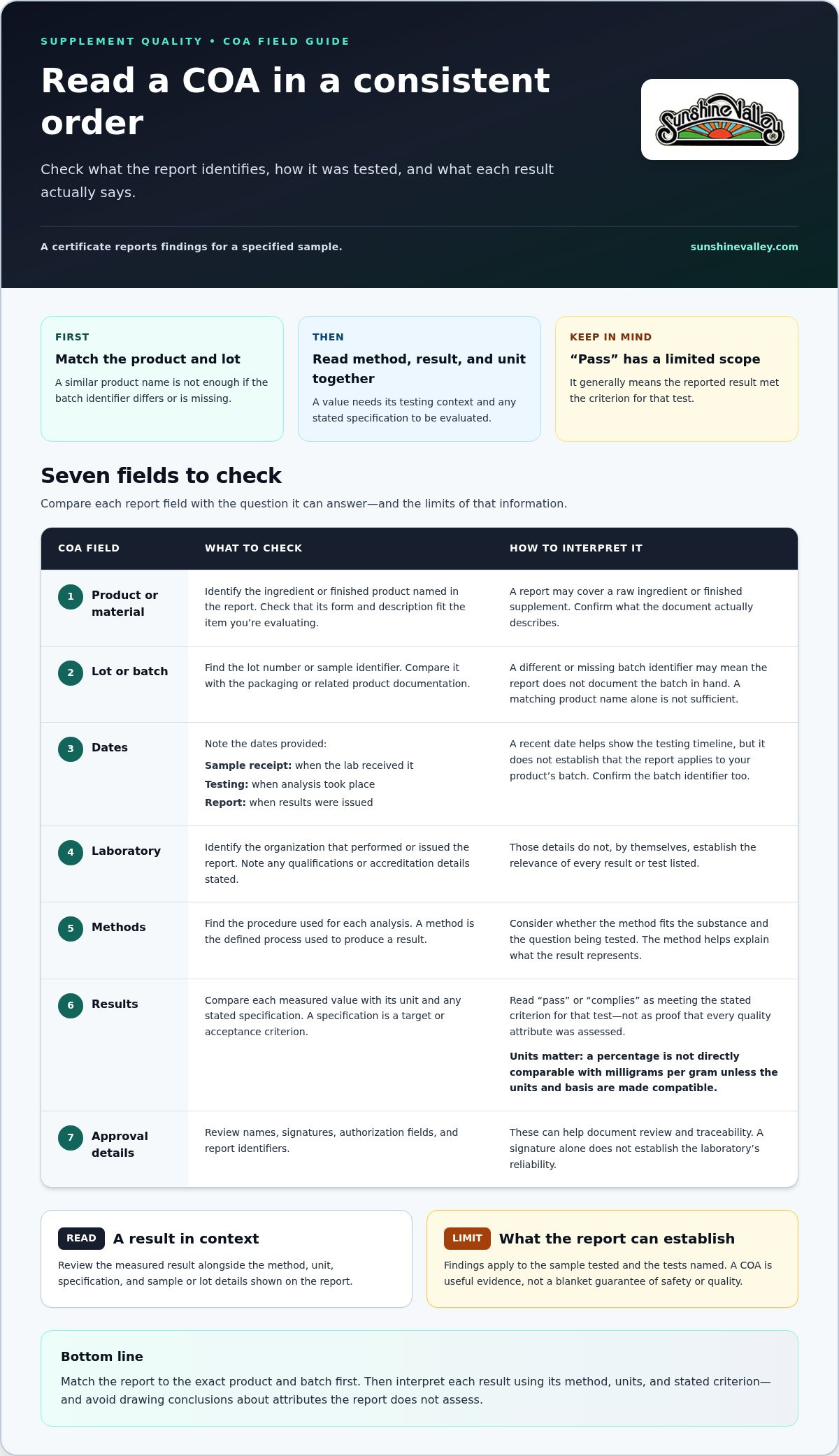
Review the document in a fixed order. This makes mismatches and missing context easier to spot than starting with a prominent “pass” statement. For a practical approach to how to read a certificate of analysis for supplements, check these fields:
- Product or material: Identify the ingredient or finished product named in the report. Check that its form and description fit the item you’re evaluating.
- Lot or batch: Find the lot number or sample identifier and compare it with the packaging or related product documentation. A similar product name isn’t enough if the batch identifier differs or is missing.
- Dates: Note sample receipt, testing, and report dates, if provided. Receipt is when the lab received the sample, testing indicates when analysis took place, and the report date marks when results were issued. A recent date alone doesn’t show that the report applies to your product’s batch.
- Laboratory: Identify the organization that performed or issued the report. Note any stated qualifications or accreditation details, while remembering that these don’t establish the relevance of every result.
- Methods: Find the procedure used for each analysis. A method is the defined process used to produce a result. Check that it fits the substance and question being tested.
- Results: Compare each reported value with its unit and any stated specification. A specification is a target or acceptance criterion. “Pass” or “complies” generally means the reported result met that criterion, not that every quality attribute was assessed.
- Approval details: Review names, signatures, authorization fields, and report identifiers. These can help document review and traceability, but a signature alone doesn’t establish the laboratory’s reliability.
Which identity, batch, and date details should you check?
Look for the material name, sample description, sample or report ID, and lot number. Compare them with the packaging or associated product documentation. For example, if the container shows one lot identifier and the report names another, the report may not document the batch in hand. Dates help establish the testing timeline, but they don’t replace a matching batch identifier.
How do you read methods, results, and signatures?
Read each result alongside its method, unit, and specification. A result expressed as a percentage isn’t directly comparable with one reported in milligrams per gram unless the units and basis are made compatible. Certification programs may involve additional review beyond a single laboratory report. See NSF’s NSF dietary supplements certification program for context on independent supplement testing and certification.
Illustrative example, not an actual product result: A hypothetical report lists a material, a lot ID, a test method, a measured value in a stated unit, and a specification. First confirm that the lot matches the package. Then interpret the value against the specification using the method and unit shown. This example is not a real test result or a claim about any product.
Use this sequence when assessing powdered ingredients such as Sunshine Valley’s powdered supplements. The field-by-field check keeps your attention on what the document actually records.
How to Judge Test Methods, Results, and Detection Limits on a COA
A result is meaningful in relation to what the lab measured, how it measured it, and what level it could report. Interpret a test result alongside its method and reporting limit. Keep those details together when comparing the result with a specification.
| COA field | What to check |
|---|---|
| Specification | The stated target, range, or acceptance criterion for the test. |
| Measured result | The reported finding, which may be a numerical value or a phrase such as “not detected.” |
| Unit | How the amount is expressed. Compare values only when their units and basis are compatible. |
| Method | The analytical procedure used to answer the test question. |
| Reporting limit | The lowest level the lab reports or quantifies under the stated method and conditions. |
What do pass, fail, and not detected mean?
“Pass” or “fail” depends on the specification and decision rule shown on the report. A passing result means the finding met that stated criterion. It doesn’t establish that every possible test would pass. A numerical result gives a measured amount. By contrast, “not detected” generally means the substance wasn’t detected above the method’s stated threshold. It doesn’t necessarily mean the substance is absent.
Detection limit, quantitation limit, and reporting limit may refer to different thresholds, and laboratories may use the terms differently. Read the COA’s definitions and units rather than treating them as interchangeable. If a result is reported below a limit, don’t interpret it as a precise zero or compare it directly with a threshold expressed on a different basis.
Why do laboratory methods and reporting limits matter?
Methods are designed for particular substances and analytical questions. One procedure may identify an ingredient, while another measures its amount or assesses a specific contaminant. There’s no universally “best” method. The practical question is whether the method fits the analyte and purpose stated on the COA. When considering how to read a certificate of analysis for supplements, method fit matters as much as the result’s appearance.
Consider whether the laboratory’s accreditation covers the relevant testing scope, and whether the report clearly identifies the sample and its handling. Accreditation alone doesn’t answer every question about an individual result. The USP Verified dietary supplements program provides context for what a verification mark represents. A mark and a COA are distinct forms of information, so assess each on its own terms.
How to Verify a Supplement COA Matches the Product You Have
A report can contain clear results and still be the wrong report for the item in your hand. Check its identity and batch details before interpreting the findings. A generic sample report may illustrate what a test document looks like, but it doesn’t establish that every production batch was tested or that its results apply to your package.
- Ingredient name: Does the report name the same ingredient shown on the product or its documentation?
- Product form: Does it describe the same form, such as a powder, rather than a different preparation?
- Lot or batch identifier: Does the identifier match the package exactly?
- Report details: Are the laboratory, test dates, methods, units, and review fields identifiable?
Does the lot number on the COA match your supplement?
Compare the full lot or batch code on the packaging with the identifier on the report. Check that the ingredient name and form align as well. If a code is abbreviated, obscured, or different, note the discrepancy and treat the batch connection as unclear until the documentation resolves it. A mismatch or missing identifier is a traceability gap, not proof by itself that the product is defective.
A report dated near your purchase may still relate to another lot. Dates show when sample handling, testing, or reporting occurred; they don’t substitute for a matching batch code. This is a practical safeguard when applying how to read a certificate of analysis for supplements to a product you have.
How should you assess a laboratory and report completeness?
Look for the laboratory’s name, relevant method details, test dates, units, and fields showing review or authorization. If the report claims accreditation, consider whether its scope covers the specific analysis in question. Accreditation is useful context, but a general accreditation statement alone doesn’t establish that every test on the report falls within that scope.
Keep a simple record of unclear or absent details. Note the field, what the report says, and what remains uncertain. Missing method information, for instance, limits your ability to interpret a result; it doesn’t mean the test failed. Distinguish an incomplete document from a reported result that fails a stated specification.
Documentation is one part of quality assessment. Process discipline, including hygienic supplement manufacturing, offers related manufacturing context. Ingredient-focused information, such as mannitol powder quality standards, can also help frame questions about a specific material. Neither replaces matching the report to the product and batch.
For powdered ingredients, apply the same checks to the product details and any documentation you review. Explore Sunshine Valley’s powdered supplements as you evaluate ingredient quality thoughtfully.
Apply COA Checks When Choosing Powdered Supplements
A COA can support a careful product decision when its findings apply to the ingredient and batch you’re considering. Separate clear results from unanswered questions. If a report omits a method, doesn’t identify a lot, or gives a result you can’t interpret, record that limitation. Don’t treat it as a failed test or assume that missing information proves quality.
What should you do after reviewing a supplement COA?
Use the same sequence for each powdered supplement so that you can assess documents consistently. A polished format or a single “pass” statement shouldn’t replace checking what was tested and what the report actually establishes.
Reusable COA checklist: Confirm the report is relevant to the product; match the ingredient, form, and batch; assess whether the method fits the test; compare the result with its specification and unit; note the reporting limit; and record any missing or unclear details.
The practical value of learning how to read a certificate of analysis for supplements is being able to assess documentation without claiming it proves more than it does. A COA addresses its stated sample and tests. On its own, it doesn’t answer every question about manufacturing, handling, or personal suitability.
How does quality-minded product selection fit the COA checklist?
Testing documents are one part of a broader quality assessment. Manufacturing discipline and hygiene standards offer relevant context, but they don’t replace interpreting a specific report. Consider batch relevance alongside what’s known about the manufacturer’s approach.
Sunshine Valley offers powdered supplements including Inositol, Mannitol, Lactose, MSM, and Niacinamide. The company emphasizes state-of-the-art manufacturing and strict hygiene standards. These are elements of the wider quality picture, not claims about a particular product’s COA, laboratory, certification, or test result.
Apply the checklist with care, then consider the product and its documentation together. Sunshine Valley’s powdered supplement range includes options to consider as part of a thoughtful approach to ingredient quality.
Make Your Next Supplement Choice With Confidence
A COA is most useful when it matches the product and lot you’re considering, identifies suitable methods, and presents results alongside their units, specifications, and reporting limits. Learning how to read a certificate of analysis for supplements also means recognizing what the document leaves unanswered. A reported pass applies to the stated test and criterion, not every aspect of quality or suitability.
Use the same checklist each time: confirm relevance and batch match, review the method and result, note the reporting limit, and record any missing details. Then consider documentation alongside broader manufacturing practices, without treating either as a substitute for the other.
Sunshine Valley offers powdered supplements including Inositol, Mannitol, Lactose, MSM, and Niacinamide, and emphasizes state-of-the-art manufacturing and strict hygiene standards. Explore the range as you make a considered choice.
Explore Sunshine Valley powdered supplements and choose the powdered ingredient that fits your needs.
Frequently Asked Questions
What is a certificate of analysis for supplements?
A certificate of analysis is a report of analytical results for a specified sample or batch. It may list tests for identity, strength, purity, or selected contaminants, along with methods, units, and results. Its scope is limited to the analyses shown. A COA differs from a product label, which describes the supplement for consumers, and from a marketing claim, which promotes a product.
How can I tell whether a supplement COA matches my product batch?
Compare the COA’s ingredient name, product form, and lot or batch identifier with the package or associated product documentation. Check that the report describes the same material, not just a similarly named ingredient. Dates can help explain the testing timeline, but they don’t establish batch relevance. If an identifier differs or is missing, treat that as an unresolved documentation question, not automatic proof of a product defect.
Does a certificate of analysis prove that a supplement is safe?
No. A COA provides evidence about the specific sample and tests reported, not an unconditional guarantee of safety. It may not address every contaminant, quality attribute, storage condition, or factor relevant to an individual. Interpret any “pass” result against the specification and test stated on the document. A COA can inform a quality assessment, but it doesn’t provide medical advice or establish that a supplement is suitable for everyone.
Is a third-party supplement test the same as a certificate of analysis?
No. Third-party testing describes who performed an analysis, while a COA is a document that records analytical findings for a specified sample. A third-party lab may issue a COA, but the terms aren’t interchangeable. A test may have a separate report, and a COA’s issuer or testing arrangement can vary. Review the document for the laboratory, sample identity, methods, results, and scope of testing.
What does not detected mean on a supplement COA?
“Not detected” generally means the substance wasn’t detected above the stated threshold for that method and sample. It doesn’t necessarily mean the substance is completely absent or present at zero. Look for a detection, quantitation, or reporting limit and note its unit. Those thresholds aren’t automatically interchangeable, so interpret the finding in the context of the method and any specification on the report.
What information should a reliable supplement COA include?
A useful COA should identify the tested material or product and sample, and provide a lot or batch identifier when assessing batch relevance. Look for the laboratory, test dates, analytical methods, results, units, specifications, and reporting limits where applicable. Review any authorization or approval details, too. No single field proves reliability; assess whether the report is complete enough to interpret and clearly relates to the item in question.
How recent should a certificate of analysis for supplements be?
There isn’t one universal age that makes a COA relevant or irrelevant. The key question is whether it applies to the product’s specific lot and whether its sample and testing details are clear. A recent report for a different batch may be less useful than an older report that clearly matches the batch, though the test date still matters to interpretation. Check sample, testing, and report dates alongside the lot identifier.


Leave a comment
This site is protected by hCaptcha and the hCaptcha Privacy Policy and Terms of Service apply.