




Does “USP grade” on a supplement label prove the product is certified or safe? Not by itself. Understanding usp grade supplements meaning starts with separating a reference to a USP quality standard from the distinct USP Verified Mark, which signals product-specific review.
When assessing a quality claim, start with its exact wording, identify whether it applies to an ingredient or the finished product, and look for evidence that matches that scope. A label phrase alone can’t tell you the full story. This guide explains what USP standards and verification indicate, what they don’t guarantee, and which label details and supporting documents can help you assess a claim carefully.
USP-related claims are also different from FDA oversight, and neither should be mistaken for proof that a supplement treats or prevents disease. For powdered supplements, manufacturing practices and clear quality information are useful context. Sunshine Valley focuses on powdered supplements, ingredient quality, and hygienic manufacturing. Those points provide brand context, but they do not establish USP certification. The goal is to make a measured decision based on the exact claim and the evidence behind it.
Key Takeaways
- Understand the usp grade supplements meaning by checking whether the label refers to an ingredient standard, finished-product verification, or a general quality claim.
- Learn how USP-NF standards, the USP Verified Mark, and manufacturer claims differ in scope and evidence.
- Use the exact wording and context of a claim to distinguish ingredient specifications from claims about the finished supplement.
- Assess what a USP-related claim does and doesn’t establish about quality, safety, and clinical benefit.
- See how Sunshine Valley’s powdered supplement focus and manufacturing priorities provide brand context without serving as proof of USP certification.
USP Grade Supplements Meaning: What Does the Label Actually Say?
The phrase “USP grade” can sound like a formal certification, but the words alone don’t show that a supplement has been reviewed or verified by the United States Pharmacopeia (USP). To understand usp grade supplements meaning, identify what the label specifically claims, which ingredient or product it refers to, and what evidence supports that statement.
A reference to a USP standard is not automatically proof that a finished supplement meets it. The standard may apply to a particular ingredient, while a claim about the whole product calls for evidence about the finished formulation. A USP reference also doesn’t establish that a supplement is effective for a health condition or approved by the FDA.
What is the United States Pharmacopeia?
USP is an independent scientific organization that develops quality standards for medicines, dietary ingredients, supplements, and other specified substances. Its standards are published in the United States Pharmacopeia National Formulary (USP-NF). The compendia include standards for particular ingredients and products. A standard applies only when a relevant monograph or other requirement covers the substance in question. For historical background, see the United States Pharmacopeia (USP) Wikipedia overview.
A monograph is a written standard for a defined substance or product. Depending on its scope, it may set requirements for identity, strength, quality, or specific tests. It does not necessarily address every attribute of a finished supplement. A label that names a USP standard is most informative when it identifies the exact ingredient or product and the applicable standard.
Is “USP grade” an official certification?
Not on its own. “USP grade” is often used imprecisely in marketing or product descriptions. The wording alone doesn’t establish USP review, verification, or certification. A manufacturer might state that an ingredient meets a USP-NF standard, but that is a company claim. Third-party verification is separate and requires evidence of the relevant review or program status.
Check whether the claim applies to a raw ingredient or the finished supplement, then look for documentation that identifies the standard and supports the stated scope. Broad phrases such as “USP quality” are not equivalent to a verified mark or a documented test result.
A USP reference is meaningful only when the exact claim, the product or ingredient it covers, and the supporting evidence are clear. That distinction helps you assess quality language without reading more into it than the label establishes.
USP Standards, USP Verified, and FDA Rules: The Important Differences
These terms describe different kinds of quality information. A USP-NF standard sets requirements for a specified ingredient or product. The USP Verified Mark indicates that a product has been reviewed under USP’s verification program. FDA oversight is a separate regulatory framework, not a USP endorsement.
| Claim or mark | What it indicates | What to keep in mind |
|---|---|---|
| USP-NF standard | Defined requirements for a particular ingredient or product, described in a monograph or other standard. | A reference doesn’t, by itself, prove that a specific supplement has been assessed against the standard. |
| USP Verified Mark | A product has met the applicable requirements of USP’s product verification program. Its published scope includes checks such as label accuracy, specified contaminants, dissolution, and manufacturing practices. | Verification applies within the program’s defined scope. It doesn’t establish clinical effectiveness or screen for every possible contaminant. |
| Manufacturer quality claim | The company is making a statement about its own product or ingredient, such as claiming it meets a named standard. | Look for the precise claim and supporting evidence. It isn’t the same as independent USP verification. |
How do USP standards differ from USP verification?
Standards describe quality requirements. Verification is a program that evaluates a product against defined criteria. A company may refer to a USP-NF standard without the finished supplement carrying the USP Verified Mark. The USP Dietary Supplement Standards page outlines USP’s role in standards and its supplement verification work. Check the current program criteria and the exact product scope before interpreting a mark.
What does FDA regulation mean for supplements?
The FDA regulates dietary supplements under food-related requirements and does not approve them for safety and effectiveness before they reach the market. Manufacturers must follow dietary supplement current good manufacturing practice (cGMP) requirements, including controls intended to support product identity, quality, purity, and composition. FDA oversight and USP verification are distinct: one is a regulatory framework, and the other is a voluntary quality program.
FDA compliance concerns regulatory requirements; a USP standard defines specific quality criteria, and neither statement alone proves a supplement’s clinical benefit. FDA cGMP requirements and USP program criteria are distinct, so interpret each claim according to its own scope.
For a practical example of ingredient-focused quality context, explore powdered supplement ingredients from Sunshine Valley.
Does USP Grade Mean a Supplement Is Safer or More Effective?
No. A USP-related claim can point to a defined quality requirement, but it doesn’t, by itself, prove that a supplement provides a clinical benefit or is risk-free. The practical usp grade supplements meaning depends on the exact substance, standard, and evidence behind the claim.
Quality controls still matter. A standard may specify tests for identity, strength, purity, or other attributes, but only those included in the applicable standard. Meeting a specification can support confidence in a defined aspect of quality. It doesn’t show that an ingredient prevents or treats a condition, or that the supplement is appropriate for every person.
What can a USP standard help establish?
Start with the standard’s scope. If a monograph applies to a particular ingredient, it may set requirements and testing methods for that ingredient. It may not cover the complete formulation, every manufacturing step, or all possible contaminants. For a powdered ingredient, an ingredient-level standard and evidence about the finished supplement answer different questions.
Finished-product testing and oversight can address aspects beyond the raw material, depending on what is assessed. The label claim should make clear whether it refers to an ingredient or the finished product. Without that distinction, it’s easy to assume broader coverage than the evidence supports.
What does a USP claim not guarantee?
A USP reference doesn’t mean the FDA has approved a supplement, and it isn’t a guarantee of universal safety or effectiveness. The FDA explains its role and manufacturer responsibilities in its FDA Regulation of Dietary Supplements overview. Regulatory requirements, a USP quality specification, and evidence for a health outcome are separate considerations.
Product formulation, manufacturing controls, packaging, storage, and use can all affect what a quality claim means in practice. A standard’s requirements may not address every risk or every factor relevant to an individual. Even a well-defined quality result can’t establish how a supplement will affect a particular person.
“Grade” language can signal a quality reference, but its value depends on the exact standard, the material it covers, and the evidence available. Read it as one useful part of an assessment, not a complete verdict on safety or benefit.
How to Evaluate 'USP Grade' on a Supplement Label
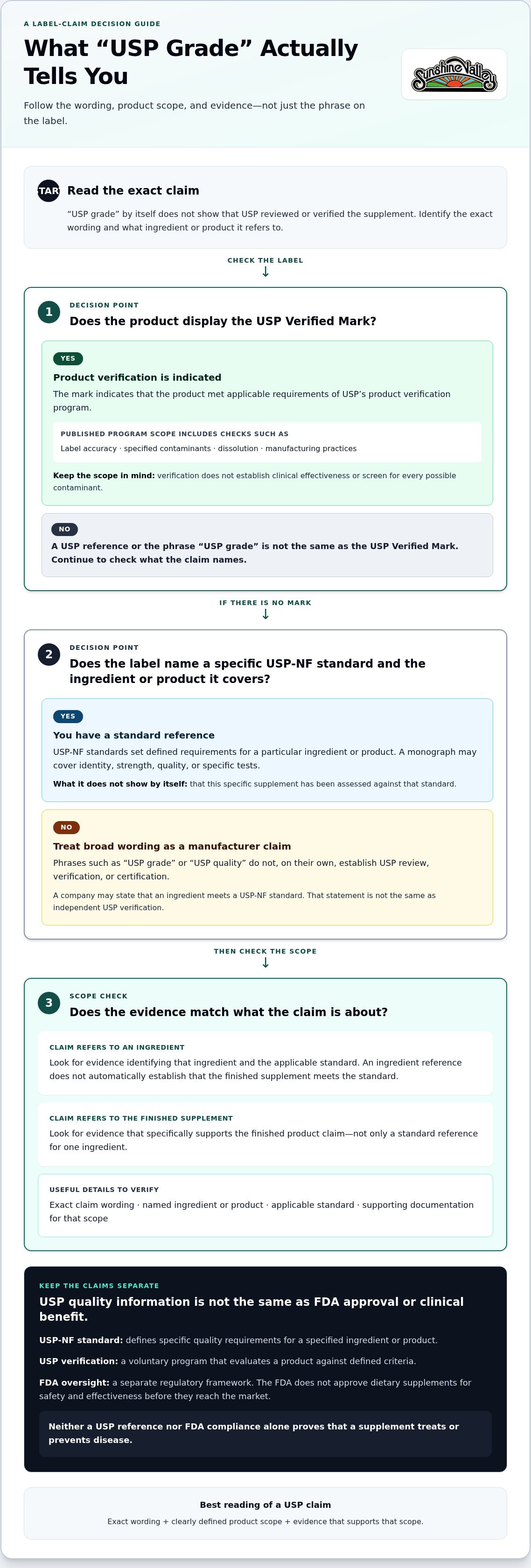
A careful label review starts with the claim itself. The phrase “USP grade” may refer to an ingredient specification, a finished product, or general marketing language. To judge usp grade supplements meaning in context, use this checklist and keep each claim within its stated scope.
A practical label and documentation checklist
- Read the exact wording and scope. Identify whether the label names a USP-NF standard, displays the USP Verified Mark, or simply uses terms such as “USP quality.” Note whether the claim applies to an ingredient or to the finished supplement.
- Check the ingredient details. Review the full ingredient name, amount per serving, serving information, and other label disclosures. Confirm that the substance named in the claim matches the ingredient on the label.
- Separate specific evidence from broad language. Terms such as “premium” or “pharmaceutical quality” don’t identify a particular standard or test. Look for a named specification, mark, or other clearly described evidence rather than treating descriptive wording as proof.
- Review supporting quality documents. If provided, a certificate of analysis (COA) may report results for specified tests on an ingredient or product batch. Check that its batch or lot identifier matches the product, and note the date, methods, results, and issuing laboratory or organization.
- Compare the document with the claim. A COA has value only within its scope. A result for one ingredient or test doesn’t establish every attribute of the finished supplement, prove clinical effectiveness, or independently verify all aspects of manufacturing and handling.
What makes quality documentation useful?
Specificity matters. A document that identifies the tested material, batch, methods, and results is easier to interpret than an undated statement with no clear product reference. The document should also correspond to the label claim: ingredient-level results support an ingredient-level assessment, while a finished-product claim calls for evidence that addresses the finished product.
Manufacturing context is another part of a measured review. For more detail on this topic, read the guide to hygienic supplement manufacturing. Clear quality language and documentation help readers understand what is being assessed without turning one claim into a blanket assurance.
Explore Sunshine Valley powdered supplements as you consider ingredient details and quality information together.
How Sunshine Valley Approaches Powdered Supplement Quality
Sunshine Valley focuses on powdered dietary supplements and ingredient quality. The brand emphasizes hygienic manufacturing as part of its approach to product quality. This focus provides useful context, but it is not evidence that a product carries a USP Verified Mark or meets a particular USP standard. Those claims require product-specific support.
What quality principles matter for powdered supplements?
Clear ingredient information is a practical starting point. Review what the product contains, how the serving is described, and whether any quality statement identifies a specific standard or supporting documentation. Manufacturing hygiene also matters as part of a broader quality approach, but a general statement about manufacturing doesn’t answer every question about an individual product.
Brand adjectives such as “premium” can describe a company’s positioning, but they aren’t a substitute for product-specific evidence. Assess the exact item and the scope of each claim. For an ingredient-focused example, see the mannitol powder quality standards guide.
How to make a more informed supplement choice
Keep three kinds of claims distinct. A USP-NF standard sets requirements for a specified ingredient or product. The USP Verified Mark refers to review under USP’s verification program. A manufacturer claim is the company’s own statement and should be interpreted according to its wording and evidence.
Compare the label’s exact language with available documentation. Check whether the information applies to an ingredient or the finished product, and whether any batch-specific document matches the product in hand. This measured approach helps you evaluate quality statements without treating one mark, test, or brand description as a guarantee of safety or health results.
Understanding usp grade supplements meaning is ultimately about matching each claim to its scope and evidence. Explore the Sunshine Valley supplement range with those quality considerations in mind.
Make Your Next Supplement Choice With Confidence
The phrase usp grade supplements meaning depends on the claim’s exact wording and scope. A USP-NF standard describes requirements for a specified ingredient or product; the USP Verified Mark reflects a separate verification program. Neither a general label phrase nor a quality specification proves clinical benefit or FDA approval.
For a more informed assessment, compare the label with available supporting documents. Check whether the evidence relates to an ingredient or the finished supplement, and avoid reading broad marketing terms as proof of specific testing or certification.
Sunshine Valley offers powdered dietary supplements, including Inositol, Mannitol, Lactose, MSM, and Niacinamide, with an emphasis on ingredient quality and hygienic manufacturing. These are useful points of brand context as you consider product information.
Explore Sunshine Valley’s powdered supplements and make your next choice with the label and quality information in view.
Frequently Asked Questions
What does USP grade mean for supplements?
To understand usp grade supplements meaning, first check what the claim refers to. USP means the United States Pharmacopeia, an independent scientific organization that develops standards for specified ingredients and products. “USP grade” is often used loosely, so the wording alone doesn’t establish that USP reviewed a supplement or that it meets a particular standard. Look for the named standard, its scope, and evidence supporting the claim.
Is USP grade the same as USP Verified?
No. A USP standard sets requirements for a specified ingredient or product. The USP Verified Mark represents a separate product verification program with defined criteria. A reference to a USP-NF standard doesn’t mean a supplement bears that mark. Check whether a label shows the actual mark and whether the specific product appears in USP’s current verification information. The distinction matters because a standard and product-specific review are different kinds of evidence.
Does USP grade mean a supplement is FDA approved?
No. A USP reference doesn’t mean the FDA approved a dietary supplement before sale. The FDA regulates supplements under applicable food and dietary supplement requirements, including manufacturing rules, but doesn’t pre-approve them for safety and effectiveness in the way the question suggests. FDA oversight and a USP standard are separate. Neither alone proves that a supplement will provide a particular health benefit or is appropriate for every person.
Can a supplement say USP grade without being USP certified?
Yes. A manufacturer may use “USP grade” to describe an ingredient or make a claim about its product without the phrase itself proving USP review or certification. The wording can be ambiguous. Look for a precise reference to the standard, the material it applies to, and evidence supporting the claim. Don’t assume a general phrase is equivalent to the USP Verified Mark or independent verification.
Does USP grade guarantee a supplement is pure?
No single phrase guarantees absolute purity. A relevant USP standard may specify tests or limits for particular quality attributes, but its scope depends on the ingredient or product and the requirements it contains. A result for one substance or contaminant doesn’t establish that every possible impurity has been assessed. Review the exact claim and any supporting documentation, including what was tested and whether it applies to the ingredient or finished product.
What is the difference between USP grade and pharmaceutical grade?
Neither phrase should be treated as a complete quality assessment without context. USP grade is often used imprecisely; a specific USP-NF standard may set requirements for a defined substance. “Pharmaceutical grade” can also be broad marketing language unless it identifies applicable specifications and evidence. Some USP standards cover pharmaceutical substances, but that doesn’t make a supplement a medicine or establish that it is FDA approved, effective, or suitable for a particular use.
How can I check whether a supplement meets a USP standard?
Start by identifying the exact wording on the label and whether it refers to an ingredient or the finished supplement. Look for a named USP-NF standard or the USP Verified Mark, then check the relevant USP information to understand its scope. If available, review a certificate of analysis for the product’s batch or lot, test methods, results, date, and issuer. A document supports only the claims and tests it actually covers.



Leave a comment
This site is protected by hCaptcha and the hCaptcha Privacy Policy and Terms of Service apply.