




Collagen and MSM have different roles, so taking them together may offer complementary support rather than duplicating the same function. Collagen is a structural protein found in connective tissues, while MSM supplies sulfur that may support collagen synthesis. This distinction helps explain how MSM helps with collagen production for skin and joints.
If you’re comparing the two supplements, it’s reasonable to wonder whether MSM adds anything when collagen is already part of your routine. It depends on what each ingredient contributes: collagen is a building block, while MSM may support the body’s collagen-making process.
This article explains the proposed mechanism, what research says about MSM and collagen for skin and joints, and how the supplements compare. It also outlines what the evidence can and can’t tell you, helping you make a more informed decision about which kind of support fits your goals.
Key Takeaways
- MSM may provide sulfur that supports collagen formation, while collagen supplements supply collagen itself. Their roles are complementary, not interchangeable.
- Research has explored MSM’s potential effects on skin hydration, firmness, elasticity, texture, and the appearance of wrinkles. The findings offer context, not a guarantee of results.
- Human studies have also examined MSM for joint symptoms, including pain and stiffness. These outcomes don’t by themselves establish that MSM increases collagen in joints.
- Compare the evidence for each supplement against your skin or joint goals to understand what each may contribute.
Skin hydration, elasticity, texture, roughness, and wrinkles
MSM may support skin appearance by supplying sulfur involved in structural proteins and collagen formation. Studies have examined its effects on hydration, firmness, elasticity, roughness, and wrinkles.
For a closer look at MSM’s role in the body, watch this video:
Skin Hydration and Elasticity Findings
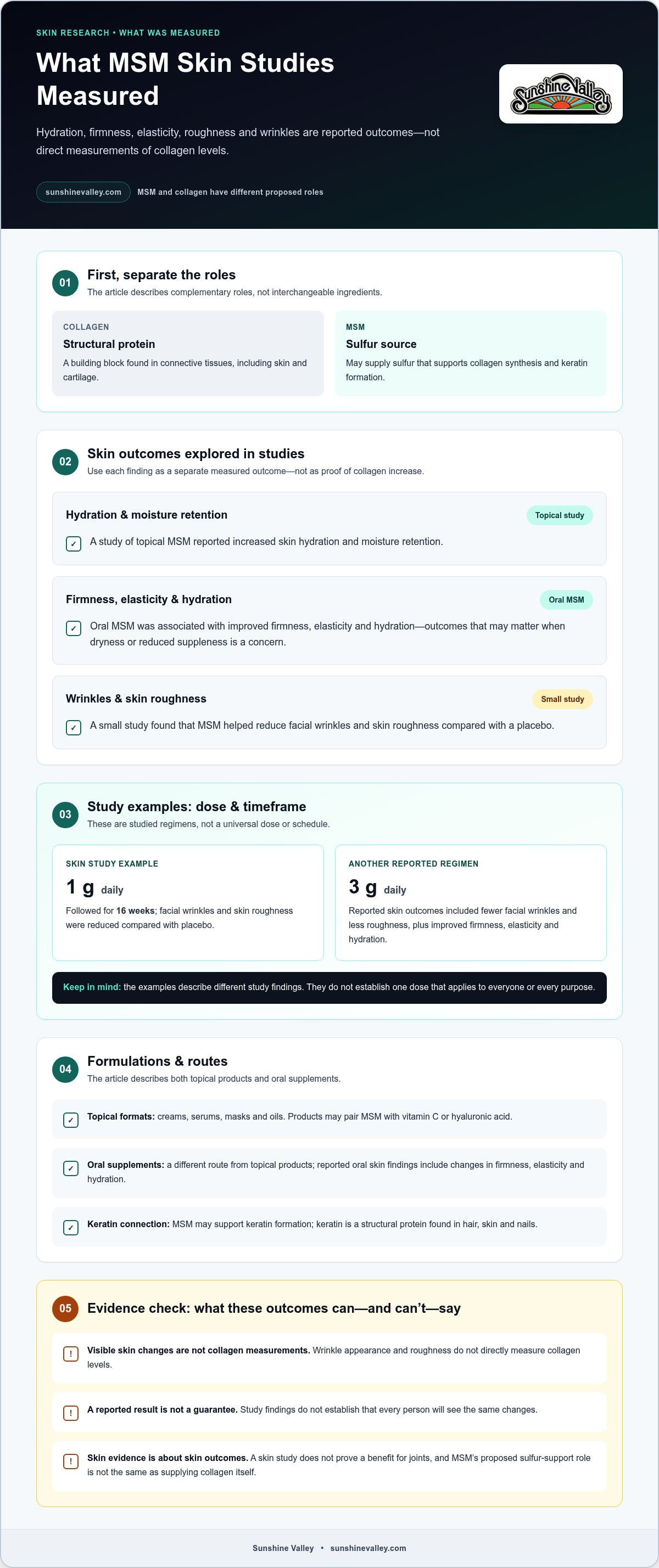
Hydration describes the skin’s moisture content, while elasticity is its ability to stretch and return toward its prior shape. Both can affect how smooth and resilient skin looks. A study of topical MSM reported increased hydration and moisture retention. Separately, oral MSM was associated with improved firmness, elasticity, and hydration, outcomes that may matter when dryness or reduced suppleness is a concern.
At 3 g daily, oral MSM reduced facial wrinkles and skin roughness and improved skin firmness, elasticity, and hydration, according to Original study authors. These findings concern measured skin outcomes; they don’t establish that every person will see the same change or that MSM replaces daily skin-care practices.
Skin Texture, Roughness, and Wrinkles
Texture refers to the skin’s visible and tactile surface, while roughness and wrinkles describe distinct changes in that surface. A small study found that 1 g of MSM daily for 16 weeks helped reduce facial wrinkles and skin roughness compared with a placebo. That timeframe gives readers a concrete example of how long one study followed participants.
These findings may interest people focused on visible signs of aging, but the measured outcomes should be considered separately. Wrinkle appearance and roughness don’t directly measure collagen levels. Oxidative stress is another area of interest: research has reported that MSM can help protect skin cells from oxidative stress, a process that may affect skin health.
Beauty Formulations and Collagen’s Role
Hair, skin, and nail formulations may include MSM because sulfur supports keratin, a structural protein found in all three. Creams, serums, masks, and oils are topical formats; oral supplements provide a different route. Topical products may pair MSM with vitamin C or hyaluronic acid, ingredients associated with collagen synthesis and hydration, respectively.
Collagen provides structural support in skin and connective tissues, including cartilage. It matters for skin firmness and joint structure, but a skin study doesn’t prove a joint benefit. MSM’s proposed role is different: it supplies sulfur that may support collagen synthesis and keratin formation, rather than acting as collagen itself.
MSM Effects, Dose, and Timeline
Study doses vary by outcome. The skin findings above include 3 g daily and 1 g daily for 16 weeks; joint research has examined different doses and follow-up periods. These examples describe studied regimens, not a single dose that applies to every purpose.
What is the typical MSM dose used in studies of skin or joint health? Skin studies have used 1 g daily or 3 g daily, while joint studies have examined 1,200 mg daily and 3.4 g per day. How long does MSM take to show effects on collagen-related outcomes? One small skin study assessed changes over 16 weeks; that provides a study timeframe, not a universal schedule.
Research on MSM combined with collagen
Research has examined methylsulfonylmethane (MSM) alongside collagen and other ingredients. These combinations may address different skin-related questions, but each study’s design and measured outcomes matter.
MSM Combined with Collagen
A double-blind, placebo-controlled, randomised four-way study evaluated dietary supplements containing collagen and MSM over 12 weeks. It compared three test products, allowing researchers to examine formulations with different ingredient combinations. The study design is relevant because a combined supplement may have effects that cannot be assigned to MSM or collagen alone.
However, the available findings here don’t identify the study’s specific results or which product performed best. The number of products and the 12-week duration describe the research setup, not proof that taking MSM with collagen increases collagen production. For readers, the useful distinction is between a combination being studied and a demonstrated benefit for a particular outcome.
Collagen and MSM have different proposed roles: collagen is a structural protein, while MSM is discussed as a sulfur source that may support synthesis. A combination could therefore supply collagen while supporting processes related to its formation. That’s a rationale for combining ingredients, not a substitute for evidence comparing them separately.
Human Research on Collagen Synthesis
Human studies of combination products can measure visible skin changes, joint symptoms, or other outcomes, but those measures don’t automatically show collagen synthesis directly. The 12-week study’s four-way design is a useful example: evaluating three test products can compare formulations, while the measured outcome determines what conclusions readers can draw.
Other combination research considers MSM alongside ingredients that are not collagen. A 2017 review reported that MSM combined with pyruvic acid improved skin melasma, tightness, and wrinkles. This finding concerns a specific combination and skin outcomes; it doesn’t establish that MSM alone produces those effects or that pyruvic acid adds the same value to collagen supplements.
One study also found that MSM combined with silymarin helped manage rosacea symptoms. Rosacea outcomes differ from direct measurements of collagen formation, so this result shouldn’t be treated as evidence that the combination builds collagen or treats arthritis or osteoarthritis. The ingredients and condition studied determine how relevant each finding is.
When comparing products, note the ingredients, whether MSM is paired with collagen or another compound, and the outcome researchers measured. Readers exploring MSM as a standalone supplement can review Super MSM supplement information alongside this evidence.
How MSM may support collagen synthesis
MSM may support collagen synthesis by providing sulfur, which is involved in forming structural proteins. Collagen supports skin and connective tissues, while keratin is found in hair, skin, and nails. This proposed role helps explain how MSM helps with collagen production without making it a substitute for collagen itself.
The proposed mechanism starts with sulfur availability. MSM has been proposed as a source of sulfur that may play a role in supporting proteins such as collagen and keratin. The body must still assemble these proteins through its own processes. In practical terms, MSM may supply a material involved in synthesis; it doesn’t deliver finished collagen directly to the skin, cartilage, or tendons.
Collagen formation also depends on the tissue in question. In skin, collagen helps maintain structure and elasticity. In joints, it is part of cartilage and other connective tissues. MSM’s proposed contribution is to support collagen formation in these settings, rather than act as the tissue’s structural framework. This distinction explains why collagen and MSM are often discussed together despite having different roles.
MSM occurs naturally in humans and animals, and its sulfur content is one reason researchers examine it for structural protein support. The proposed process isn’t simply “more sulfur equals more collagen.” Protein synthesis involves the body’s broader systems, so sulfur availability is only one part of a more complex process. A supplement’s role should be understood as supportive, not as a direct replacement for those systems.
Inflammation is another area of interest, separate from collagen synthesis. MSM has anti-inflammatory properties and may help reduce swelling and stiffness. These effects may matter to people considering connective-tissue support, but symptom changes don’t demonstrate increased collagen formation. Less stiffness and greater collagen production, for example, are different outcomes that require different measurements.
Researchers also examine MSM’s effects on skin appearance, including hydration and elasticity. These visible features can relate to skin structure, but they don’t directly show how much collagen the body has made. This distinction matters when interpreting supplement claims: a change in hydration or appearance isn’t the same as a laboratory measurement of collagen synthesis.
Overall, MSM’s proposed contribution is specific: sulfur may support the synthesis of collagen and keratin, while collagen itself provides structural support in skin and connective tissues. This framework helps readers assess claims about MSM for skin, hair, nails, or joints. The key question is whether a study measured protein synthesis directly or assessed a related outcome, such as comfort, hydration, or appearance.
What does research say about MSM and collagen synthesis in humans?
Human research has examined MSM for skin and joint outcomes, but those outcomes don’t necessarily measure collagen synthesis directly. A change in pain, stiffness, or skin appearance is a clinical result. It doesn’t establish how much new collagen the body produced or where it formed.
Joint studies offer useful context. In a study of 100 people over age 50, a supplement containing 1,200 mg of MSM daily for 12 weeks reduced joint pain, stiffness, and swelling compared with a placebo. Those results describe symptoms. They don’t show that MSM increased collagen in cartilage or other connective tissues.
A separate study involved 49 people with knee osteoarthritis. Participants taking 3.4 grams of MSM per day for 12 weeks had reduced pain and stiffness and improved physical function compared with a placebo. These changes may matter to people managing osteoarthritis, but the measured outcomes were function and symptoms, not collagen production.
Exercise studies have also assessed joint discomfort rather than collagen synthesis. In a study of 22 healthy women, 3 grams of MSM daily for three weeks leading up to a half marathon was associated with less muscle soreness and joint pain than a placebo. This finding concerns exercise-related discomfort, not a direct measurement of cartilage repair.
Another example comes from athletic men who took 3 grams of MSM daily for two weeks. The study associated supplementation with lower IL-6 levels and less muscle pain after intense resistance exercise. IL-6 is an inflammatory marker; its change doesn’t demonstrate increased collagen synthesis or establish a structural benefit for joints.
To evaluate collagen synthesis directly, researchers would need to measure collagen-related markers or tissue changes, rather than rely only on pain or mobility scores. Study details matter: the population, MSM regimen, comparison group, duration, and measured endpoint all shape what a finding can support. A knee osteoarthritis result, for instance, can’t automatically be applied to skin firmness or tendon structure.
Overall, human studies provide evidence about particular outcomes, including joint symptoms and exercise-related discomfort. They offer less direct evidence about whether MSM increases collagen synthesis in human tissues. This distinction helps readers interpret claims carefully: symptom improvement may be valuable, but it isn’t proof of a collagen-building effect.
What is the evidence for MSM supporting collagen in joints, tendons, or cartilage?
Human studies have examined MSM for joint symptoms, including pain, stiffness, and swelling. These outcomes matter to people with osteoarthritis or activity-related discomfort. They don’t directly establish that MSM increases collagen in cartilage, tendons, or other connective tissues. Symptom relief and collagen synthesis are related research questions, but they aren’t interchangeable results.
In a study of 100 people over age 50, a supplement containing 1,200 mg of MSM daily for 12 weeks reduced joint pain, stiffness, and swelling compared with a placebo. Those results suggest a potential effect on joint symptoms in the studied group. They don’t show that cartilage collagen increased, because the reported outcomes were symptoms rather than collagen measurements.
A study of 49 people with knee osteoarthritis examined a different regimen. Taking 3.4 grams of MSM per day for 12 weeks reduced pain and stiffness and improved physical function compared with a placebo. The functional outcome adds useful context: participants’ ability to move improved alongside symptom measures. Still, that result cannot confirm collagen formation in the knee.
Collagen is a structural component of cartilage and connective tissues. MSM, by contrast, supplies sulfur that may support collagen synthesis. This gives the combination a biological rationale, but a rationale isn’t direct evidence of tissue rebuilding. To demonstrate collagen support in a joint, research would need to assess collagen-related markers or structural changes, rather than rely only on pain scores, swelling, or mobility.
For readers comparing the two studies, the useful points are the participants, dose, duration, and measured outcome. The first involved adults over age 50 and reported pain, stiffness, and swelling. The second focused on knee osteoarthritis and included physical function. Both compared MSM supplementation with a placebo over 12 weeks, but neither reported a direct measurement of collagen synthesis.
These findings may help frame MSM’s possible role in joint support, especially when symptoms affect daily movement. They don’t establish the same effects for tendons, every joint, or skin. A knee osteoarthritis study, for example, addresses a narrower question than whether MSM supports collagen throughout the body. Keeping the outcome and tissue in view helps avoid overstating the human evidence.
If you’re exploring MSM as part of a supplement routine, review Super MSM alongside the evidence and the outcomes that matter to you.
Sunshine Valley: Super Mannitol
Sunshine Valley’s Super Mannitol is a separate supplement option for readers exploring interests beyond MSM and collagen. The evidence discussed here concerns MSM, collagen, and specific skin or joint outcomes; it doesn’t establish a collagen-related role for Super Mannitol.
Keeping those distinctions clear can help you choose an offering based on its intended place in your supplement routine. Sunshine Valley also offers Super Inositol, Super Lactose, and Super Niacinamide. These are separate options, not substitutes for evidence about MSM and collagen.
For details about Super Mannitol, visit Sunshine Valley online or contact the company.
Make your next choice with clear priorities
Choose supplements based on the outcome you want to support, and keep each ingredient’s role clear. Understanding how MSM may help with collagen production can inform your choice, but shouldn’t replace attention to your broader wellness goals. Your response to a supplement may differ from the outcomes described in studies.
Sunshine Valley offers Super Mannitol, Super Inositol, and Super Lactose as distinct supplement options. They aren’t substitutes for MSM or collagen, so consider them for their own place in your routine rather than assuming they serve the same purpose. A thoughtful choice starts with knowing what you’re looking for and matching it to the right offering.
If you’d like to learn more about Sunshine Valley’s offerings, share your questions with Sunshine Valley. Take the next step at your own pace, guided by clear goals and informed choices.
Frequently Asked Questions
Why should I take MSM with collagen?
Some people consider taking them together because they have different proposed roles: collagen supplies collagen, while MSM supplies sulfur that may support its synthesis. Combining them doesn’t automatically mean greater benefit. Start with your goal, such as supporting skin appearance or joint comfort, then compare the evidence for each ingredient and the outcomes measured. Vitamin C is another relevant nutrient because it supports collagen fibre synthesis.
How does MSM work?
MSM is described as a sulfur donor, and sulfur is involved in the body’s formation of structural proteins. This suggests a pathway for supporting collagen and keratin. MSM is also associated with anti-inflammatory properties. These are distinct ideas: a change in swelling or discomfort isn’t the same as a measured change in collagen formation. The outcome studied helps clarify what an MSM result means.
What can MSM do?
Research has examined MSM for several outcomes, including skin hydration and visible texture, as well as joint discomfort and stiffness. These findings relate to the specific populations and measures used in each study. An outcome involving exercise-related soreness, for example, doesn’t establish an effect on skin, and a skin appearance measure doesn’t establish a change in cartilage. When interpreting a study, consider the outcome that matches your interest.
What is MSM?
MSM is the common abbreviation for methylsulfonylmethane, a sulfur-containing compound found naturally in humans and animals. It’s also used in dietary supplements. The term names the ingredient, not a particular effect or a finished collagen product. A label listing MSM identifies the supplement ingredient; it doesn’t by itself show what outcome the product may support or how it was evaluated.
What is Methylsulfonylmethane?
Methylsulfonylmethane is the full name for MSM. Both terms refer to the same sulfur-containing compound, so seeing either on an ingredient list doesn’t mean the formula contains two separate ingredients. This distinction can help when comparing supplement labels or reading study descriptions. Look at the complete ingredient information and intended use, rather than treating the abbreviation and full name as separate substances.
What is MSM and how might it support collagen production?
MSM is a sulfur-containing compound that may support the body’s formation of collagen by supplying sulfur used in protein synthesis. Collagen itself is a structural protein, so MSM and collagen have different roles. This proposed support doesn’t mean MSM provides finished collagen. For a useful comparison, check whether a study measured collagen-related markers directly or focused on another outcome, such as skin appearance or joint symptoms.
Does MSM provide sulfur needed to make collagen?
Yes. MSM is described as a sulfur donor, and sulfur is needed for collagen synthesis. That answers the ingredient question, but it doesn’t establish how much collagen the body will produce after supplementation. Collagen formation is a biological process, not simply the result of adding one ingredient. Evidence about joint discomfort, for example, can’t by itself show that sulfur increased collagen in cartilage.
What studies have tested MSM for skin elasticity, wrinkles, or collagen levels?
Skin studies have assessed visible outcomes such as elasticity, firmness, hydration, wrinkles, and roughness. One study used 3 g of oral MSM daily, while a small study assessed 1 g daily for 16 weeks. These findings concern skin measures; they don’t necessarily indicate direct measurement of collagen levels. When reading study claims, distinguish visible changes from tests that directly assess collagen synthesis.



Leave a comment
This site is protected by hCaptcha and the hCaptcha Privacy Policy and Terms of Service apply.