




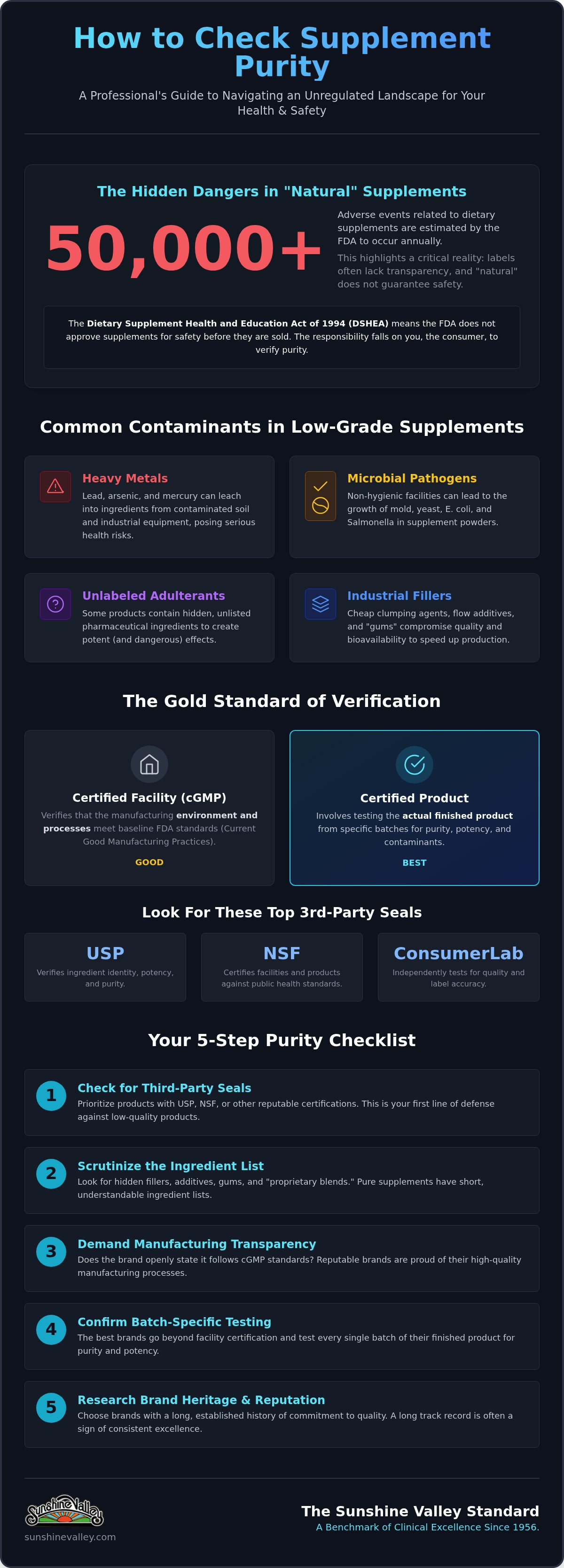
The FDA estimates that over 50,000 adverse events related to dietary supplements occur every year, a staggering figure that highlights the persistent gaps in consumer safety. This data underscores a reality many health-conscious individuals already fear: the supplement industry remains a landscape of hidden fillers and potential heavy metal contamination.
You likely feel frustrated by "proprietary blends" and the opaque nature of current regulations. It's difficult to maintain confidence in your wellness regimen when labels lack transparency. Learning how to check supplement purity is the only way to ensure you are consuming pure, lab-grade ingredients rather than industrial byproducts. This guide provides the professional methodology required to vet any brand with clinical precision. We will examine the implications of the Dietary Supplement Listing Act of 2026, decode the most prestigious third-party certifications, and provide a structured 5-step checklist to secure your health through rigorous verification.
Key Takeaways
- Understand why "natural" labels do not guarantee safety and how to navigate the 2026 regulatory gap with precision.
- Identify the top third-party certifications that audit manufacturing facilities to ensure batch-to-batch ingredient consistency.
- Learn how to check supplement purity by spotting hidden fillers and excipients that compromise product quality.
- Utilize a professional 5-step checklist to verify a brand's heritage and physical manufacturing standards before purchasing.
- Discover the "Super" standard for filler-free powders, a benchmark of clinical excellence established in 1956.
Understanding the Regulatory Gap: Why Purity Isn’t Guaranteed
The common assumption that a product on a retail shelf is inherently safe is a dangerous misconception. In the United States, the regulatory framework for supplements differs fundamentally from that of pharmaceutical drugs. While medications must undergo rigorous clinical trials and prove safety and efficacy before reaching the public, dietary supplements do not. This regulatory environment makes it difficult for consumers to know how to check supplement purity without professional guidance. Supplement purity is defined as the absolute absence of contaminants and non-functional fillers.
The global supply chain introduces significant vulnerabilities. Raw materials are often sourced from multiple international suppliers, where soil quality and processing standards vary wildly. A product labeled "Natural" is not a synonym for "Pure" or "Safe." Many natural ingredients are prone to heavy metal accumulation or microbial growth if not handled in clinical-grade facilities. Purity requires active verification, not passive trust in marketing claims.
The FDA’s Role and the DSHEA Act
The current landscape of the industry is largely defined by the Dietary Supplement Health and Education Act of 1994 (DSHEA). Under this law, the FDA is not authorized to approve dietary supplements for safety or effectiveness before they are marketed. Instead, the burden of proof lies with the manufacturer to ensure their products are safe. The FDA’s role is primarily reactive. The agency typically only intervenes after a product is already on the market and has caused documented harm or adverse events.
This post-market monitoring system often fails to catch low-purity products. Many manufacturers exploit the "Generally Recognized As Safe" (GRAS) loophole to introduce new ingredients without extensive federal review. Without pre-market testing requirements, the responsibility for vetting quality falls entirely on the consumer. Understanding how to check supplement purity involves looking past the label and investigating the manufacturer's specific testing protocols.
To see how a trusted heritage brand provides educational resources on ingredient safety and efficacy, you can learn more about the science behind Coenzyme Q10.
Common Contaminants in Low-Grade Supplements
Low-grade manufacturing processes frequently result in products that are technically legal but biologically compromised. These contaminants are rarely listed on the ingredient panel. Common risks include:
- Heavy Metals: Lead, arsenic, and mercury often leach into botanical ingredients from contaminated soil or industrial processing equipment.
- Microbial Pathogens: Non-hygienic facilities can allow for the growth of mold, yeast, or bacteria such as E. coli and Salmonella.
- Unlabeled Adulterants: Some "performance" or "weight loss" powders contain hidden pharmaceutical ingredients to create immediate, albeit dangerous, effects.
- Industrial Fillers: Cheap clumping agents and flow additives are used to speed up production, often at the expense of ingredient bio-availability.
The absence of these elements is what separates professional, lab-grade powders from mass-market alternatives. Maintaining a clean supplement regimen requires a disciplined approach to vetting every brand's manufacturing lineage.
Identifying Gold-Standard Certifications and Third-Party Testing
Trust is not a scientific metric. Many brands claim "lab-tested" on their labels without specifying the laboratory or the standards used. True verification comes from independent, third-party organizations that maintain no financial stake in the product's market success. As of early 2026, major retailers like Amazon require third-party verification for compliance with Current Good Manufacturing Practices (cGMPs). This regulatory shift has made it easier for consumers to understand how to check supplement purity by looking for specific, accredited seals.
A critical distinction exists between a "certified facility" and a "certified product." A facility may be cGMP compliant, which verifies that the manufacturing environment and processes meet baseline standards. However, this doesn't guarantee the purity of every individual batch. Product-specific certification involves testing the actual powder for heavy metals, microbes, and potency. Professional-grade powders, such as pure MSM or Inositol, require this level of batch-to-batch scrutiny because they lack the buffers and fillers found in mass-market tablets. When you are vetting your supplements, always prioritize products that undergo finished-good testing.
USP, NSF, and ConsumerLab: The Big Three
These organizations represent the industry benchmark for safety and transparency. Each serves a distinct role in the verification process:
- USP (U.S. Pharmacopeia): Verifies that the supplement contains the ingredients listed in the stated potency. It also ensures the product does not contain harmful levels of specified contaminants.
- NSF International: Focuses on manufacturing hygiene and the absence of banned substances. The "NSF Certified for Sport" seal is the most rigorous tier for athletic safety.
- ConsumerLab: Operates as an independent watchdog. They purchase products directly from retail shelves to test for label accuracy, heavy metals, and disintegration rates.
How to Request and Read a Certificate of Analysis (CoA)
A Certificate of Analysis (CoA) is the most transparent document a brand can provide. It's a batch-specific report from an analytical laboratory that details the exact test results for a particular production run. Reputable manufacturers keep these documents on file and provide them to discerning customers upon request. This level of transparency is a hallmark of clinical-grade providers.
When reviewing a CoA, check that the batch number matches the one printed on your product packaging. Look for specific numerical values rather than a vague "Pass" result. Key fields include the purity percentage of the active ingredient and the specific microbial limits for yeast, mold, and bacteria. Red flags include missing dates, redacted laboratory names, or reports that are more than two years old. If you require the highest level of assurance, consider choosing lab-grade powders from heritage brands that prioritize documented clinical excellence.
Evaluating the Label: Spotting Fillers, Additives, and "Gums"
The ingredient panel is the most immediate tool for those learning how to check supplement purity. It requires a disciplined eye to distinguish between the nutritional payload and industrial processing aids. Most commercial products are divided into active ingredients and excipients. Active ingredients are the compounds intended to support your health. Excipients are inactive substances used to facilitate manufacturing, stabilize the formula, or improve the product's shelf life. In many mass-market formulations, the volume of inactive fillers often exceeds the active nutrients. This dilution compromises the efficacy of your regimen.
Powdered supplements like Inositol or Mannitol face specific stability challenges. Because pure powders are often hygroscopic, they tend to clump or absorb moisture during the production cycle. Many companies resolve this by adding chemical anti-caking agents. This is a compromise of quality for the sake of convenience. High-tier manufacturing environments use advanced climate controls to maintain powder integrity without these additives. Reviewing established mannitol powder quality standards illustrates that achieving 100% purity is a result of meticulous engineering rather than chemical intervention. The "Clean Label" movement focuses on this standard, prioritizing products where every milligram of powder serves a biological purpose.
Common Fillers to Avoid in Powdered Supplements
Many additives are industry standards but remain undesirable for the discerning consumer. Magnesium Stearate and Stearic Acid are the most common flow agents. They act as lubricants to prevent ingredients from sticking to high-speed encapsulation machinery. While generally recognized as safe, they provide no health benefit and can potentially interfere with ingredient absorption. Silicon Dioxide and Maltodextrin are also frequent inclusions. Maltodextrin, a processed carbohydrate, often serves as a cheap bulking agent to make a small amount of active ingredient appear more substantial. Gums like Xanthan or Guar are sometimes added to flavored powders to improve mouthfeel, but they can cause digestive sensitivity. Artificial colors and synthetic sweeteners also introduce unnecessary chemical complexity. A pure, lab-grade powder should be free of these non-functional elements.
Standardized Extracts vs. Whole Herb Powders
Scientific rigor requires consistency. Whole herb powders are simply dried plants ground into a fine consistency. Their potency fluctuates based on soil quality, harvest time, and regional climate. Standardized extracts represent a more sophisticated approach. They are processed to contain a specific, guaranteed percentage of active phytochemicals. This ensures that each serving provides a predictable clinical effect. This precision is vital for those managing specific health goals. For example, niacinamide vitamin b3 powder benefits from high-purity standardization to ensure consistent nutritional support without the variables found in lower-grade alternatives. Prioritizing standardized, lab-grade designations is a fundamental step in how to check supplement purity effectively.
How to Vet a Supplement Brand: A 5-Step Consumer Checklist
Vetting a manufacturer is a rigorous process that goes beyond scanning a retail shelf. Understanding how to check supplement purity requires a systematic audit of a brand's operational integrity. This five-step checklist provides a professional framework for identifying lab-grade offerings. It moves past marketing claims to examine the foundational standards of production. By applying these criteria, you can eliminate low-tier products that compromise your wellness regimen with hidden contaminants or ineffective formulations.
Step 1 & 2: Heritage and Manufacturing Transparency
Heritage is a primary indicator of reliability. Brands with a multi-decade history, such as those established for over 20 years, often maintain more stable supply chains and established relationships with premium raw material suppliers. This longevity suggests a commitment to quality that outlasts fleeting market trends. You should always verify whether a company manufactures their own products or utilizes a third-party contract filler. Direct control over the production facility ensures strict adherence to hygienic supplement manufacturing standards. A brand that owns its facility acts as a disciplined guardian of its own quality, whereas contract manufacturing often introduces variables in cleanliness and ingredient handling.
Step 3, 4 & 5: Label Integrity and Scientific Support
Transparency in labeling is non-negotiable. You must avoid products that hide behind "Proprietary Blends," as these often mask low-tier ingredient ratios with cheap fillers. A pure product lists every ingredient with its specific weight. Scrutinize the "Other Ingredients" list for unnecessary additives like magnesium stearate or artificial sweeteners. It's also essential to evaluate the availability of batch-specific Certificates of Analysis (CoA). With the 2026 shift toward mandatory third-party verification on platforms like Amazon, reputable brands are increasingly making this data accessible to the public. Finally, you should prioritize clinical-grade heritage over viral marketing trends. Look for formulations backed by documented scientific support and allergen-free certifications rather than influencer endorsements.
Applying these steps ensures that you are consuming only what is necessary for your health. Professional-grade supplements are defined by what they exclude as much as what they include. If a brand cannot provide a clear manufacturing lineage or batch-specific testing data, it does not meet the standard for lab-grade purity. For those seeking the highest clinical standard, you can view the Super line of pure powders from Sunshine Valley, a benchmark for filler-free nutrition since 1956.
The Sunshine Valley Standard: Purity Since 1956
Sunshine Valley represents a 70-year tradition of clinical excellence. Established in 1956, our brand has functioned as a disciplined guardian of health for seven decades. Our history is rooted in serving a prestigious, high-profile clientele who demand absolute transparency and scientific rigor. While mass-market brands focus on viral marketing trends, we prioritize manufacturing precision. This heritage provides a professional benchmark for how to check supplement purity at the most demanding levels. We don't just follow industry standards; we define them through our "Super" line of unadulterated powders.
The manufacturing environment is the final safeguard of product integrity. Our facility operates with modern technological sophistication, utilizing state-of-the-art hygienic protocols. We maintain strict climate and particulate controls to prevent cross-contamination and moisture absorption. This controlled environment allows us to process fine powders without the chemical flow agents or anti-caking additives used by high-speed contract fillers. It's a methodical, professional approach to wellness. Each batch reflects our commitment to excellence and our history of reliable manufacturing.
Clinical Grade vs. Food Grade: The Sunshine Valley Difference
Food-grade standards are a baseline for the general population. They are often insufficient for the discerning individual focused on health optimization. Sunshine Valley adheres to clinical-grade protocols that exceed basic food requirements. This distinction is vital for maintaining ingredient integrity and ensuring maximum bioavailability. For example, our premium msm powder undergoes meticulous handling to preserve its molecular structure and purity. We eliminate the variables found in lower-tier products. High-tier powders must contain only the active compound to ensure predictable results.
Our Zero-Filler Guarantee for Powdered Supplements
We refuse to use clumping agents. No artificial flow enhancers. No synthetic stabilizers. Our zero-filler guarantee is a foundational pillar of our operations. Pure, unadulterated powders allow for precise dosing and complete control over your nutritional intake. They integrate seamlessly into daily wellness routines without the digestive interference caused by common excipients. Our commitment to cleanliness is absolute.
- 100% Active Ingredients: No maltodextrin, magnesium stearate, or silicon dioxide.
- Hygienic Lab-Grade Processing: Advanced environmental controls for powder stability.
- Documented Batch Consistency: Rigorous testing to ensure superlative quality in every serving.
Understanding how to check supplement purity leads to a singular conclusion: the manufacturer's standards are the only true guarantee. Start your journey with a brand that has defined clinical excellence since 1956. Choose Sunshine Valley for a supplement regimen built on uncompromised purity and professional-grade ingredients.
Securing Your Wellness Through Clinical Verification
Bridging the gap between marketing claims and biological safety requires a disciplined, professional approach. You now possess the necessary framework for how to check supplement purity by auditing labels for hidden fillers and demanding batch-specific transparency. True health optimization is built on foundations of clinical-grade manufacturing and uncompromised ingredient integrity. Trust is earned through decades of adherence to these rigorous protocols.
Sunshine Valley has remained a trusted guardian of purity since 1956. Our "Super" line represents the absolute pinnacle of filler-free nutrition. Every powder is processed in facilities that exceed standard industry hygiene norms, ensuring that you consume only active, beneficial compounds. We eliminate the variables of low-tier production to ensure your wellness regimen remains effective, safe, and prestigious. You deserve the precision of lab-grade standards in every serving.
Experience Clinical-Grade Purity: Shop the Sunshine Valley Collection
Take command of your nutritional future with the confidence that only professional heritage can provide. Success in health begins with the quality of your ingredients.
Just as you protect your physical health by vetting your supplements, ensuring your assets are covered by a professional agency like SI Insurance is another vital step in maintaining overall security; they offer a wide range of coverage options for both individuals and businesses.
Frequently Asked Questions
Is it possible to check supplement purity at home?
No. Reliable purity testing requires sophisticated analytical equipment such as High-Performance Liquid Chromatography (HPLC) or Inductively Coupled Plasma Mass Spectrometry (ICP-MS). Visual inspection and home "dissolution tests" are insufficient. They cannot detect microscopic pathogens or heavy metal concentrations. Professional verification must occur in a controlled laboratory environment to ensure clinical accuracy.
What is a Certificate of Analysis (CoA) and how do I get one?
A Certificate of Analysis is a batch-specific document detailing the exact laboratory results for a production run. It verifies the identity, potency, and purity of the ingredients. You can obtain one by contacting the manufacturer's customer service department. Provide the lot or batch number printed on your product packaging to receive the corresponding report.
Does the FDA approve dietary supplements for purity?
No. Under the Dietary Supplement Health and Education Act of 1994, the FDA does not approve supplements for safety or purity before they reach the market. The agency’s role is primarily reactive. Manufacturers are legally responsible for ensuring their products are safe and accurately labeled before sale. This regulatory gap is why independent vetting is a vital step in how to check supplement purity.
What are the most common fillers found in powdered supplements?
Maltodextrin, magnesium stearate, and silicon dioxide are the most prevalent additives. Manufacturers use these as bulking agents or flow enhancers to speed up production cycles. While common in food-grade products, these excipients provide no nutritional benefit. They can interfere with the bioavailability of the active compound and may cause digestive sensitivity in some individuals.
Are expensive supplements always purer than cheaper ones?
Not necessarily. High pricing often reflects aggressive marketing budgets rather than ingredient quality. However, clinical-grade manufacturing and zero-filler protocols involve higher operational costs. Lab-grade powders from heritage brands often carry a premium price due to the rigorous testing and hygienic standards required to maintain a 100% pure product line.
How can I tell if a third-party seal on a bottle is real?
Don't rely solely on the physical label. Visit the official website of the certifying body, such as NSF, USP, or Informed-Sport. These organizations maintain public, searchable databases of every certified product and brand. If a brand is not listed in the official registry, the seal on the bottle may be unauthorized or expired.
What does "cGMP" stand for in supplement manufacturing?
It stands for Current Good Manufacturing Practices. These are regulations enforced by the FDA to ensure that products are consistently produced and controlled according to quality standards. It covers everything from facility cleanliness to equipment maintenance. While cGMP is a baseline requirement, it does not replace the need for batch-specific purity testing.
Can I trust supplements sold on major online marketplaces like Amazon?
As of 2026, Amazon requires all supplement brands to provide third-party verification of cGMP compliance. This has significantly reduced the presence of fraudulent products. However, you should still exercise caution. Always verify the brand's history and request a CoA. Understanding how to check supplement purity involves looking beyond the platform's baseline requirements to confirm a brand's specific clinical standards.

Leave a comment
This site is protected by hCaptcha and the hCaptcha Privacy Policy and Terms of Service apply.