




A premium-looking label isn’t proof of a premium supplement. The signs of a high-quality supplement are in the details: a clearly identified ingredient, transparent serving information, credible manufacturing details, and evidence that supports specific quality claims. Those details can be harder to find than bold promises about purity or performance.
It’s understandable to want a simple way to compare products. Terms such as “natural” and “pure” can sound reassuring, but they don’t establish what’s in a product or how it was made. Dietary supplement manufacturers must follow current Good Manufacturing Practices, but compliance is a baseline requirement, not proof that a supplement is effective or right for you.
This practical checklist covers ingredient identity, labels, manufacturing transparency, testing, and certifications, including what each can and can’t show. You’ll also learn to distinguish regulatory compliance from evidence of quality, and quality from medical effectiveness. The goal is to make a clearer, more informed choice based on verifiable information, not marketing language.
Key Takeaways
- Use the signs of a high-quality supplement as a practical guide: start with clear ingredient identity, serving details, and information you can verify.
- Learn what identity and purity testing can indicate, and why neither is a blanket guarantee of safety or effectiveness.
- Look beyond words such as “natural,” “pure,” and “premium” by checking what evidence supports each claim.
- Apply a straightforward checklist to compare a product’s label and information with your intended use.
- Sunshine Valley’s in-house manufacturing, hygiene standards, and history since 1956 provide context, but don’t replace product-specific evidence.
What Are the Signs of a High-Quality Supplement? Start With the Label
The signs of a high-quality supplement begin with information you can assess, not the confidence of a slogan. Look for a clearly identified ingredient, transparent serving details, reliable labeling, appropriate manufacturing controls, and quality evidence you can inspect. Premium language, polished packaging, and a higher price may shape expectations, but none establishes what a product contains or how it was made.
Quality and effectiveness are separate questions. A supplement may be accurately labeled and made under appropriate controls, yet that alone doesn’t show whether its ingredients work for a particular health goal. Start by understanding what a dietary supplement is, then assess the specific product rather than relying on broad promises.
For a visual overview, watch this video about signs of high-quality vitamin D:
Which label details should a supplement clearly provide?
Start with the product identity and serving information. The label should name the ingredient, state its amount per serving, define the serving size, and provide a complete ingredient list. Clear directions, relevant warnings, storage guidance, and responsible business contact information help you understand how the product is presented and who is accountable for it.
Apply the same review to powders, capsules, and other forms. For a powder, check how the serving is measured. For a capsule, note the amount per serving and how many capsules make up that serving. A clear label helps you compare products, but it isn’t proof of clinical benefit.
How do quality claims differ from health claims?
Identity and purity claims concern what a product contains and whether testing or other evidence supports its composition. Health claims concern what an ingredient may do in the body. These require different kinds of evidence. A clean-looking label, a “pure” description, or a list of quality controls can’t establish that a product is safe for every individual.
Quality evidence and clinical evidence answer different questions: one examines what’s in the product, while the other examines whether it produces a health effect.
Keep that distinction in view as you compare labels. First separate checkable product information from claims about outcomes. Then review the manufacturing and testing details that may support specific quality claims.
How to Assess Ingredient Identity, Purity, and Testing Evidence
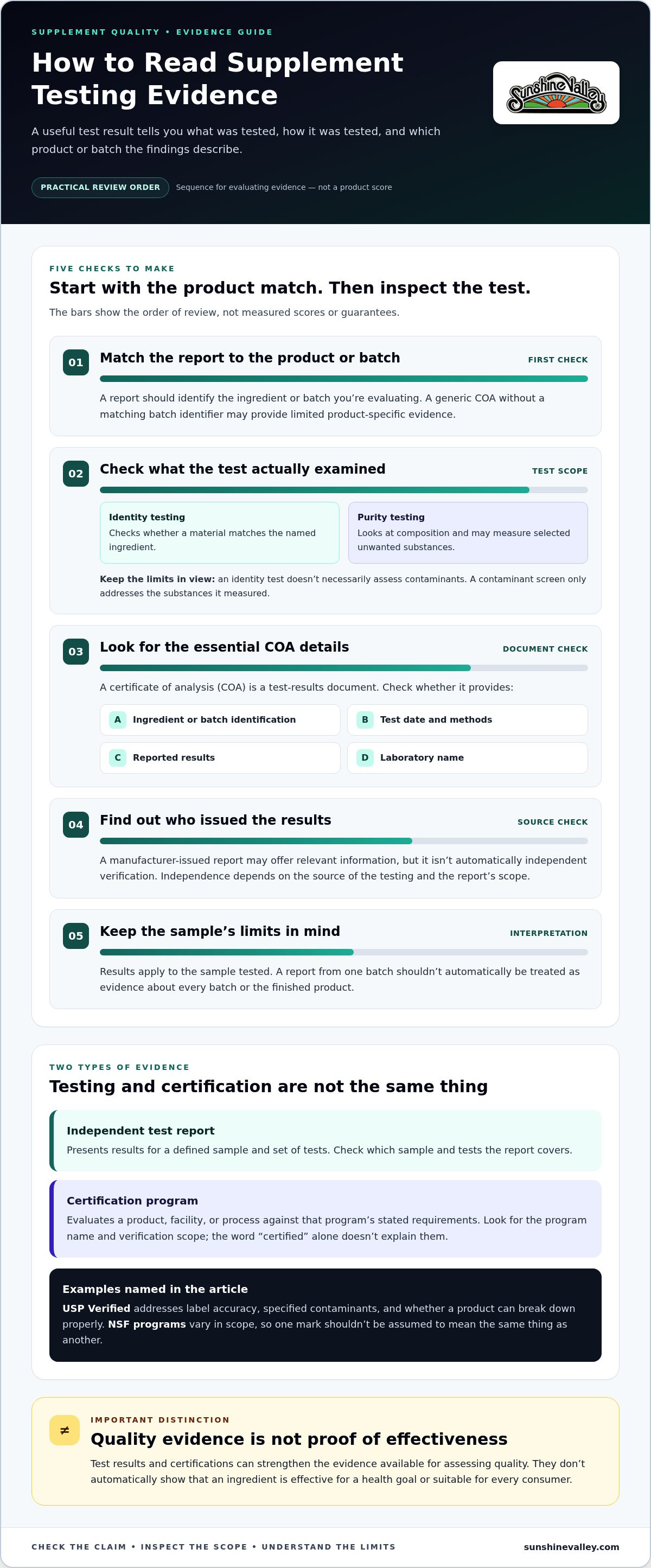
Testing can provide useful evidence, but the word “tested” doesn’t tell you what was examined. Identity testing checks whether a material matches the named ingredient. Purity testing looks at composition and may measure selected unwanted substances, such as particular contaminants. Neither result is a blanket safety guarantee. What a test establishes depends on the sample, method, substances measured, and results reported.
Read the scope carefully. An identity test doesn’t necessarily assess contaminants, and a contaminant screen only addresses the substances it measured. Results also relate to the sample tested. A report from one batch shouldn’t automatically be treated as evidence about every batch or the finished product.
What should a certificate of analysis show?
A certificate of analysis (COA) is a test-results document. Check that it identifies the ingredient or batch, gives the test date and methods, reports results, and names the laboratory. These details help you understand what was tested and whether the findings relate to the product or batch you’re evaluating.
A generic COA without a matching batch identifier may offer limited product-specific evidence. Check who issued the document and what it covers. A manufacturer-issued report may provide relevant information, but it isn’t automatically independent verification. That depends on the source of the testing and the report’s scope.
What can third-party testing or certification establish?
An independent test report presents results for a defined sample and set of tests. A certification program is different: it evaluates a product, facility, or process against the program’s stated requirements. The word “certified” alone doesn’t tell you which requirements apply, so look for the program name and the scope of its verification.
USP and NSF International offer programs with distinct criteria and marks. For example, the USP Verified mark addresses label accuracy, specified contaminants, and whether a product can break down properly. NSF programs vary in scope, so one mark shouldn’t be assumed to mean the same thing as another. Review the particular program’s current criteria to understand what a seal represents.
A certification or test result can strengthen the evidence available for assessing quality. It doesn’t automatically prove that an ingredient is effective for a health goal or suitable for every consumer. Sunshine Valley offers powdered supplements, so apply the same careful approach to each product: evaluate its specific information and evidence rather than inferring test results from general manufacturing statements.
Does a High-Quality Supplement Need to Be “Natural,” “Pure,” or Certified?
Words such as “natural,” “pure,” “clean,” and “premium” can suggest care, but they don’t tell you exactly what a supplement contains or what standards were used to make it. Treat them as prompts to look for specific explanations and supporting evidence, not as quality measures on their own. The signs of a high-quality supplement come from details you can evaluate, not adjectives that sound reassuring.
“Natural” doesn’t, by itself, establish an ingredient’s identity, purity, or risk level. Origin alone can’t tell you how a substance was processed, what else is present, or whether it’s appropriate for a particular person. The same caution applies to “pure” and “clean”: without a clear definition and relevant evidence, these terms leave important questions unanswered.
What do “natural” and “pure” mean on a supplement label?
Interpret these descriptions in context. Look for specific ingredient disclosures and supporting information that explains what the claim means for that product. Don’t assume the terms have one universal meaning across supplement labels; consult current FDA guidance for how labeling claims are treated. A descriptive phrase isn’t a substitute for ingredient information or evidence supporting a measurable quality claim.
How should consumers interpret certifications and FDA oversight?
A certification can be useful when you know which program issued it and what the program currently evaluates. Requirements differ, and a seal applies only within its stated scope. It may address a defined product or manufacturing standard, but it doesn’t automatically establish that a supplement is effective, risk-free, or suitable for every consumer. Check the certifier’s current criteria rather than relying on the seal’s appearance alone.
FDA oversight differs from voluntary standards and third-party certification. The FDA doesn’t approve dietary supplements for safety and effectiveness before they’re marketed. It regulates supplements and can take action under applicable requirements, including after products reach the market. A product’s availability for sale, or a claim that it follows manufacturing requirements, shouldn’t be presented as FDA approval or proof of clinical benefit.
Use each claim to guide a different question: What does the term mean here? What evidence supports it? What does the certification cover? Reading labels this way is more informative than treating any single phrase or seal as a guarantee.
Sunshine Valley offers powdered supplements, including powdered supplement offerings. Evaluate the product information and evidence rather than relying on broad quality language alone.
Use This Supplement Quality Checklist Before You Choose
Use this five-step review to compare supplements across forms and ingredient categories. It helps you assess the information available, but it can’t determine whether a product is appropriate for your individual health needs.
- Confirm the ingredient and serving. Check the ingredient name, amount per serving, serving size, and complete ingredient list. Match these details to the product you intend to use rather than relying on front-label claims.
- Read directions and cautions. Review the suggested use, warnings, and storage instructions. Make sure the serving information is clear and relevant to your intended use.
- Look for traceable batch information. Note any lot or batch identifier. If testing documents are provided, check whether they correspond to that batch and identify the sample, laboratory, methods, test date, and results.
- Interpret test results within their limits. A report speaks only to the sample and substances tested. It doesn’t establish that every batch was tested or prove effectiveness, suitability, or complete safety.
- Check certification claims. Identify the certifier and review the program’s stated scope and current requirements. Don’t assume a seal covers every quality measure or guarantees a health benefit.
Together, these steps turn the signs of a high-quality supplement into practical questions to ask before choosing. If an ingredient amount, serving size, or testing claim is unclear, treat that as a reason to look for clearer information, not as evidence of a result the label doesn’t establish.
When should you seek personalized health advice?
Product quality is only one part of a personal decision. Speak with a qualified healthcare professional before using a supplement during pregnancy or nursing, or while receiving ongoing medical care. Medication use, allergies, and existing health conditions can affect whether a product is appropriate and how it may interact with your circumstances.
This checklist is for general education. It doesn’t diagnose a condition or recommend treatment, and a label or test document can’t replace advice tailored to your health history. For product information, explore Sunshine Valley’s powdered supplement offerings.
How Sunshine Valley Approaches Supplement Quality and Transparency
Sunshine Valley emphasizes premium ingredients, in-house manufacturing, and strict hygiene standards. These commitments offer useful context, but the signs of a high-quality supplement still depend on product-specific information you can assess. Review ingredient identity, serving details, directions, storage guidance, and product documentation. Broad company statements alone don’t prove a particular product’s results.
What can company history tell you about supplement quality?
Founded in 1956, Sunshine Valley has a long history in powdered dietary supplements. Longevity is heritage, not a substitute for evidence about an individual product. Clear manufacturing descriptions and product information help readers make informed comparisons. Learn more about Sunshine Valley’s approach to hygienic supplement manufacturing, then consider the information for the specific product you’re evaluating.
How to apply the checklist to powdered supplements
Super Inositol and Super MSM are examples of Sunshine Valley’s powdered offerings. Start by confirming the named ingredient and reviewing the amount per serving, serving size, full ingredient list, directions, and storage guidance. When reviewing quality documentation, check whether it identifies a relevant batch, the sample tested, the laboratory, methods, date, and results. A document supports only the claims within its stated scope; don’t assume it covers every batch or proves an ingredient’s effectiveness.
For more background on evaluating product information, read the guide to mannitol powder quality standards. Sunshine Valley also offers Super Niacinamide. Its related resource on high-purity niacinamide powder provides another starting point for reviewing ingredient-specific information. Neither a company’s history nor a general manufacturing statement replaces product-specific evidence.
Explore Sunshine Valley’s product information with the checklist in mind. Assess each powder using the details provided for that product, and distinguish documented facts from assumptions about purity, safety, or health effects.
Make Your Next Supplement Choice With Confidence
The signs of a high-quality supplement are in details you can assess: clear ingredient and serving information, transparent manufacturing practices, and quality evidence with a defined scope. Labels, certificates, and testing can help you evaluate what a product contains, but they don’t prove that it will deliver a health effect or suit every person.
Use the checklist to compare products thoughtfully. Review ingredient identity, directions, warnings, storage guidance, and relevant testing or certification information. For personal health questions, seek advice from a qualified healthcare professional.
Sunshine Valley, founded in 1956, emphasizes premium ingredients, in-house manufacturing, and strict hygiene standards. Its history provides context, while product details remain important to your individual assessment. Explore Sunshine Valley’s powdered supplements and use the checklist to guide your review.
Frequently Asked Questions
What are the signs of a high-quality supplement?
The signs of a high-quality supplement include a clearly identified ingredient, transparent serving amounts, a complete ingredient list, and clear directions and warnings. Look for manufacturing information and quality evidence you can examine, such as a relevant test report or certification with a defined scope. Premium wording, packaging, or price alone doesn’t prove quality. These indicators help assess product identity and controls, but they don’t establish that the supplement is effective for a health goal.
How can I tell if a supplement is pure?
Look for specific evidence about composition, not just a “pure” claim. A relevant test report should identify the sample or batch, methods, results, test date, and laboratory. Check which substances were measured and whether the results apply to the product or batch you’re considering. Testing provides evidence about the items examined, but can’t prove the absence of every unwanted substance or guarantee safety for every person.
Does the FDA approve dietary supplements before they are sold?
No. The FDA doesn’t approve dietary supplements for safety and effectiveness before they’re marketed. Manufacturers and distributors are responsible for ensuring products meet applicable requirements, including accurate labeling and appropriate manufacturing controls. FDA oversight includes monitoring the market and taking action when warranted. A product being sold, or a label referring to manufacturing compliance, shouldn’t be mistaken for FDA approval or proof that the supplement delivers a particular health benefit.
Is third-party tested always better for supplements?
Third-party testing can add useful independent evidence, but the phrase alone doesn’t reveal what was tested or how. Review the report’s sample, laboratory, methods, date, and results, and check whether it relates to a specific batch. A certification program differs from a single test report because it follows defined requirements within a stated scope. Neither automatically proves effectiveness or suitability for every consumer, so judge the evidence by what it actually covers.
What should a supplement certificate of analysis include?
A useful certificate of analysis should identify the ingredient or batch, test date, methods, reported results, and laboratory. Check that the document matches the product or batch you’re evaluating and specifies what the tests measured. A general certificate without a traceable batch identifier may offer limited product-specific evidence. Also consider who issued it: a certificate isn’t independent verification unless the source and testing arrangement support that description.
Can a supplement be high quality but still not be right for me?
Yes. Accurate labeling and quality controls don’t establish that a supplement suits your needs or health circumstances. Ingredients may be unsuitable for an individual because of medication use, allergies, an existing condition, pregnancy, or nursing. Discuss personal risks with a qualified healthcare professional, especially if you’re receiving ongoing care. Product-quality evidence addresses the product; personalized guidance considers the person using it.
Does “natural” on a supplement label mean it is safer?
No. “Natural” doesn’t by itself establish an ingredient’s identity, purity, or risk level, and it doesn’t guarantee that a product is safe for everyone. Interpret the term in context. Review the ingredient list, serving information, warnings, and supporting documentation for specific quality claims. A natural-origin description can’t replace evidence about what a supplement contains or individualized advice about whether it’s appropriate for you.



Leave a comment
This site is protected by hCaptcha and the hCaptcha Privacy Policy and Terms of Service apply.