




What’s the most useful answer about MSM and joint comfort? Neither a confident yes nor a dismissive no. Searching for msm supplement benefits for joints can bring up bold promises, but those claims don’t always reflect what human research can establish.
If you’re weighing a supplement for joint discomfort, it’s reasonable to want more than marketing language. Early research suggests MSM may support joint comfort for some people, but the evidence has limits. A supplement claim isn’t proof that it treats arthritis or another condition.
This article separates proposed benefits from what studies actually show. You’ll learn where the evidence is encouraging but limited, what researchers think MSM may do, and what remains uncertain. We’ll also cover potential side effects, how to review product labels, and what to discuss with a healthcare professional. The goal is to help you decide whether MSM is worth asking about without mistaking possibility for proven treatment.
Key Takeaways
- Learn what research can and can’t tell you about msm supplement benefits for joints, and why possible support isn’t proof of treatment.
- Understand how proposed explanations for MSM’s effects differ from findings in human studies.
- Use a practical checklist to review a powder’s ingredients, directions, cautions, and company information.
- Remember that manufacturing standards and product quality don’t establish that a supplement will improve joint comfort.
- Identify questions to raise with a healthcare professional before considering MSM, especially if you have health concerns or take medication.
What Are MSM Supplements, and How Might They Relate to Joint Health?
Methylsulfonylmethane, usually shortened to MSM, is an organic, sulfur-containing compound sold as a dietary supplement. It’s marketed for joint support because sulfur is part of compounds found in connective tissue. Researchers have also proposed that MSM may affect inflammation or oxidative stress. These ideas provide reasons to investigate MSM, not proof that taking it improves joint health in people.
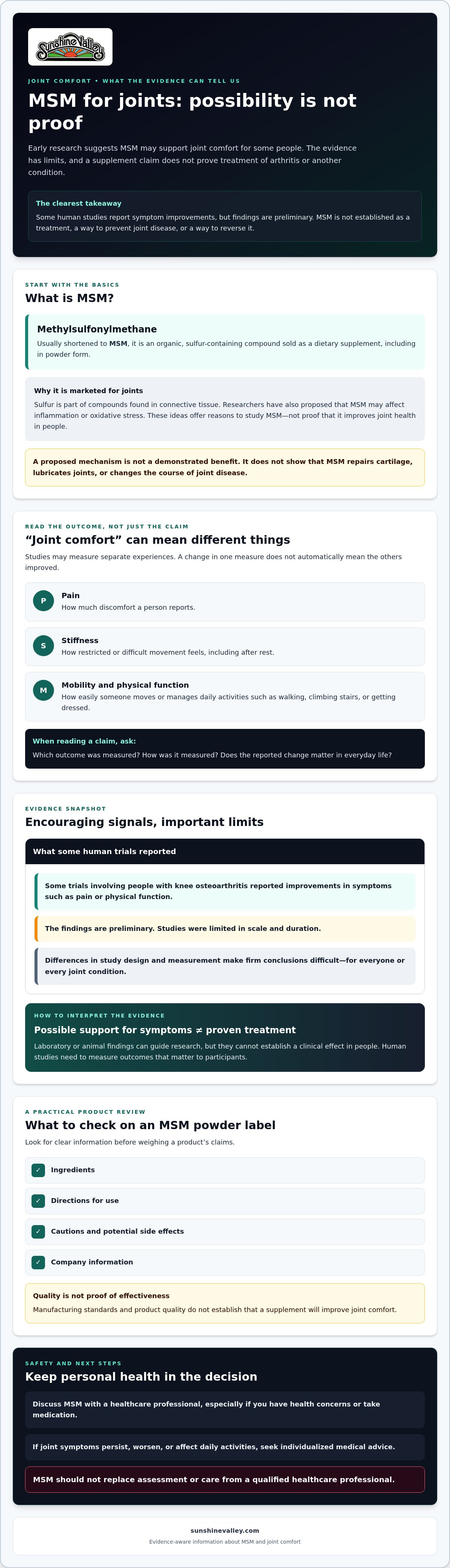
Key distinction: A supplement support claim describes a possible effect being studied. It doesn’t establish MSM as a medical treatment or a way to prevent or reverse joint disease.
What is MSM, and why is it sold as a joint supplement?
Methylsulfonylmethane (MSM) is used in dietary supplements, including powders. Its proposed connection to joint comfort comes from hypotheses about sulfur’s role in connective tissue and possible biological effects. Those hypotheses shouldn’t be mistaken for evidence that MSM repairs cartilage. MSM is also distinct from prescription medicines and other ingredients marketed for joint health. Their effects and evidence need to be considered separately.
What do people mean by joint comfort?
“Joint comfort” can describe several different experiences, which studies may measure separately. Pain is the intensity of discomfort. Stiffness is difficulty moving a joint, often after rest. Mobility describes how easily a person can move, while physical function concerns everyday activities such as walking, climbing stairs, or getting dressed. A change in one measure doesn’t automatically mean improvement in the others.
Joint symptoms can have many causes, so discomfort can mean different things from person to person. Marketing language may blur these distinctions. The phrase msm supplement benefits for joints doesn’t specify the outcome being discussed, how it was measured, or whether a reported change matters in daily life. Those details are important when interpreting research.
- Pain: How much discomfort a person reports.
- Stiffness: How restricted or difficult movement feels.
- Mobility and function: What movements or daily tasks a person can manage.
If joint symptoms persist, worsen, or affect daily activities, seek individualized medical advice. MSM shouldn’t replace assessment or care from a qualified healthcare professional. The useful question isn’t simply whether a product is called a joint supplement, but what specific outcome the evidence supports and how certain that evidence is.
How Could MSM Affect Joints, and What Does Human Research Measure?
Researchers have proposed that MSM may influence inflammation and oxidative stress, processes involved in the body’s response to tissue stress. These are plausible areas of study, not confirmed explanations of how MSM affects joint symptoms in people. A mechanism observed in a lab doesn’t show that taking a supplement will produce a noticeable or reliable benefit.
What mechanisms have researchers proposed for MSM?
The scientific review hosted by the National Center for Biotechnology Information discusses research into MSM’s possible anti-inflammatory and antioxidant activity. Some mechanistic findings come from laboratory or animal research. They can guide further investigation, but they can’t establish a clinical effect in humans or show that MSM rebuilds cartilage, lubricates joints, or changes the course of joint disease.
A plausible mechanism alone cannot establish a clinical benefit. To assess a joint-health claim, researchers need to test MSM in people and measure outcomes that matter to participants.
What can human studies tell us about joint benefits?
The review of evidence on MSM for joint health summarizes human studies, including research involving people with knee osteoarthritis. Some trials reported improvements in symptoms such as pain or physical function, but the findings are preliminary. The studies were limited in scale and duration, and differences in design and measurement make it difficult to draw a firm conclusion for everyone or every joint condition. These results don’t establish MSM as a treatment.
Joint studies may track several outcomes, each offering a different view of change:
- Pain scores: Participants rate the intensity of discomfort, often using a standardized scale.
- Stiffness: Researchers assess how restricted movement feels, including difficulty after rest.
- Physical function: Measures may ask whether daily activities or specific movements feel easier.
A change in one outcome doesn’t necessarily mean that mobility, stiffness, and daily function all improve. Nor does a study average predict an individual’s response. The study population, comparison group, follow-up period, and outcomes measured all shape what a result can tell us. Claims about msm supplement benefits for joints should be judged against human evidence, not mechanism alone.
If you’re comparing powders after considering the evidence and safety questions, review the available Super MSM powder information and its label. Don’t assume a product has proven joint effects.
Do MSM Supplement Benefits for Joints Hold Up? Evidence, Limits, and Expectations
Human research offers a signal worth studying, not a settled conclusion. Some small trials involving people with knee osteoarthritis have reported improvements in symptoms such as pain or physical function. Those findings apply to the participants and measures in those studies. They don’t establish the same result for everyone with joint discomfort. A UCLA Health expert discussion of MSM and arthritis also puts the evidence in perspective: promising reports aren’t enough to establish MSM as an arthritis treatment.
What outcomes have studies reported for joint symptoms?
Trials have assessed patient-reported pain and measures of physical function. These outcomes can provide useful information about symptoms, but they don’t show that MSM changes the underlying disease. Findings on one measure also shouldn’t be treated as proof of improvement in stiffness, mobility, or every aspect of daily life.
Use this table to read the evidence without turning a limited result into a broad promise:
| Proposed benefit | Evidence type | What findings suggest | Key limitation |
|---|---|---|---|
| Less joint pain | Small human trials, including research in people with knee osteoarthritis | Some studies reported symptom improvement | Limited participant numbers and follow-up make results uncertain |
| Better physical function | Human studies using symptom or function measures | Some results suggest possible improvement in daily function | Measures and study designs differ, and results may not apply to other populations |
| Less stiffness or improved mobility | Not consistently established by the available evidence | There isn’t enough basis to promise a reliable effect | These are distinct outcomes and require direct, well-designed study |
Why should readers interpret MSM claims cautiously?
A placebo comparison helps researchers separate a supplement’s possible effect from changes that might occur because participants expect to feel better or because symptoms naturally fluctuate. Small studies can miss real differences or produce results that don’t hold up in larger trials. Short follow-up leaves unanswered whether a change lasts. When studies use different doses, populations, and scoring systems, comparing results becomes harder.
For that reason, the phrase msm supplement benefits for joints should be read as a question about possible symptom support, not evidence of prevention or treatment. Even encouraging findings don’t show that MSM treats arthritis, prevents joint disease, or replaces appropriate medical care. Individual responses can vary, and a study average can’t predict what one person will experience.
How to Consider MSM Safely: Questions, Precautions, and Medical Advice
Use a measured decision process before adding MSM to your routine. First, identify the concern you want to address. Then review what human research can and can’t establish, check the full product label, and discuss possible use with a healthcare professional. This keeps a supplement decision separate from diagnosing or treating the cause of joint symptoms.
Who should speak with a healthcare professional first?
Ask a clinician or pharmacist before using MSM if you have a medical condition, take medication, are pregnant, or are breastfeeding. A potential interaction with blood-thinning medications has been noted, so don’t assume a supplement is risk-free simply because it’s sold without a prescription. Share the product’s ingredients and label directions so a professional can consider them alongside your health history and other products.
Consult a healthcare professional before adding a supplement to your care, especially if you have a medical condition or take medication. Seek medical assessment for joint symptoms that persist, worsen, or have no clear explanation. This article can help you prepare informed questions, but it can’t provide an individual diagnosis or treatment plan.
How can readers assess supplement information responsibly?
Read the entire label before deciding whether a product is appropriate. Check:
- Ingredients: Confirm what the product contains, including any additional ingredients.
- Directions and cautions: Follow verified label directions. Don’t assume a dose used in a study is right for you or that every product has the same serving instructions.
- Company information: Look for clear manufacturer contact details and information that allows you to ask questions about the product.
- Quality verification: Look for independent testing information where available, and confirm what it verifies. A quality or manufacturing claim isn’t proof of a joint-health effect.
In the United States, the FDA doesn’t evaluate dietary supplements for safety and effectiveness in the same way it evaluates prescription drugs. Supplements also can’t be marketed as treatments or cures for disease. Treat promises to cure arthritis, prevent joint disease, or guarantee results as warning signs. The phrase msm supplement benefits for joints describes an area of interest, not a guaranteed outcome.
If you’re considering a powder, review the available Super MSM product information and verify its current label details before use. Sunshine Valley identifies Super MSM as a powdered dietary supplement. Confirm product-specific directions, cautions, or testing claims from current product information rather than assuming them.
Choosing an MSM Powder with Clear Information: What to Check Before You Buy
After reviewing the evidence and considering safety, assess the product itself. A clear label helps you understand what you’re buying and how the manufacturer says to use it. It can’t establish that MSM will improve joint symptoms, but it provides practical information for comparing products and asking informed questions.
What information should an MSM supplement label make clear?
Check the current product label rather than relying on a general description or online headline. Look for:
- Ingredient identity: Does the label clearly identify MSM and list any other ingredients?
- Serving instructions: Are the directions readable and specific to that product? Don’t assume directions from another brand or a research study apply.
- Warnings and storage: Review cautions and storage instructions, and ask the manufacturer about anything that’s unclear.
- Company contact details: Can you identify and contact the company responsible for the product?
- Quality claims: If a label mentions purity, testing, certification, or manufacturing standards, look for specific supporting information. Don’t assume a claim means independent verification unless that is clearly documented.
Be cautious with claims that promise arthritis relief, disease prevention, or guaranteed results. Product quality and clinical evidence answer different questions. Manufacturing controls may relate to how a product is made, but they don’t prove that the ingredient improves pain, stiffness, or function. The phrase msm supplement benefits for joints shouldn’t replace evidence about a specific product and a clearly measured outcome.
Where does Sunshine Valley Super MSM fit?
Sunshine Valley offers Super MSM as a powdered dietary supplement. Founded in 1956, the company identifies premium ingredients, modern manufacturing, and strict hygiene standards as priorities. These are company-level commitments, not proof of product-specific clinical outcomes, testing certifications, purity figures, or joint benefits. Review the current Super MSM label for its actual ingredients, directions, cautions, and storage details before deciding whether it suits your needs.
Use the same checklist for any MSM powder: confirm what the label states, investigate claims you can’t verify, and discuss use with a healthcare professional when appropriate. For more background on evaluating MSM powder information, read Sunshine Valley’s premium MSM powder guide.
Make Your Next Step an Informed One
MSM may support joint comfort for some people, but the human evidence remains limited. Studies measure different outcomes, and a promising result doesn’t make MSM a proven treatment for arthritis or guarantee an individual response. Keep that distinction in mind when assessing claims about msm supplement benefits for joints.
A sound decision starts with your needs: consider what you hope to address, review the evidence, check the product’s current label, and speak with a healthcare professional when appropriate. Clear ingredient and use information can help you evaluate a supplement, but manufacturing priorities and product quality are separate from proof of clinical benefit.
Sunshine Valley states that it prioritizes premium ingredients, modern manufacturing, and strict hygiene standards. These company-level commitments offer context, not a promise of joint relief. Thoughtful questions and careful label review can help you make a choice that fits your circumstances.
Frequently Asked Questions
Does MSM help with joint pain?
MSM may help reduce joint pain for some people, but the human evidence is limited and doesn’t establish a reliable effect. Small studies, including research involving people with knee osteoarthritis, have reported symptom improvements. Results don’t guarantee an individual benefit, and pain findings don’t necessarily mean stiffness or daily function improved too. Consider the study population, comparison group, and outcomes measured before drawing conclusions about MSM.
Can MSM supplements help with arthritis?
MSM hasn’t been established as a treatment for arthritis. Some small human studies involving people with knee osteoarthritis have examined symptoms such as pain and function, but promising findings aren’t proof that MSM treats the disease or changes its course. Don’t use a supplement in place of medical assessment or recommended care. If you have arthritis or ongoing joint symptoms, discuss supplement use with a healthcare professional.
How long does MSM take to work for joints?
There’s no established timeline for MSM to improve joint symptoms, and some people may not notice a benefit. Research varies in design, duration, and outcomes measured, so a result from one study can’t predict when or whether another person will respond. Don’t increase the amount or continue taking a product beyond its label directions in pursuit of faster results. Ask a healthcare professional what’s appropriate for your circumstances.
Is MSM safe to take every day?
Daily use may be tolerated by many people, but that doesn’t mean it’s suitable for everyone or at any amount. Safety information depends on the dose, product, health history, and other medications or supplements. Follow the directions and cautions on the specific product label, and don’t assume research doses are personal recommendations. Ask a healthcare professional before regular use, particularly if you have a medical condition, take medication, are pregnant, or are breastfeeding.
What are the side effects of MSM supplements?
Reported side effects are generally mild and may include stomach discomfort, bloating, or skin rash. Not everyone experiences them, and product formulations and individual responses can differ. Stop taking a supplement and seek appropriate medical advice if you develop a concerning reaction. Check the label for warnings, and speak with a healthcare professional before use if you have a health condition, take medication, or are unsure whether MSM is appropriate for you.
Can I take MSM with other medications or supplements?
Check with a healthcare professional or pharmacist before combining MSM with medication or other supplements. A potential interaction has been noted with blood-thinning medications, so people taking them should seek professional advice before using MSM. Bring the product label and a list of medicines and supplements you take. This helps the professional assess ingredients and possible risks for your situation. Don’t stop or alter prescribed medication to make room for a supplement.
Is MSM the same as sulfur or a prescription joint medication?
No. MSM is an organic compound that contains sulfur, but it isn’t the same as elemental sulfur, and the body’s sulfur-containing compounds have different forms and roles. MSM sold in supplements is also not a prescription joint medication. It shouldn’t be treated as a proven arthritis therapy or as a replacement for prescribed care. Claims about msm supplement benefits for joints describe possible support under study, not an established medical treatment.
To review Sunshine Valley’s powdered Super MSM and its available product information, visit Sunshine Valley’s Super MSM page.



Leave a comment
This site is protected by hCaptcha and the hCaptcha Privacy Policy and Terms of Service apply.