




A commonly used myo-inositol and D-chiro-inositol ratio for fertility is 40:1, with myo-inositol as the larger amount. But the ratio is only part of the picture: the two forms have distinct roles, and PCOS can affect ovulation and fertility. Understanding how these pieces fit together makes supplement claims easier to interpret.
It’s understandable to focus on the numbers when weighing fertility-support options. A ratio can sound like a simple answer, but its meaning depends on how myo-inositol and D-chiro-inositol are combined and the concern being addressed.
This article explains how the two forms may relate to fertility, what a 40:1 ratio represents, and how PCOS, ovulation, and the available evidence connect. You’ll also learn why a ratio shouldn’t be treated as a guarantee of pregnancy or a substitute for individualized fertility care.
Key Takeaways
- Learn why myo-inositol and D-chiro-inositol are discussed together in fertility support, and how their distinct roles may matter.
- Understand how PCOS can affect ovulation and what research on inositol may tell you about this connection.
- See what a supplement ratio describes, so you can interpret the numbers on an inositol formulation more clearly.
- Explore why ovulation patterns and the type of fertility treatment can shape how inositol is considered.
- Discover how Super Inositol fits into the article’s discussion of inositol supplements.
How do myo-inositol & D-chiro-inositol support fertility?
Myo-inositol and D-chiro-inositol are forms of inositol involved in processes related to reproductive function. In polycystic ovary syndrome (PCOS), researchers study inositol supplementation for its potential relationship to insulin signaling, hormone balance, and ovulation. These factors may matter when trying to conceive, but supplement ratios and study outcomes require careful interpretation.
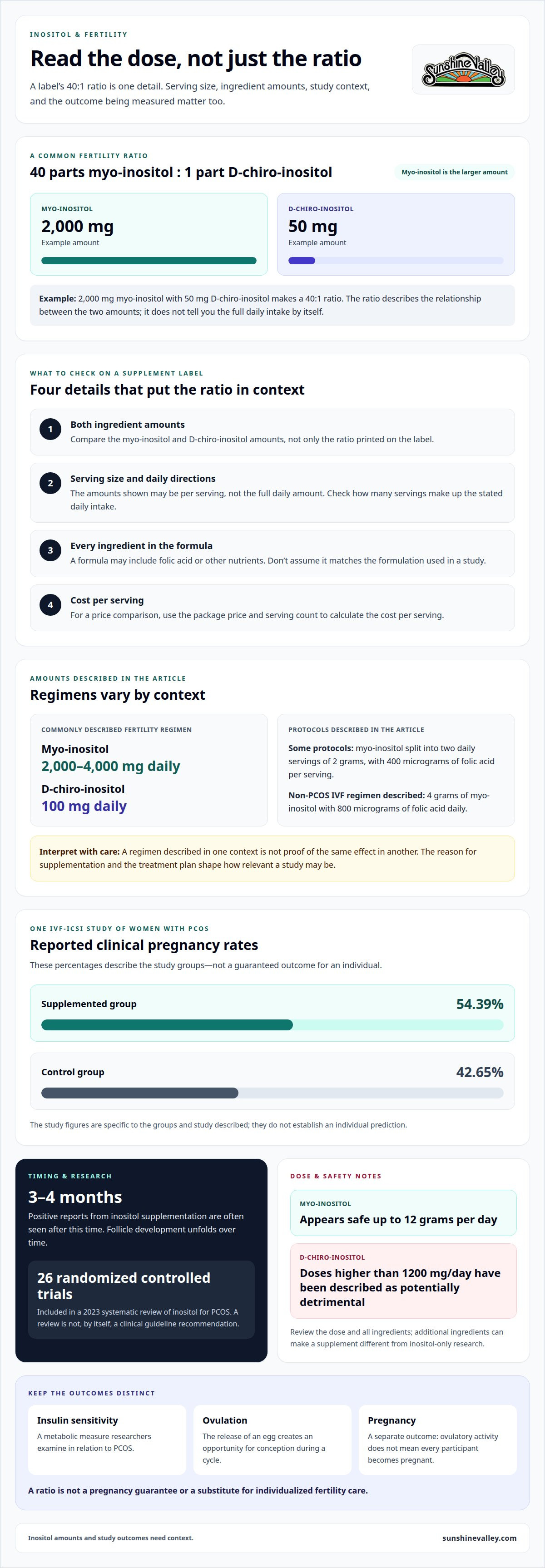
A commonly described fertility regimen provides 2,000 to 4,000 mg of myo-inositol and 100 mg of D-chiro-inositol daily. The amounts on a label show the dose per serving, not necessarily the full daily amount. For example, 2,000 mg of myo-inositol with 50 mg of D-chiro-inositol is a 40:1 ratio. Check how many servings make up the stated daily intake, then compare both ingredient amounts rather than relying on the ratio alone.
To compare label quality and cost in the United States, check the listed ingredients, amount per serving, and directions. Then calculate the cost per serving using the package price and serving count. A clear label helps distinguish a two-ingredient formula from one that also includes folic acid or other nutrients. Don’t assume a product’s formula matches the one used in a study.
Some fertility protocols split myo-inositol into two daily servings of 2 grams, with 400 micrograms of folic acid per serving. A separate IVF-ICSI study of women with PCOS reported clinical pregnancy rates of 54.39% in the supplemented group and 42.65% in the control group, according to The IVF-ICSI study authors. Those figures describe that study’s groups, not a guaranteed outcome for an individual.
For people without PCOS, myo-inositol may still be considered in fertility care, including IVF; a regimen described for non-PCOS IVF patients used 4 grams of myo-inositol with 800 micrograms of folic acid daily. Evidence from PCOS studies shouldn’t be treated as proof of the same effect in every reproductive context. The reason for supplementation and the treatment plan shape how relevant a study is.
Timing also matters. Positive reports from inositol supplementation are often seen after three to four months, while follicle development unfolds over time. An antioxidant-enriched supplement may include additional ingredients, so read each amount and distinguish the formula from research on inositol alone. Myo-inositol appears safe at doses up to 12 grams per day; D-chiro-inositol doses higher than 1200 mg/day have been described as potentially detrimental. These findings make dose and ingredient review central to supplement safety.
Does myo-inositol help you get pregnant with PCOS?
Polycystic ovary syndrome (PCOS) can affect insulin sensitivity, hormone levels, and ovulation. Inositol research examines how these factors relate to reproductive outcomes, including the likelihood of ovulating.
Insulin Signaling and Sensitivity in PCOS
Insulin signaling describes how cells respond to insulin and use glucose. In PCOS, reduced sensitivity can contribute to the body producing more insulin, a process researchers examine alongside reproductive hormone activity. Myo-inositol is involved in insulin-signaling pathways, so researchers study supplementation as one way to support this process. Insulin sensitivity and fertility are connected, but they are not interchangeable measures.
Insulin Resistance and Hormone Levels
Insulin resistance means the body responds less effectively to insulin, and elevated insulin can influence hormone levels. In PCOS, this relationship can affect ovarian function and contribute to irregular ovulation. Inositol’s potential relevance is its connection to insulin signaling, not a direct action that guarantees a particular hormone change. This pathway helps explain why studies assess metabolic markers and ovulation separately.
Ovulation and Fertility in PCOS
Ovulation releases an egg, creating an opportunity for conception during a menstrual cycle. When PCOS disrupts ovulation, fewer cycles may offer that opportunity. In one study of 50 women with PCOS, insulin resistance, and absent ovulation, 29 showed evidence of ovulation while taking myo-inositol. That finding offers a specific example, but ovulation is not the same outcome as pregnancy, and the distinction matters when interpreting fertility research.
A 2023 systematic review of inositol for PCOS included 26 randomized controlled trials, according to The systematic review authors. A review gathers findings across studies; it does not, by itself, establish a clinical guideline recommendation. The results should therefore be read as evidence about studied outcomes, not a single rule for every patient with PCOS.
How does inositol compare with metformin or fertility medications? The available figures here don’t establish that inositol is more effective than either. In one study, 13 of 18 women who had not ovulated on myo-inositol showed an ovulatory response after clomiphene was added. That result describes a combined-treatment group, not a direct comparison proving one option is best.
Another study reported pregnancy in 37.9% of women with PCOS, insulin resistance, and absent ovulation while taking myo-inositol. This outcome differs from ovulation: a treatment can be associated with ovulatory activity without every participant becoming pregnant. The distinction helps patients assess what a study measured and whether its results address their own fertility question.
Together, the review and individual studies show why PCOS-related infertility is considered through several outcomes: insulin sensitivity, hormone levels, ovulation, and pregnancy. Inositol research focuses on these connections, while medication studies may examine different approaches or combined regimens. Explore inositol supplement information as you learn how supplement formulations fit into this research.
Myo-inositol and D-chiro-inositol ratio
A ratio compares the relative amounts of two ingredients, not the total dose or the number of servings. In a 40:1 formula, the myo-inositol amount is forty times the D-chiro-inositol amount. This proportion is discussed in fertility research because the two forms have different roles in reproductive health. The ratio alone, however, cannot show whether a product matches a particular study’s full protocol.
Researchers have tested more than one proportion. A clinical trial found that a 40:1 myo-inositol-to-D-chiro-inositol ratio was the most effective of the ratios tested for restoring ovulation, according to The clinical trial authors. The trial compared seven ratios, from D-chiro-inositol alone to an 80:1 ratio favoring myo-inositol. Its finding applies to the ratios and outcome examined, not every measure of fertility or every person.
Other research used different formulations. One comparison examined a 3.6:1 ratio in women with PCOS undergoing ICSI, while another study compared a 5:1 ratio with folic acid alone. These figures describe separate study designs. They shouldn’t be ranked as if they were all tested in the same group under identical conditions. The participants, treatment setting, supplement composition, and measured outcome all affect interpretation.
Ratio claims are sometimes explained by comparing them with inositol levels in the body. The myo-inositol-to-D-chiro-inositol ratio in healthy follicular fluid is approximately 100:1. Follicular fluid surrounds the developing oocyte, but that observation does not establish a supplement dose or prove that matching the fluid’s proportion improves pregnancy outcomes. It provides biological context, not a stand-alone prescription.
To interpret a ratio, look at three details: the amount of each ingredient, the serving size, and the daily directions. A product may have the same ratio as a research formula but provide a different total amount. Other ingredients in the study matter, too. For example, fertility research has examined folic acid alongside inositol, so comparing ratios alone cannot establish that two complete protocols are equivalent.
Read research outcomes precisely. Restored ovulation, oocyte quality, fertilization, and pregnancy are distinct measures. A ratio associated with improved ovulation in one trial does not automatically establish improvement at every later stage of reproduction. The study population and treatment context matter, particularly when research involves PCOS or assisted reproduction such as ICSI.
For practical comparison, treat the ratio as one part of the evidence, then examine the study population, dose, co-ingredients, and endpoint. A 3.6:1 result from an ICSI setting and a 40:1 ovulation finding answer different research questions. That distinction helps keep a promising result in perspective while assessing how a formulation relates to fertility goals.
Myo-inositol and D-chiro-inositol ratio for ovulation
Ovulation studies assess whether an egg is released, while menstrual tracking records cycle patterns. These outcomes are related, but they do not measure the same aspect of ovarian function.
Inositol and Menstrual Cycles
Inositol supplementation is studied for its relationship to ovulation and menstrual cycles, particularly in polycystic ovary syndrome (PCOS). In a small study, 88% of women with PCOS taking 2,000 mg of myo-inositol and 200 micrograms of folic acid twice daily had at least one menstrual cycle. That result describes cycle occurrence, not proof that every cycle included ovulation.
The distinction matters for fertility analysis. Bleeding can provide information about menstrual patterns, while evidence of ovulation addresses egg release. Women who respond to myo-inositol may notice menstrual regularity changes within 3-6 months. Tracking both cycle patterns and ovulation gives a clearer picture than treating a period alone as confirmation.
Ovarian Function and Ovulation in PCOS
Ovarian function includes follicle development and egg release. In PCOS, irregular ovulation can make fertile timing less predictable, which is why studies examine ovulation as a specific outcome. Inositol research explores whether supporting insulin-related pathways may be associated with improved ovarian function, rather than treating the syndrome as a single symptom.
One small study reported that 72% of participants maintained ovulation after the study ended. That finding concerns persistence of ovulation, not a pregnancy rate. For someone interpreting results, the useful question is which ovarian outcome a study measured, and whether it assessed participants with PCOS or another group.
Ovulation and Menstrual Regularity
Menstrual regularity describes how consistently cycles occur; ovulation is the release of an egg during a cycle. A more predictable pattern can help identify potential fertile windows, but regular bleeding alone does not establish that ovulation occurred. This distinction matters in PCOS, where cycle changes and ovarian function may not move in step.
For example, the small study’s 88% figure refers to participants having at least one menstrual cycle, while its 72% figure refers to maintaining ovulation after the study. Keeping those endpoints separate prevents a cycle statistic from being mistaken for proof of fertility. Changes may take 3-6 months to become noticeable.
The Ratio and Pregnancy Outcomes
A 40:1 myo-inositol-to-D-chiro-inositol ratio has been reported as the most effective tested ratio for restoring ovulation. This supports an ovulation-related finding, not a direct conclusion about pregnancy. Ovulation creates an opportunity for conception, while pregnancy also depends on subsequent reproductive steps.
So, does the 40:1 ratio improve ovulation or pregnancy rates? It has evidence for ovulation restoration, but that finding does not establish that the ratio itself raises pregnancy rates. A study’s analysis should be read by its endpoint: ovulation, menstrual regularity, and pregnancy are separate outcomes.
Myo-inositol and D-chiro-inositol roles in fertility
Myo-inositol and D-chiro-inositol are related compounds, but fertility research examines them as distinct ingredients. Their combined use is studied in relation to insulin signaling, ovarian activity, and ovulation. Their different roles help explain why a supplement’s ratio, total amount, and research context all matter.
Myo-inositol is the larger component in many fertility formulations. Research examines its relationship to insulin signaling and reproductive processes, including follicle development. D-chiro-inositol also plays a role in insulin-related pathways, but the two forms are not interchangeable simply because both are inositols. Combined formulas provide both, with the balance varying across clinical studies.
That balance can matter because a ratio describes the relative amounts, not the overall serving. For example, 2,000 mg of myo-inositol and 50 mg of D-chiro-inositol produce a 40:1 ratio. A different product could share that proportion while supplying a different total amount. Reading both ingredient quantities therefore gives a more complete picture than relying on ratio language alone.
Study design shapes what research on a combined treatment can tell us. Studies involving women with PCOS may focus on ovulation, while assisted-reproduction studies may assess outcomes during IVF or ICSI. These settings differ from trying to conceive without treatment. Don’t assume a result tied to one group or outcome demonstrates the same effect across all reproductive situations.
For instance, a retrospective IVF-ICSI cohort included 92 women diagnosed with PCOS. The study compared a supplemented group with a control group, examining ovarian and treatment outcomes. This type of evidence can inform questions about inositol during assisted reproduction, but it does not isolate every possible ingredient effect or establish how the same combination works for every patient.
Fertility outcomes occur in stages. Supporting insulin-related pathways is not the same as restoring ovulation; ovulation is not fertilization, and fertilization is not pregnancy. Interpret a clinical result according to the endpoint measured. This distinction matters especially when a study reports changes in ovarian response rather than live pregnancy outcomes.
For women with PCOS, a combined inositol formula may be considered in the context of menstrual patterns, metabolic concerns, and fertility treatment. Relevant evidence depends on the formulation and the outcome being studied. Compare ingredient amounts and serving directions with the clinical context instead of assuming every product or protocol represents the same intervention.
For a straightforward inositol option, explore Super Inositol and consider how a single-ingredient supplement differs from the combined formulas discussed in fertility research.
Sunshine Valley: Super Inositol
Sunshine Valley offers Super Inositol, a powdered inositol supplement for those considering inositol as part of their wellness routine. It may be relevant if you’re looking for an inositol supplement and understand the difference between inositol research and a product’s formulation. The studies discussed above involve particular ratios, amounts, and combinations, so don’t assume a single-ingredient supplement provides the same blend or matches a fertility protocol.
Use the evidence as context when deciding what matters to you, such as ingredient identity and serving directions. Super Inositol is an option if you’re looking for an inositol supplement rather than a combined myo-inositol and D-chiro-inositol formula. Contact Sunshine Valley to learn more about Super Inositol.
Make Your Next Fertility-Support Decision With Clarity
Use what you’ve learned to make your next conversation about fertility support more focused. The myo-inositol and D-chiro-inositol ratio for fertility is one factor to consider alongside the full ingredient list, serving directions, and research context. Keep your goal in view, whether you’re exploring supplement options or preparing questions about PCOS and ovulation for your care team.
Sunshine Valley offers Super Inositol, Super Mannitol, and Super Lactose. These are distinct supplements, so consider each according to its ingredients and your needs rather than treating them as interchangeable fertility formulas. Knowing what you’re looking for can help make your next step more purposeful.
For information about Sunshine Valley’s offerings, contact Sunshine Valley. Take your time, stay informed, and move forward with confidence.
Frequently Asked Questions
What is myo-inositol?
Myo-inositol is a form of inositol found in the body and used in supplement formulations. In fertility discussions, researchers study it in relation to insulin signaling, ovarian function, and ovulation. A label may list it alone or alongside D-chiro-inositol and folic acid. These ingredients are not interchangeable, so check each amount and the serving directions to understand what a supplement provides.
Does more D-chiro-inositol mean better results?
No. A higher D-chiro-inositol amount does not automatically mean greater fertility support. The balance between the two forms matters, and high doses of D-chiro-inositol alone are not recommended because excess in the ovaries may impair egg quality. Research discussions describe doses higher than 1200 mg/day as potentially detrimental. Compare the formula’s stated amounts rather than choosing a supplement based only on a larger number.
How Does Myo-Inositol Work in PCOS Specifically?
In PCOS, researchers study myo-inositol for its relationship to insulin signaling and ovulation. The idea is that insulin-related pathways may connect metabolic function with ovarian activity. This does not mean myo-inositol acts as a fertility medication or produces the same response for everyone. To assess a study, distinguish its measured outcome, such as ovulation, from pregnancy or another endpoint.
How long does it take to notice a difference in cycle regularity?
Changes in menstrual regularity may take 3-6 months to become noticeable among people who respond to myo-inositol. A cycle change is not, by itself, proof that ovulation occurred. For example, record the timing of bleeding separately from any ovulation information you track. Keeping those observations distinct can make it easier to describe changes and understand what a supplement’s effects may involve.
What myo-inositol to D-chiro-inositol ratio is recommended for fertility?
A 40:1 myo-inositol-to-D-chiro-inositol ratio is commonly described for fertility support. For example, 2,000 mg of myo-inositol with 50 mg of D-chiro-inositol gives that proportion. The ratio describes relative amounts, not total daily intake. Check the serving size and daily directions too, since the same proportion can appear in formulas with different ingredient amounts.
What myo-inositol and D-chiro-inositol doses have been studied for PCOS and fertility?
Studied or commonly described regimens include 2,000 to 4,000 mg of myo-inositol daily with 100 mg of D-chiro-inositol daily. Other protocols use 2 grams of myo-inositol with 400 micrograms of folic acid, taken twice daily. These are examples of research and supplementation regimens, not interchangeable instructions. Compare the full formula, including folic acid, with the exact outcome and population studied.
What are the side effects and risks of taking myo-inositol and D-chiro-inositol?
Myo-inositol appears safe at doses up to 12 grams per day, while high doses of D-chiro-inositol alone are not recommended. Research discussions describe amounts above 1200 mg/day of D-chiro-inositol as potentially detrimental. These figures do not establish that every dose or combination is suitable for every person. Read the full ingredient list and serving directions, and avoid treating a higher dose as a shortcut to better results.
Can inositol supplements interact with fertility medications or other drugs?
Studies of inositol used alongside fertility medication do not establish that every supplement-and-drug combination is free of interactions. One study added clomiphene for women with PCOS who had not ovulated on myo-inositol alone, but that does not answer every medication question. If you use fertility medication or another drug, discuss the supplement name and label directions before combining them.



Leave a comment
This site is protected by hCaptcha and the hCaptcha Privacy Policy and Terms of Service apply.